
GribStream Blog
NOAA's RRFS transition brings new severe-weather probability guidance
Explore GREFS tornado, hail and wind probabilities, REFSCT short-range thunder and GEFSCT daily thunder guidance in GribStream.
How likely are tornadoes, hail, damaging winds or thunderstorms at a given location? NOAA’s Storm Prediction Center is introducing three calibrated probability products alongside its transition to RRFS and REFS. GREFS, REFSCT and GEFSCT are now available in GribStream, with a city-based dashboard and API access.
The source is NOAA's parallel feed. SPC_POST v3 is scheduled to become operational on or after 14 October 2026, beginning with the 12 UTC cycle, with a possible delay for severe weather. NOAA implementation notice.
Three products, different questions
| Dataset | Guidance | Forecast periods |
|---|---|---|
| GREFS | Calibrated tornado, hail and damaging-wind probabilities, combining atmospheric conditions from GEFS with storm characteristics from REFS | Rolling four-hour windows and remainder-of-convective-day periods, through 60 hours |
| REFSCT | Calibrated thunderstorm probabilities from REFS | One-hour, four-hour and full periods, through 60 hours |
| GEFSCT | Machine-learning calibrated thunderstorm probabilities from GEFS across North America | Eight 24-hour periods per run |
Applications can query these calibrated probabilities directly. A thunderstorm probability and a severe-hazard probability answer different questions; their values should not be treated as interchangeable. NOAA product descriptions.
Read the period as well as the percentage
GribStream preserves source percentages on a 0–100 scale. Each value describes an interval, and forecasted_time identifies its end. A four-hour probability at 18 UTC describes 14–18 UTC. Overlapping windows must not be added together, and a longer-period probability should not be divided into hourly probabilities.
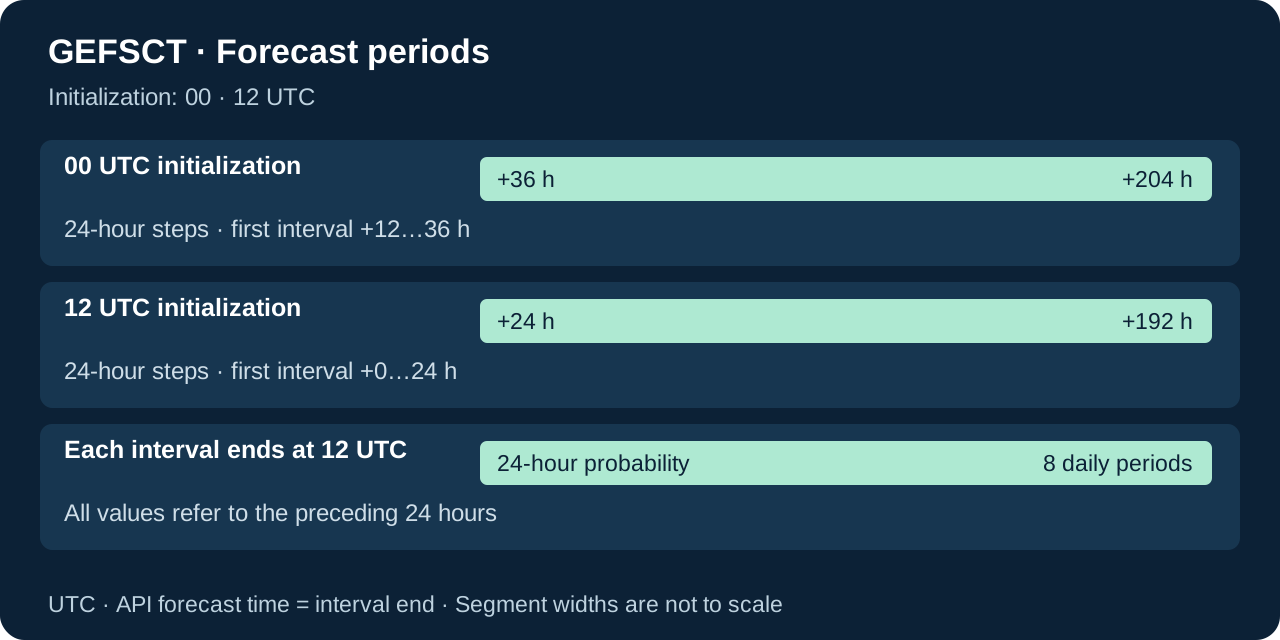
One detail matters when reading GEFSCT forecasts: every daily interval ends at 12 UTC. The 00 UTC run has endpoints from +36 through +204 hours; the 12 UTC run has endpoints from +24 through +192 hours. Both contain eight periods, spaced 24 hours apart. These timings come from the native GRIB intervals and files in the parallel feed.
GREFS also distinguishes the age of its GEFS input. For a 12 UTC REFS run, 0h lag uses the 12 UTC GEFS run, while 6h lag uses the 06 UTC GEFS run. Both use the same REFS run. At 00 UTC, the 6h branch uses the previous day’s 18 UTC GEFS run. The lag describes how old the GEFS input is. It does not change the forecast period or indicate a publication delay, and a smaller lag does not necessarily mean a more accurate forecast. GribStream offers the two versions as separate selectors.
REFSCT’s full-period guidance also needs an exact duration. Two periods can end at the same time but start at different times; their selectors keep those probabilities separate.
Try the probabilities
The SPC probability dashboard separates severe hazards, one-hour thunder, four-hour thunder and daily thunder. Its audit tables retain initialization and interval-end timestamps. Choose a United States city and time range, then inspect the exact source periods.
For an API request, this GREFS variable selects four-hour tornado probabilities using GEFS from the same cycle:
{
  "name": "TORPROB",
  "level": "surface",
  "info": "4 hour probability; GEFS lag 0h; prob >0",
  "alias": "tornado_pct"
}
Use it with /api/v2/grefs/timeseries, or /api/v2/grefs/runs to select initialization times. The prob >0 text preserves a source GRIB qualifier; it is not a threshold you supply to filter returned percentages. Each model page includes its generated selector inventory and UTC cadence diagram.
What happens to the older SPC feeds?
NOAA plans to retire its HREF-, SREF- and NAM-based SPC guidance during this transition. The new datasets have their own GribStream identifiers, so applications can switch to them explicitly. These three products do not include a lightning-density replacement. Transition notice.
The affected feeds are scheduled to stop receiving new runs when NOAA implements SPC_POST v3, on or after 14 October 2026 at 12 UTC. A weather-related delay also delays their retirement.
spctor4hr,spchail4hr,spcwind4hr: migrate to GREFS four-hourTORPROB,HAILPROBandWINDPROB, with an explicit GEFS input-lag selector.spctstm1hr,spctstm4hr: migrate to REFSCTTSTM, selecting one-hour or four-hour periods.spcltg4hr: no lightning-density replacement among these three products.
GEFSCT adds daily thunder guidance. These are changes in input models and calibration, so applications must select the new dataset and variables explicitly. The old identifiers remain available, but their data expires under the existing two-day retention policy. This notice covers SPC’s derived products, not the separate retirement schedules of the underlying models.
GribStream will move these three source feeds from NOMADS para/ to prod/ after verifying NOAA’s actual implementation. The switch is not automatic on the planned date.
GribStream retains runs initialized within the last two days, matching the existing SPC feeds. This limits how far back runs can be queried, not how far ahead they forecast: each retained GEFSCT run still includes all eight daily periods. Availability depends on NOAA publishing the files, and the parallel feed may change before the operational transition.
This is forecast guidance, not an official warning service. GribStream is independent of NOAA. Source data is available under the NWS use terms.