
GribStream Blog
ICON-ART-EU joins GribStream: Saharan dust and solar forecasts
DWD ICON-ART-EU brings 10 km mineral dust, aerosol optical depth and solar radiation forecasts to GribStream: 130 parameter families and up to five days ahead.
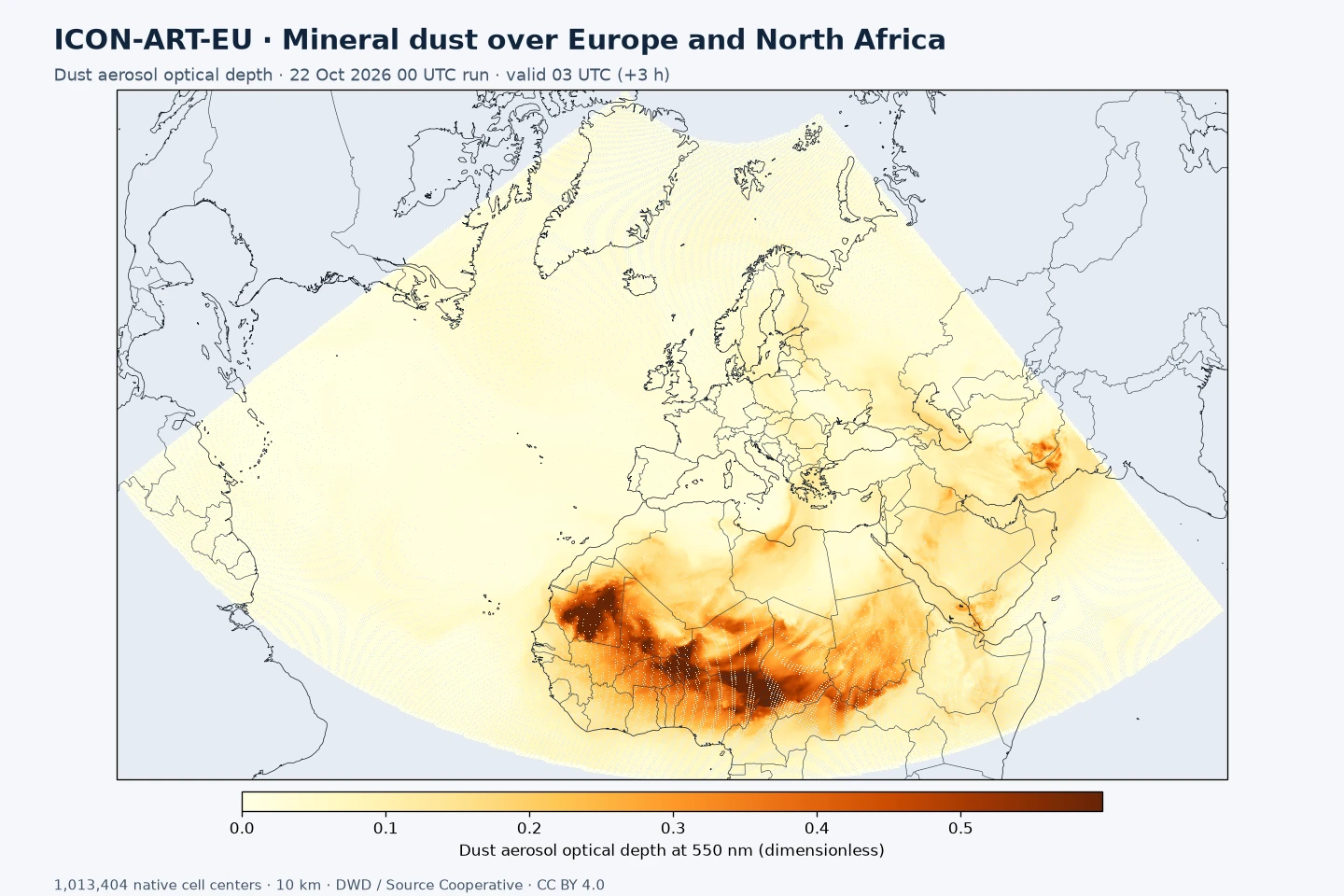
DWD ICON-ART-EU is now available on GribStream as iconarteu. The new dataset brings mineral dust forecasts, aerosol optical depth and solar radiation together with weather over Europe, North Africa and the surrounding region. It includes 130 parameter families, covering 422 combinations of parameter, level and source annotation, on the current 10 km grid.
For solar forecasters, this adds a particularly useful view of the atmosphere. A plume of Saharan dust can change the sunlight reaching a photovoltaic plant thousands of kilometres from its source. ICON-ART-EU provides both the evolving dust plume and the radiation fields needed to investigate its effect on a solar forecast.
A five-day dust and weather forecast at 10 km
| Feature | Available on GribStream |
|---|---|
| Coverage | Europe, North Africa and the surrounding region |
| Horizontal grid | Approximately 10 km; 1,013,404 native triangular cell centers |
| Forecast cycles | 00, 06, 12 and 18 UTC every day |
| Forecast range | Up to 120 hours, with output intervals of 1, 3, 6 or 12 hours depending on the field and lead time |
| Inventory | 130 parameter families; 422 parameter, level and annotation combinations |
| History | Available runs on the current grid from 6 October 2026 |
What ICON-ART adds to a weather model
ART stands for Aerosol and Reactive Trace gases. Developed at Karlsruhe Institute of Technology (KIT) in collaboration with DWD and other partners, it extends the ICON modeling framework with atmospheric composition. KIT’s model overview describes the emission, transport and removal of aerosols and trace gases, together with their interactions with clouds and radiation. DWD uses ICON-ART operationally for mineral dust forecasting.
For mineral dust, the forecast follows a physical chain: particles enter the atmosphere, travel with the air, mix vertically and leave it through settling and deposition. Particle size matters for both transport and the way a plume interacts with light. The public ART-EU product includes separate dust modes, total dust concentration, column quantities and deposition diagnostics, alongside the meteorological conditions driving the event.
The 2026 ICON-ART model description by Hoshyaripour and colleagues explains how aerosol mass and optical properties enter radiation calculations, and how optical depth and lidar backscatter diagnostics are derived. That connection between particles and radiation is central to the model’s value for energy applications.
Saharan dust and photovoltaic power forecasts
Dust scatters and absorbs sunlight, changing the direct beam and diffuse sky radiation reaching the surface. Its interactions with clouds can also affect the radiation forecast. A solar forecasting system therefore benefits from examining aerosol conditions alongside cloud cover.
There is a concrete ICON-ART example in the literature. In a DWD/KIT study of the Saharan dust outbreak over Germany on 4 April 2014, Rieger and colleagues found that including mineral dust effects improved the photovoltaic power forecast at 65% of the pyranometer stations examined in that case study.
With ART-EU on GribStream, a solar team can build time series for every plant in a portfolio using:
TAOD_DUSTto track forecast dust optical depth above each site.ASWDIR_SandASWDIFD_Sfor direct and downward diffuse short-wave radiation at the surface.CLCT,T_2M,U_10MandV_10Mfor cloud cover, temperature and wind context.
These inputs support dust-event flags, site-level forecast evaluation and tests of whether dust-aware features improve a generation model. The radiation fields are in W/m² and are means from the forecast run’s start; interval calculations should account for that averaging period.
Optical depth, airborne dust and deposition
Different questions call for different dust fields. Aerosol optical depth (AOD) measures extinction through an atmospheric column at a specified wavelength. ART-EU’s TAOD_DUST is dimensionless and refers to 550 nm. NASA’s aerosol science guide explains the column measurement and why the vertical distribution matters when relating it to conditions near the ground.
| Question | Useful ART-EU fields |
|---|---|
| When will a dust plume pass above a solar site? | TAOD_DUST, with direct/diffuse radiation and cloud cover |
| Where is the dust within the atmosphere? | DUST_TOTAL_MC on 44 published model layers, plus layer-maximum dust concentration |
| How much dust mass is in the whole column? | DUST_TOTAL_MC_VI |
| How is dust being removed? | Dry deposition, sedimentation and wet-deposition diagnostics for the separate dust modes, with precipitation |
That vertical information is useful when a plume travels aloft while the air closer to the surface follows a different pattern. Deposition fields also provide inputs for studying dust arrival at the ground and potential solar-panel soiling. Turning them into site-specific soiling losses requires a model of the panels, local conditions and cleaning; ART-EU supplies the atmospheric inputs to that work.
Weather fields and history for evaluating your forecasts
The collection also includes temperature, wind, humidity, clouds, precipitation, soil fields and surface energy fluxes. You can examine the dust event and its weather context in the same dataset, using DWD’s native parameter names. The ICON-ART-EU inventory lists the exact levels, units, annotations and forecast schedules.
Available history starts on 6 October 2026, when the current 10 km grid begins. That makes it possible to revisit an event, compare successive forecast runs and evaluate a solar model using forecasts issued before the target time. Historical access follows the public archive on Source Cooperative; some cycles are incomplete or absent.
Start with the ICON-ART-EU model page to choose fields, then use the time-series API to request them at your locations. For an energy portfolio spanning southern Europe and North Africa, this adds a common set of dust, radiation and weather forecasts across the region.
Weather data: Deutscher Wetterdienst, archived by Jacob Prince-Bieker on Source Cooperative, under CC BY 4.0.