
GribStream Blog
CAMS Global atmospheric composition forecasts are now on GribStream
GribStream now supports CAMS Global atmospheric composition forecasts with hourly five-day guidance for particulate matter, aerosol optical depth, total-column gases, and biologically effective UV dose rate.
GribStream now supports CAMS Global atmospheric composition forecasts as camsglobal: twice-daily, hourly guidance through five days for particulate matter, aerosol optical depth, total-column chemical species, and biologically effective UV dose rate on a global 0.4 degree grid.
This is a different kind of forecast from a conventional weather model. Temperature, wind, and precipitation describe the physical atmosphere; CAMS also models what the atmosphere contains and how those constituents are emitted, transported, chemically transformed, deposited, and removed. That makes it relevant to air quality, dust and smoke transport, solar-energy operations, satellite comparison, volcanic-plume screening, and environmental risk.
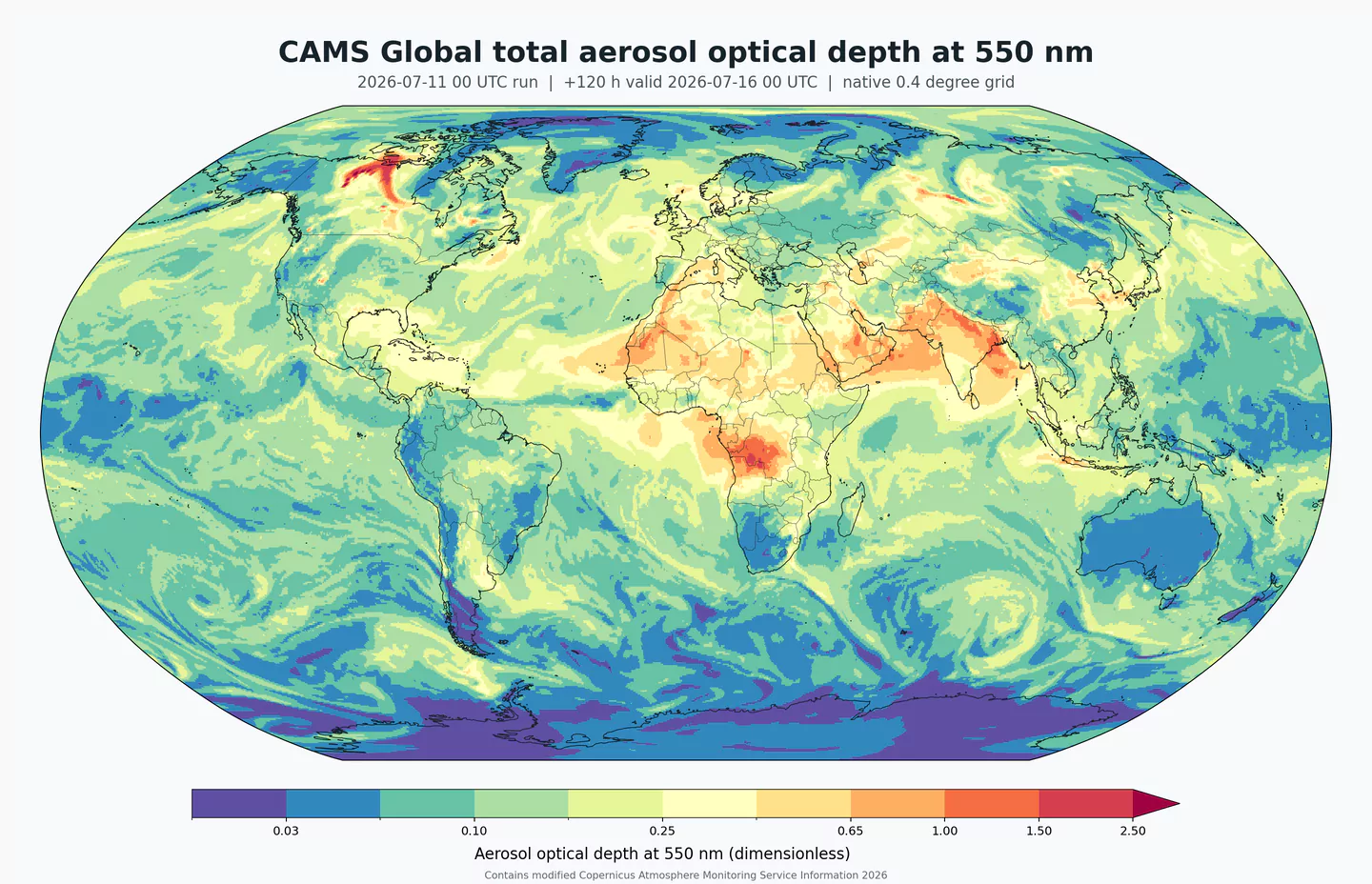
A Chemistry Forecast Built On ECMWF IFS
The Copernicus Atmosphere Monitoring Service produces the global forecast with a configuration of ECMWF's Integrated Forecasting System that includes additional CAMS modules for aerosols, reactive gases, and greenhouse gases.
The current operational documentation identifies IFS Cycle 50r1, introduced on May 12, 2026, as the system behind the approximately 40 km global product. The complete CAMS forecast represents 56 reactive trace gases in the troposphere, stratospheric ozone, and seven aerosol types: dust, sea salt, organic matter, black carbon, sulphate, nitrate, and ammonium.
The model represents transport, emissions, chemical conversion, aerosol microphysics, interaction with the land and ocean surface, dry deposition, and removal by precipitation. Its boundary conditions include inventories and observation-derived emissions. CAMS GFAS derives biomass-burning emissions from satellite observations of fire radiative power.
Each cycle starts from more than a previous model forecast. CAMS uses a four-dimensional variational data-assimilation system to constrain the initial atmospheric state with satellite observations. The current system assimilates observations related to aerosol optical depth, ozone, carbon monoxide, nitrogen dioxide, and volcanic sulphur dioxide, among others. The result is a globally complete analysis even where direct observations are sparse, followed by a five-day composition forecast.
What The First GribStream Release Includes
The source catalog is much larger than this first release. GribStream is starting with 37 composition fields that CAMS keeps on fast-access storage, all at the surface or represented as a total atmospheric column. We are intentionally leaving out duplicate meteorological fields and multi-level chemistry for now.
| Group | Included fields | Why they matter |
|---|---|---|
| Surface particulate matter | pm1, pm2p5, pm10 |
Fine- and coarse-particle guidance for global air-quality context, smoke, dust, and exposure products |
| Total aerosol optical depth | aod469, aod550, aod670, aod865, aod1240 |
Aerosol loading across visible and near-infrared wavelengths for visibility, satellite, atmospheric-correction, and solar workflows |
| Aerosol components at 550 nm | amaod550, bcaod550, duaod550, niaod550, omaod550, soaod550, ssaod550, suaod550 |
Separates ammonium, black carbon, dust, nitrate, organic matter, secondary organic aerosol, sea salt, and sulphate contributions |
| Total-column chemistry | tcco, tc_clo, tc_clono2, tc_c2h6, tchcho, tc_hcl, tc_HCN, tc_h2o2, tc_oh, tc_c5h8, tc_ch4, tc_hno3, tcno2, tc_no, gtco3, tc_pan, tc_c3h8, tcso2, tc_VSO2 |
Vertically integrated trace-gas and pollutant burden from the surface to the top of the atmosphere |
| Biologically effective UV dose rate | uvbed, uvbedcs |
Instantaneous all-sky and clear-sky erythemally weighted UV irradiance used to derive UV Index |
The selection is composition-first. If an application needs wind, temperature, humidity, pressure, or precipitation alongside CAMS, it can pair camsglobal with ECMWF IFS or another weather dataset instead of receiving duplicate meteorological fields through this feed.
Why Aerosol Optical Depth Deserves Its Own Forecast
Aerosol optical depth, or AOD, measures how strongly aerosols attenuate light through the atmospheric column. It is dimensionless and represents the whole column, not a surface concentration. CAMS provides total AOD at five wavelengths and components by aerosol type at 550 nm.
That separation supports several distinct products:
- dust monitoring can compare
duaod550with totalaod550 - smoke and combustion-related workflows can examine black-carbon and organic-matter contributions without treating them as source-exclusive tracers
- marine and coastal products can identify sea-salt aerosol loading
- solar applications can account for atmospheric attenuation that cloud-only guidance misses
- satellite and atmospheric-correction pipelines can compare model AOD at wavelengths relevant to their sensors
AOD and particulate-matter concentration are related but not interchangeable. AOD is a column-integrated optical property; pm2p5 and pm10 are modeled mass concentrations near the surface. A robust product chooses the quantity that matches the decision rather than treating either as a generic pollution score.
Source-Native Names And Units
GribStream keeps the CAMS and ECMWF short names visible. Selectors use names such as pm2p5, aod550, duaod550, tcno2, and tc_VSO2, preserving a direct connection to the official CAMS parameter tables and existing ECMWF tooling.
The source units also remain intact:
| Product type | Source unit | Practical note |
|---|---|---|
| Particulate matter | kg/m^3 |
Multiply by 1e9 to express the value in micrograms/m^3 |
| Aerosol optical depth | dimensionless | A column optical property, not a surface concentration |
| Total-column species | kg/m^2 |
Integrated mass from the surface to the top of the atmosphere |
| Biologically effective UV dose rate | W/m^2 |
Instantaneous, not accumulated; multiply by 40 to derive the dimensionless UV Index |
For uvbed and uvbedcs, CAMS documentation is internally inconsistent: its parameter table labels the local GRIB fields dimensionless, while the CAMS UV methodology and ADS metadata define an instantaneous dose rate in W/m^2. The values follow the latter convention. GribStream therefore reports W/m^2 and leaves the conversion to UVI explicit rather than silently changing the data.
The camsglobal model page exposes the exact parameter inventory. Use that inventory as the source of truth for each name, level, and info selector rather than relying on a renamed abstraction.
Cadence, Grid, And Retention
CAMS publishes global atmospheric composition forecasts from 00 and 12 UTC. The single-level products are hourly from analysis time through forecast hour 120.
GribStream's initial operational scope is:
| Property | GribStream scope |
|---|---|
| Grid | Global regular latitude-longitude, 0.4 degrees, 900 by 451 cells |
| Cycles | 00 and 12 UTC |
| Forecast steps | Hourly, +0 through +120 |
| Fields | 37 surface and total-column composition fields |
| Retention | Rolling five days of source runs |
Use /api/v2/camsglobal/timeseries for coordinate-based time series and /api/v2/camsglobal/runs for run-oriented or gridded extraction. The five-day run archive supports current forecasts, recent cycle comparison, operational dashboards, and short backtests without presenting CAMS Global as a long-term climatological record.
Where CAMS Fits
CAMS Global is broad, consistent, and built for atmospheric transport across borders, but a 0.4 degree forecast is not a street-level pollution estimate or a substitute for regulatory monitors. Likewise, tc_VSO2 can flag modeled volcanic sulphur dioxide burden, but a total-column field does not supply plume height or replace volcanic-ash advisories.
- use
camsglobalfor global composition, dust, smoke, aerosol, and pollutant-column context - use NOAA AQM for higher-resolution operational ozone and PM2.5 guidance over its U.S. domains
- use GEFS Chem when an ensemble view of global atmospheric composition is useful
- use UVI for NOAA ultraviolet guidance
- use ECMWF IFS for the meteorological state that transports and removes atmospheric constituents
The operational CAMS system is upgraded as ECMWF introduces new IFS cycles. That improves the forecast but means it should not be treated as an unchanging climate record. CAMS Global Reanalysis is the more appropriate CAMS product when a time-consistent historical composition dataset is required.
Licence And Attribution
The CAMS licence is free of charge, worldwide, royalty-free, and permits reproduction, distribution, public communication, adaptation, modification, and combination with other information. It requires source attribution and a disclaimer for published or distributed information.
GribStream uses the adapted-information notice required by that licence:
Contains modified Copernicus Atmosphere Monitoring Service Information 2026. Neither the European Commission nor ECMWF is responsible for any use that may be made of this information.
Start Here
- CAMS Global model page and parameter inventory
- ECMWF IFS model page
- GEFS Chem model page
- NOAA AQM model page
- API documentation
Sources
- CAMS Global atmospheric composition forecast dataset: https://ads.atmosphere.copernicus.eu/datasets/cams-global-atmospheric-composition-forecasts?tab=overview
- CAMS Global forecast system and parameter documentation: https://confluence.ecmwf.int/spaces/CKB/pages/212454117/CAMS%2BGlobal%2Batmospheric%2Bcomposition%2Bforecast%2Bdata%2Bdocumentation
- CAMS UV Index background and methodology: https://confluence.ecmwf.int/download/attachments/212454117/uv_index_cams_background_and_methodology.pdf?api=v2&modificationDate=1678130505018&version=1
- Dataset DOI: https://doi.org/10.24381/04a0b097
- CAMS data licence: https://atmosphere.copernicus.eu/sites/default/files/repository/CAMS_data_license.pdf