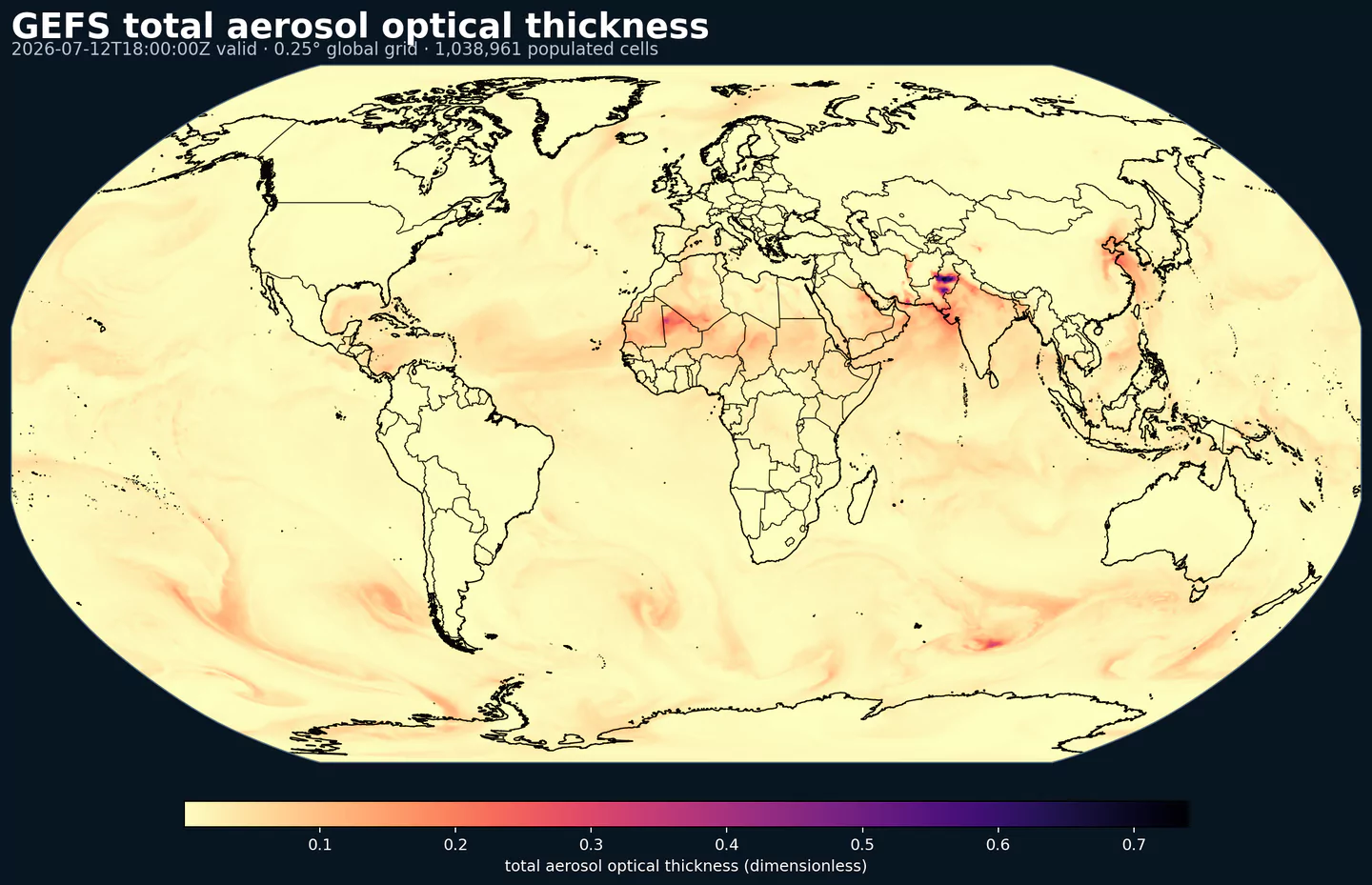
GEFS total aerosol optical thickness across the complete global atmospheric-chemistry grid, with black country boundaries. This plot was generated from the gefschem dataset.
Description
GEFS Chem extends the NOAA Global Ensemble Forecast System into atmospheric chemistry and aerosols. Instead of focusing only on temperature, wind, or pressure, it provides fields tied to composition, particle transport, and air-quality risk.
The product is useful when smoke, dust, aerosols, pollutants, visibility, or solar-radiation attenuation matter to an application. Because it belongs to the GEFS family, it can support uncertainty-aware workflows instead of a single deterministic track for chemical transport.
Global atmospheric chemistry, aerosol concentration, and pollutant-relevant forecast fields.
GEFS-family uncertainty context for transport, mixing, and chemical evolution.
Four cycles daily: 00, 06, 12, 18 UTC.
Fields available in GribStream through 120 h on a 0.25° global grid.
Resolution: 0.25° global grid.
Temporal Coverage: Updated four times daily, with forecasts extending up to 120 hours (5 days).
Primary Use Cases: air quality, pollution dispersion, visibility, solar energy, environmental monitoring, public health, aerosol research, and operations where composition changes risk.
Parameters
Search parameters
0 parameters
Click a parameter to reveal variants in a compact table with ready-to-copy JSON selectors.
Aerosol optical thickness represents the column-integrated attenuation of solar radiation by aerosols. Larger values indicate hazier conditions and reduced surface sunlight.
Units: dimensionless.
Useful for visibility, air quality, and solar energy assessments.
Column-integrated mass density is the total mass per unit area through the vertical column for the specified species. It summarizes column burden and is useful for transport diagnostics.