
GribStream Blog
Met Office UKV and MOGREPS: finer detail, forecast uncertainty
Explore 15-minute UK forecasts, ensemble uncertainty and richer global weather data with Met Office UKV, MOGREPS-G, MOGREPS-UK and Global on GribStream.
An hourly forecast can hide the detail between its timestamps. A single forecast can hide how differently the weather might unfold. The Met Office's regional models and ensembles offer ways to explore both.
Current forecast availability
GribStream currently provides a rolling three-day window of forecast runs, measured by each run’s start time—not its forecast horizon. We’re filling remaining gaps, so coverage varies by dataset, parameter and run. Longer history is planned. Check coverage for your requested dates before relying on historical data.
GribStream's Met Office collection now includes UKV, MOGREPS-G and MOGREPS-UK, alongside broader parameter coverage in Global deterministic. The family brings together worldwide forecasts, fine-scale UK and Ireland weather, selected 15-minute time series and individual ensemble scenarios.
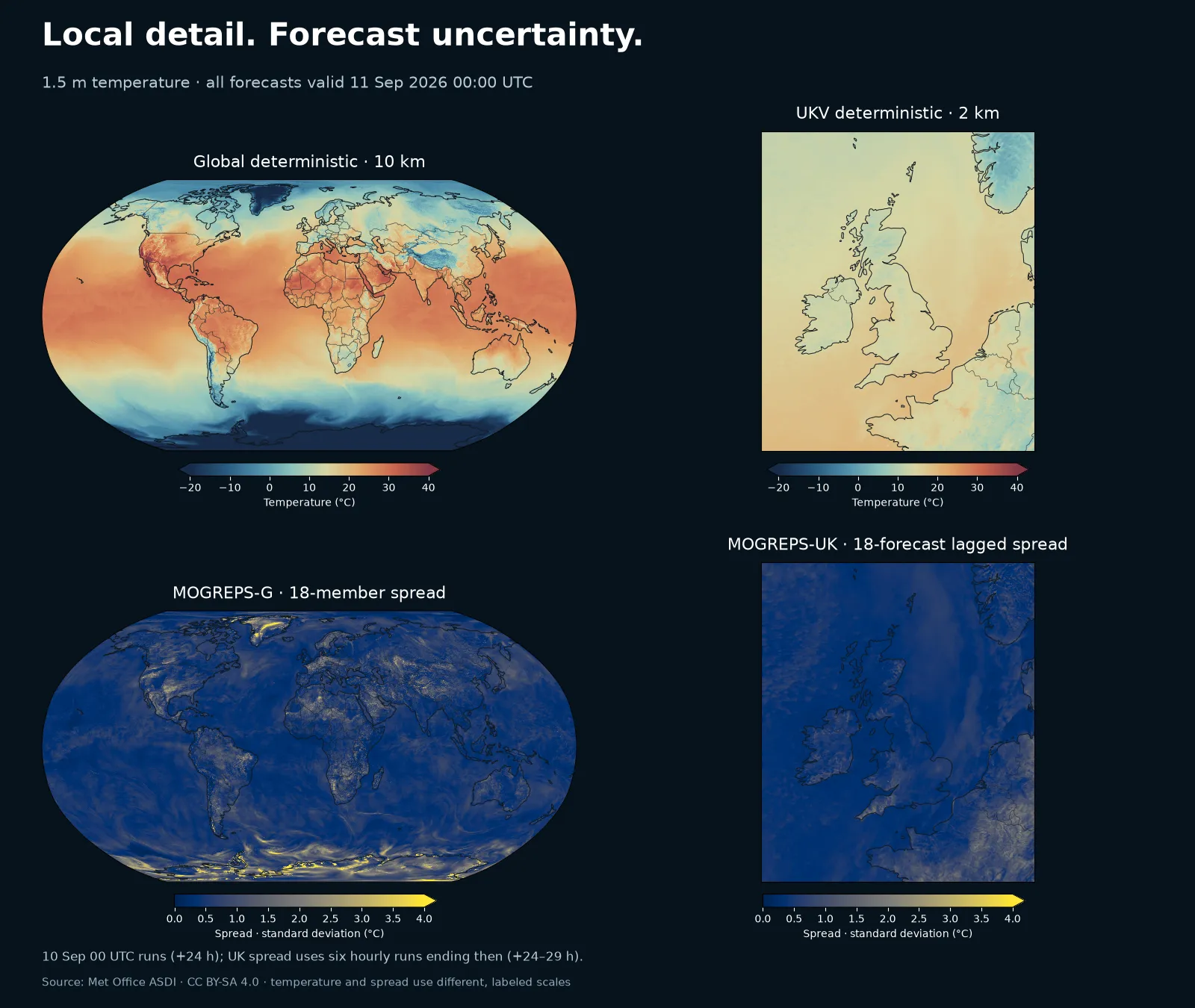
All panels are valid at 00 UTC on 11 September 2026. Deterministic temperature and MOGREPS-G use the 10 September 00 UTC runs (+24 hours). MOGREPS-G spread uses 18 members; MOGREPS-UK spread uses 18 forecasts from six hourly runs ending at 00 UTC (+24–29 hours), aligned to that same valid time. Temperature and spread use different color scales. Source: Met Office; GribStream visualization, CC BY-SA 4.0.
UKV: a closer look at local weather
A global model describes the large-scale circulation. A regional model can devote more detail to coastlines, hills and the weather developing around them.
UKV is the Met Office's high-resolution deterministic model for the UK and Ireland. Its kilometre-scale grid can represent convective showers explicitly, helping describe weather that a coarser global model cannot resolve in the same way. That matters when studying localized rainfall, snow or rapidly changing conditions—not just the broad regional outlook. The Met Office traces this approach in its history of convection-permitting forecasting.
The distinction between the model and the supplied data is worth knowing: UKV's inner simulation grid is about 1.5 km, while this open-data product is provided on a 2 km output grid. Finer spacing does not guarantee the exact location or timing of an individual shower. Met Office model configurations, UKV open-data specification.
Fifteen-minute forecasts: four timestamps within the hour
Selected UKV fields—including screen-level temperature and 10 m wind—have 15-minute output through the first 12 forecast hours. Temperature then continues hourly. Other quantities follow different schedules; quarter-hourly output is not a promise for every parameter or the full forecast horizon. The Met Office's UKV parameter specification documents these field-specific changes.
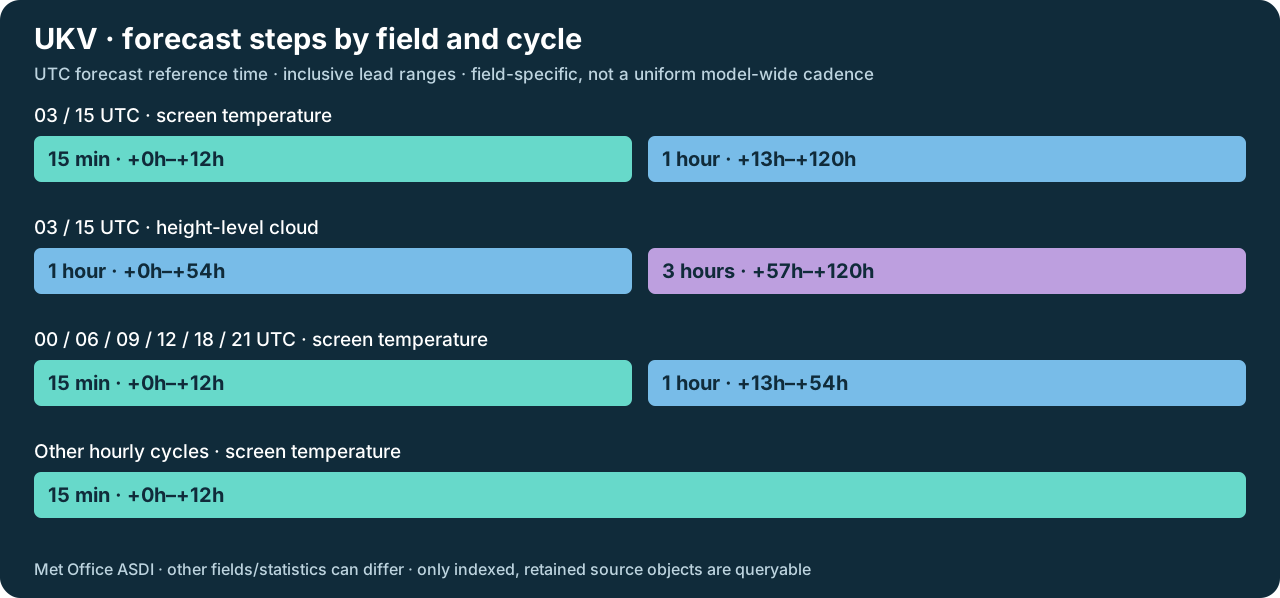
Read the labeled endpoints: forecast length depends on the run, and cadence depends on the quantity. Segment widths are not proportional to elapsed time.
Those extra timestamps can help align weather with sub-hourly energy measurements, examine the timing of a temperature change, or compare forecasts with observations between hourly boundaries. They are distinct forecast values, not extra points that GribStream creates by interpolating an hourly series.
MOGREPS-UK also supplies quarter-hourly fields. Its current source temperature series has the same early 15-minute cadence, and its rainfall collection includes accumulations over the preceding 15 minutes. An accumulation describes a period; temperature describes a particular time.
Time resolution is not delivery latency. A 15-minute forecast step does not mean a new run arrives every 15 minutes, nor that a forecast is accurate to the nearest quarter-hour. The open feed may arrive hours after its run time, which matters when choosing it for an application.
MOGREPS: how much do the forecasts disagree?
Weather is sensitive to small differences in its starting conditions. MOGREPS explores that sensitivity by producing multiple forecasts, varying both the initial conditions and aspects of the model's physical processes. Comparing the resulting scenarios gives information that one deterministic forecast cannot. How MOGREPS represents uncertainty.
MOGREPS-G provides global scenarios on an approximately 20 km grid, with 18 members in each six-hourly run. MOGREPS-UK adds regional detail, producing three new members each hour. The Met Office describes combining six successive UK cycles into an 18-forecast time-lagged ensemble. Forecasts from different runs must be compared at the same valid time. Operational ensemble configuration.
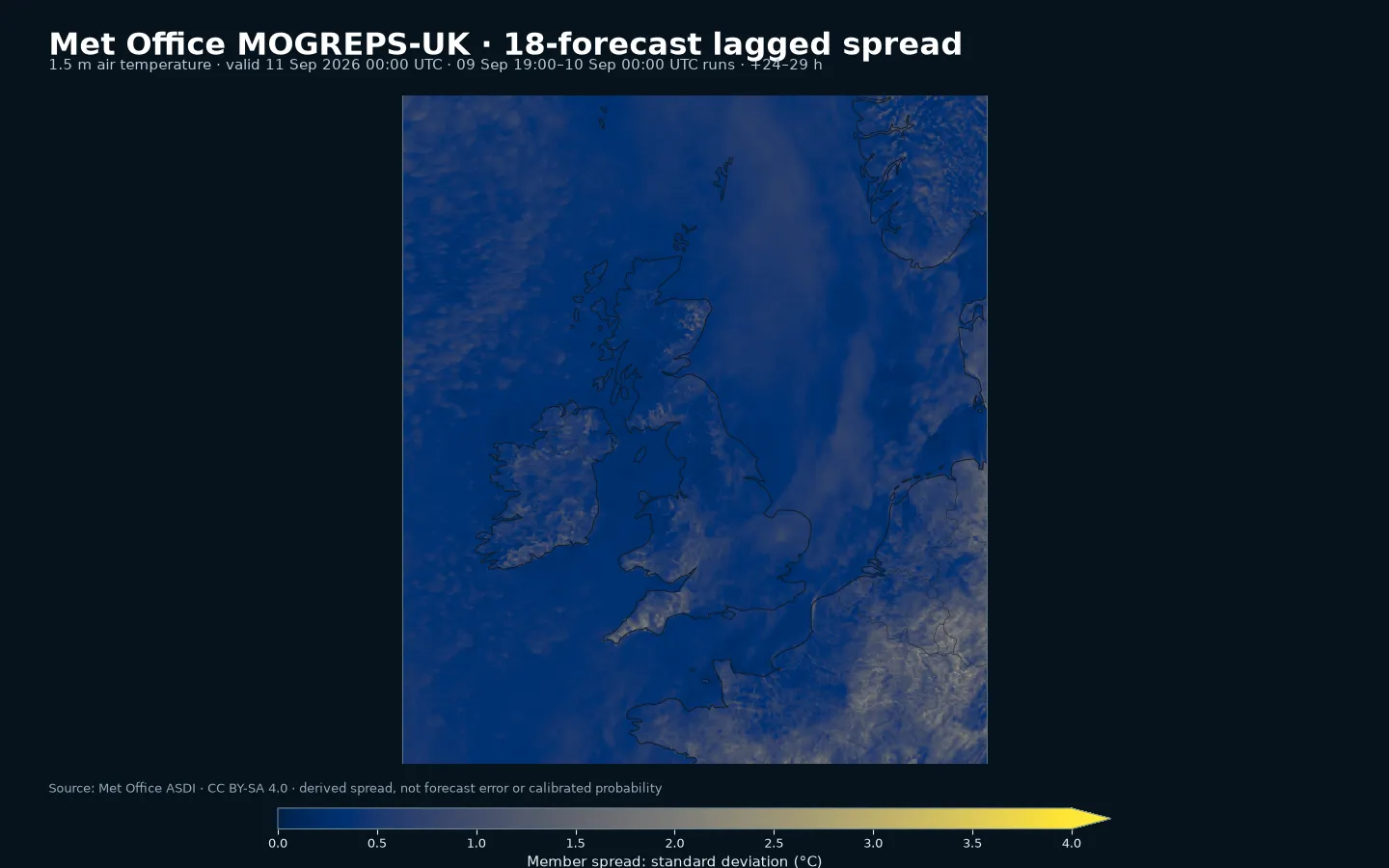
Color shows the standard deviation of 1.5 m temperature across the 18 forecasts, in degrees Celsius. Higher values mean greater disagreement at that location. This derived spread is not the temperature itself, an observed forecast error or a calibrated event probability.
Spread is useful for asking where an apparently precise forecast deserves closer scrutiny. Agreement between members is informative too, but it cannot rule out errors shared by the ensemble. Individual scenarios and observations still matter. The Met Office's ensemble forecasting introduction explains why a range of outcomes is part of the forecast.
A model family built on atmospheric science
These systems belong to the Met Office's Unified Model family, which connects global and regional forecasting. The Unified Model approach.
The published research behind the RAL3 regional configuration describes developments in cloud, precipitation, turbulence and land-surface physics. It couples the atmosphere with JULES, a land model that represents exchanges of heat, water and momentum with the surface. The evaluation found improvements in several measures, including precipitation distributions and cloud representation, while identifying remaining limitations such as a cold-temperature bias. That is a more useful picture than treating higher resolution as a universal accuracy guarantee. Bush et al., 2025.
Global: more than the original six surface fields
The expanded Global deterministic collection has 40 parameter names and 336 level/statistic combinations. Alongside temperature, humidity, pressure and wind, it adds precipitation, snow, cloud, radiation, visibility, convection and upper-air quantities.
That opens up different kinds of analysis: radiation and cloud for solar-resource studies, precipitation and snow for water-related applications, or temperature and wind profiles for examining the atmosphere above the surface. The dataset remains metofficeglobal10km; its original six-field requests keep their existing names.
Find the dataset that fits your question
| Dataset | Coverage and character | Explore |
|---|---|---|
| Global deterministic | Worldwide, about 10 km; one forecast per run | Model and parameters |
| UKV | UK and Ireland, 2 km output; selected 15-minute fields | Model and parameters |
| MOGREPS-G | Worldwide, about 20 km; global ensemble scenarios | Model and parameters |
| MOGREPS-UK | UK and Ireland, 2 km output; regional ensemble scenarios | Model and parameters |
GribStream lets you request point forecasts and time series through the same API across the family. The inventories preserve the source's parameter names and distinguish levels, accumulation periods and other statistics. Check the relevant inventory for supported fields and available periods; coverage is not identical across models.
The Met Office retains a rolling two-year source archive for Global and UKV. That is the upstream limit, not a claim that all of that history is already available in GribStream. The Met Office retains a rolling 30-day source archive for MOGREPS. Expired source files cannot be served; historical member availability depends on the run.
Explore the API documentation or start with a model page above.
Met Office data is licensed under CC BY-SA 4.0. GribStream is independent of the Met Office. The provider offers this open-data feed without operational support and does not recommend relying on it for critical business purposes. See the UKV and MOGREPS-UK source specifications for their published availability and latency guidance.