
GribStream Blog
NOAA upgrades AIGFS to v1.1 for sharper long-range forecasts
AIGFS v1.1 changes the operational AI model's loss function and fine-tuning, targeting tropical-cyclone intensity, precipitation, and long-lead forecast sharpness.
NOAA implemented AIGFS v1.1 with the July 27, 2026 12 UTC cycle. This is a substantive training upgrade to the operational Artificial Intelligence Global Forecast System—not a new dataset name or a new API surface.
A loss function designed for a spherical atmosphere
AIGFS v1.1 replaces its grid-point mean squared error loss with a spherical harmonic loss. Spherical harmonics describe global spatial patterns on a sphere, giving the training process a way to evaluate forecast structure across spatial scales rather than treating every grid point only as an independent error.
The wind terms in the loss also change. NOAA now uses wind speed and wind direction instead of the standard U and V components when calculating that part of the training objective.
These are training choices, not new output variables. GribStream continues to expose the published AIGFS U and V wind components alongside temperature, pressure, precipitation, humidity, height, and vertical velocity.
More fine-tuning and longer autoregressive training
NOAA reports two further changes:
- Fine-tuning now uses four years of Global Data Assimilation System (GDAS) analyses.
- The fine-tuning process trains AIGFS autoregressively through a 72-hour lead time.
Autoregressive training matters because AIGFS generates later forecast states from its own earlier predictions. Training across several successive steps exposes the model to the kinds of errors that can accumulate as a forecast advances.
According to the NWS implementation notice, the combined changes improve tropical-cyclone intensity forecasts and precipitation forecasts while reducing the smoothing or blurring seen at longer lead times. The notice does not provide verification scores or claim that AIGFS is uniformly more accurate for every variable, region, and forecast hour. Operational users should still compare the model with observations, ensembles, and physics-based guidance for their own cases.
What remains available through GribStream
The existing datasets continue without a code change:
aigfssfccontains 10 m wind components, 2 m temperature, mean sea-level pressure, and accumulated precipitation.aigfsprescontains geopotential height, temperature, specific humidity, wind components, and vertical velocity on 13 pressure levels.
Both use NOAA's 0.25° global grid, run at 00, 06, 12, and 18 UTC, and publish 6-hour forecast steps through hour 384. GribStream's archive crosses from AIGFS v1.0 to v1.1 at the July 27 12 UTC cycle, so forecast-verification and backtesting work should record that boundary.
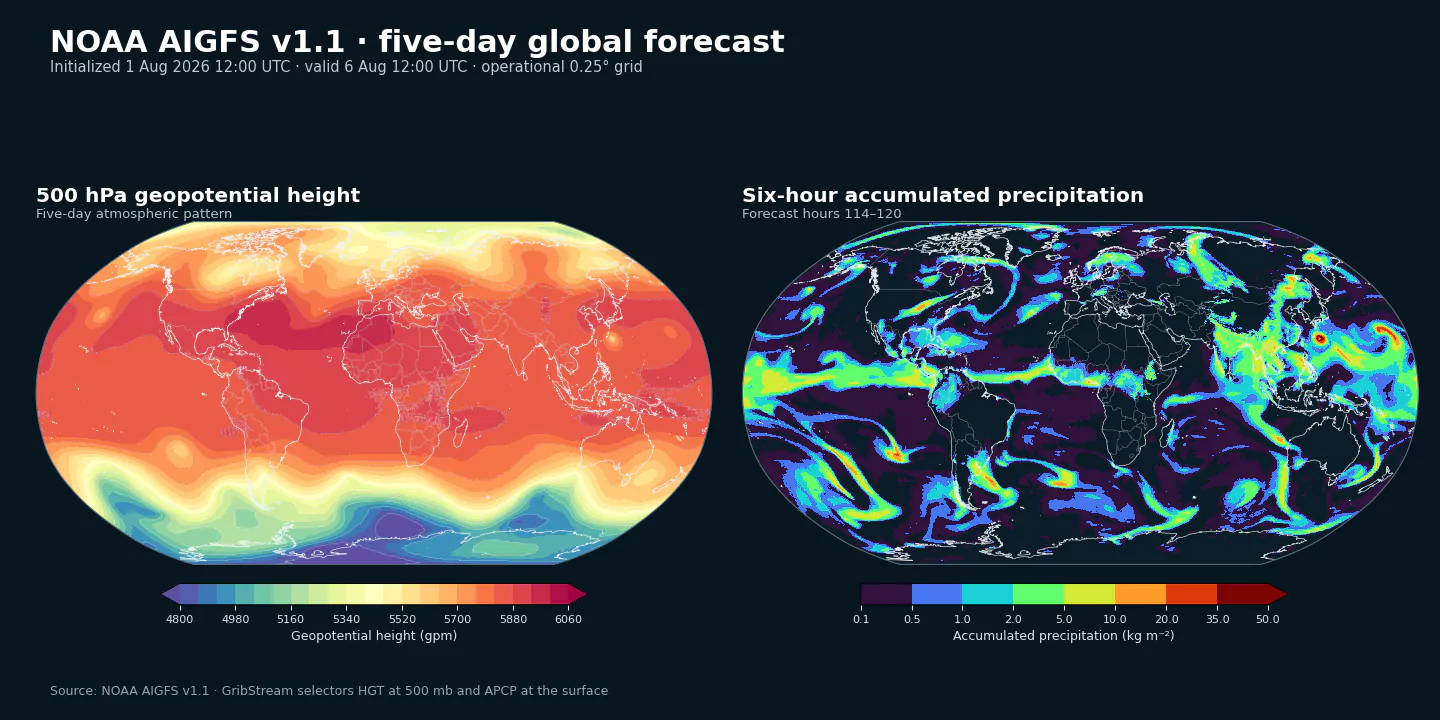
For example, this aigfspres request retrieves the five-day 500 hPa height field shown in the hero:
{
  "timesList": ["2026-08-06T12:00:00Z"],
  "grid": {
    "minLatitude": -90,
    "maxLatitude": 90,
    "minLongitude": -180,
    "maxLongitude": 180,
    "step": 1
  },
  "variables": [
    {"name": "HGT", "level": "500 mb", "alias": "height_500mb"}
  ],
  "minLeadTime": "120h",
  "maxLeadTime": "120h"
}
Send the body to POST /api/v2/aigfspres/timeseries. Use the AIGFS pressure inventory or surface inventory to copy exact selectors for other fields.
Sources
- NWS Service Change Notice 26-68, July 27, 2026: https://www.weather.gov/media/notification/pdf_2026/scn26-68_AIGFS_v1.1.pdf
- NCEP AIGFS product inventory: https://www.nco.ncep.noaa.gov/pmb/products/aigfs/
- NOAA NOMADS AIGFS operational distribution: https://nomads.ncep.noaa.gov/pub/data/nccf/com/aigfs/prod/
- NOAA/NCEP Office Note 521: https://doi.org/10.25923/xd3y-wy31