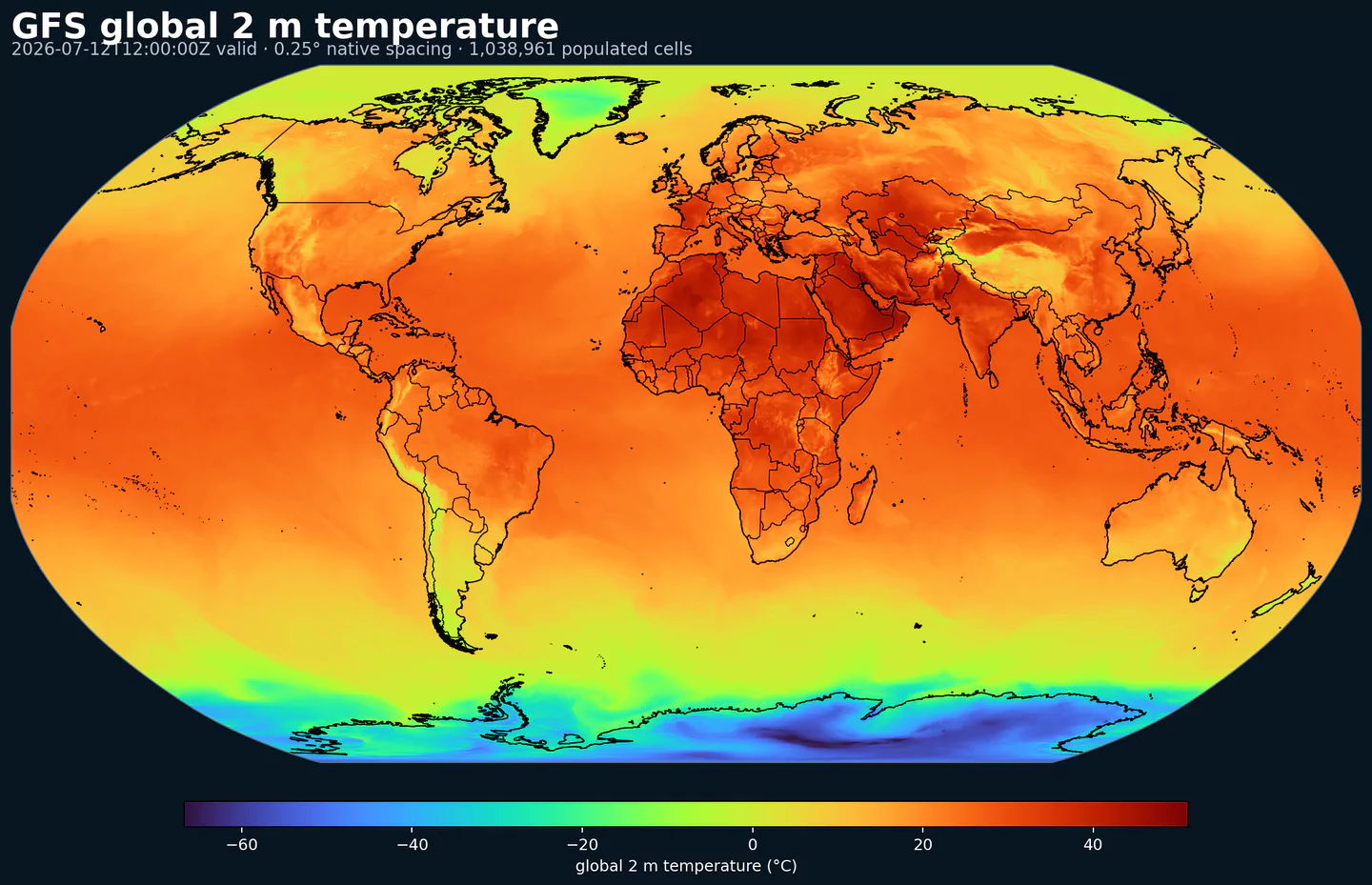
Representative global coverage: GFS 2 m temperature at its native 0.25 degree output spacing, with country boundaries overlaid. This coverage reference was generated from gfs for the aigfssfc page; available variables may differ.
Description
AIGFS Surface is the near-surface dataset from NOAA/NCEP's operational Artificial Intelligence Global Forecast System. NOAA launched AIGFS v1.0 on December 17, 2025, then upgraded the same feed to AIGFS v1.1 with the 2026-07-27 12 UTC cycle. In GribStream's archive, runs through 2026-07-27 06 UTC use v1.0 and runs from 2026-07-27 12 UTC onward use v1.1.
NOAA describes the AI-GFS family as GraphCast-based guidance developed by NCEP with NOAA research laboratories and the Earth Prediction Innovation Center. The system uses NOAA's operational global analysis as its real-time starting point, which makes it useful as an independent AI forecast alongside physics-based models such as GFS.
This surface dataset is the compact AIGFS option for applications that need the most common global weather signals without the full pressure-level atmosphere. It is useful for point forecasts, operational dashboards, medium-range model comparison, renewable-energy screening, route planning, and AI-vs-physics verification workflows.
What is in the surface product
The surface dataset includes 10 m U/V wind components, 2 m temperature, mean sea-level pressure, and accumulated precipitation. It runs on the same 0.25 degree global grid as AIGFS Pressure, with 00, 06, 12, and 18 UTC cycles and 6-hour forecast steps out to 384 hours.
Accumulated precipitation represents the total water-equivalent amount of rain and snow during the output period. It is a primary field for hydrologic impacts and event totals.
Units: kg/m^2.
Use with the model time interval to interpret totals and compare to gauges.