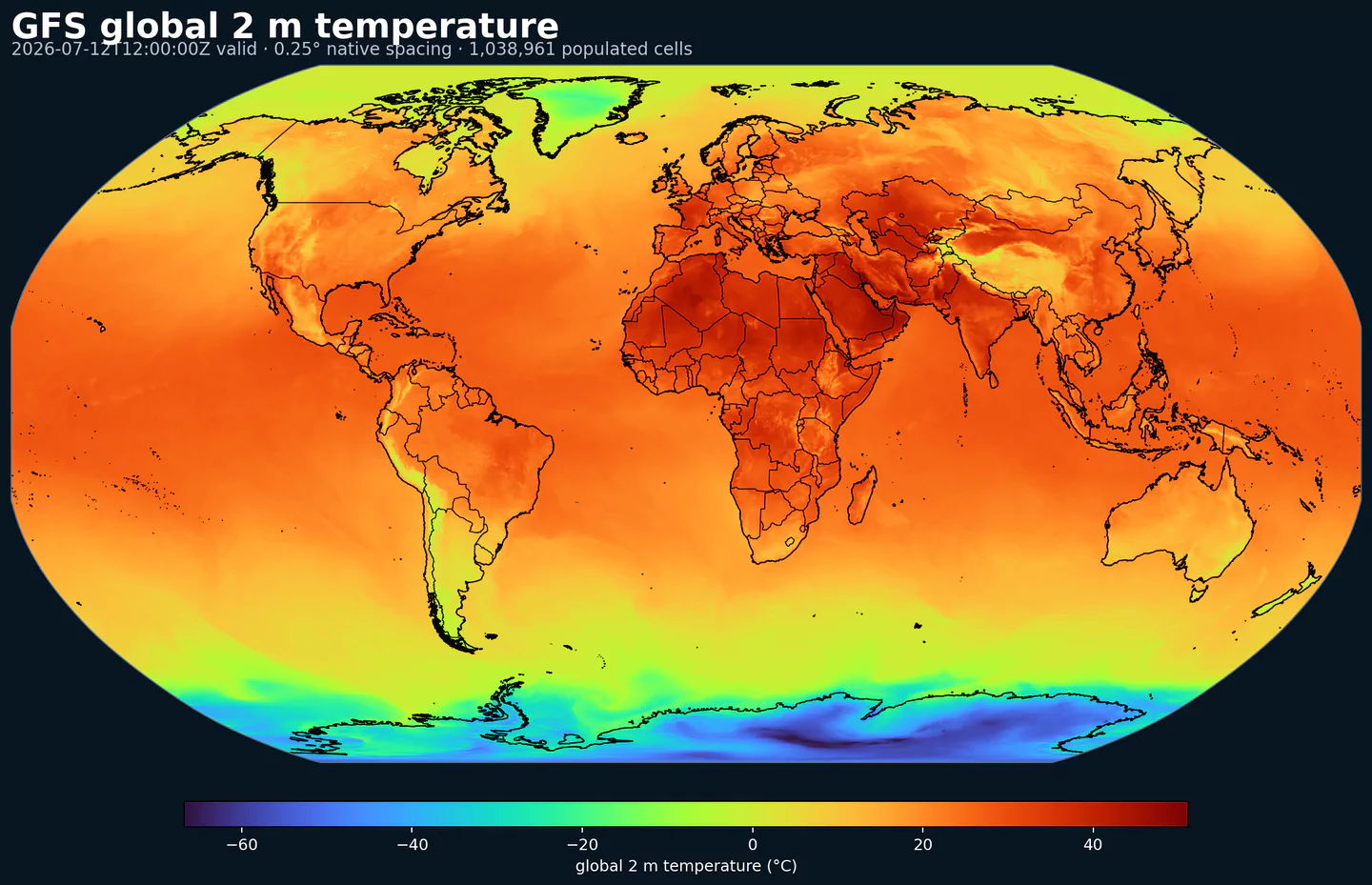
Representative global coverage: GFS 2 m temperature at its native 0.25 degree output spacing, with country boundaries overlaid. This coverage reference was generated from gfs for the aigefssfc page; available variables may differ.
Description
AIGEFS Surface is the near-surface product from NOAA/NCEP's AI Global Ensemble Forecast System. NOAA implemented AIGEFS v1.0 on December 17, 2025, as a 31-member GraphCast-based AI ensemble alongside the deterministic AIGFS and the HGEFS hybrid ensemble.
NOAA describes the AI-GFS family as GraphCast-based guidance developed by NCEP with NOAA research laboratories and the Earth Prediction Innovation Center. AIGEFS gives users member-level AI forecast scenarios, making it a natural companion to physics-based ensembles such as GEFS and AI ensemble guidance such as AIFS ENS.
This surface dataset is the compact AIGEFS option for applications that need spread across common global weather signals without the full pressure-level atmosphere. It is useful for probabilistic point forecasts, renewable-energy ranges, route-risk screening, medium-range scenario comparison, and AI-vs-physics ensemble checks.
What is in the surface product
The member-level surface dataset includes wind, temperature, humidity, pressure, and precipitation fields for members 0 through 30. Current selectors include 10 m and 100 m U/V wind components, 2 m dew point, 2 m specific humidity, 2 m temperature, mean sea-level pressure, surface pressure, surface temperature, and accumulated precipitation. It runs on the same 0.25 degree global grid as AIGEFS Pressure, with 00, 06, 12, and 18 UTC cycles and 6-hour forecast steps out to 384 hours.
Accumulated precipitation represents the total water-equivalent amount of rain and snow during the output period. It is a primary field for hydrologic impacts and event totals.
Units: kg/m^2.
Use with the model time interval to interpret totals and compare to gauges.