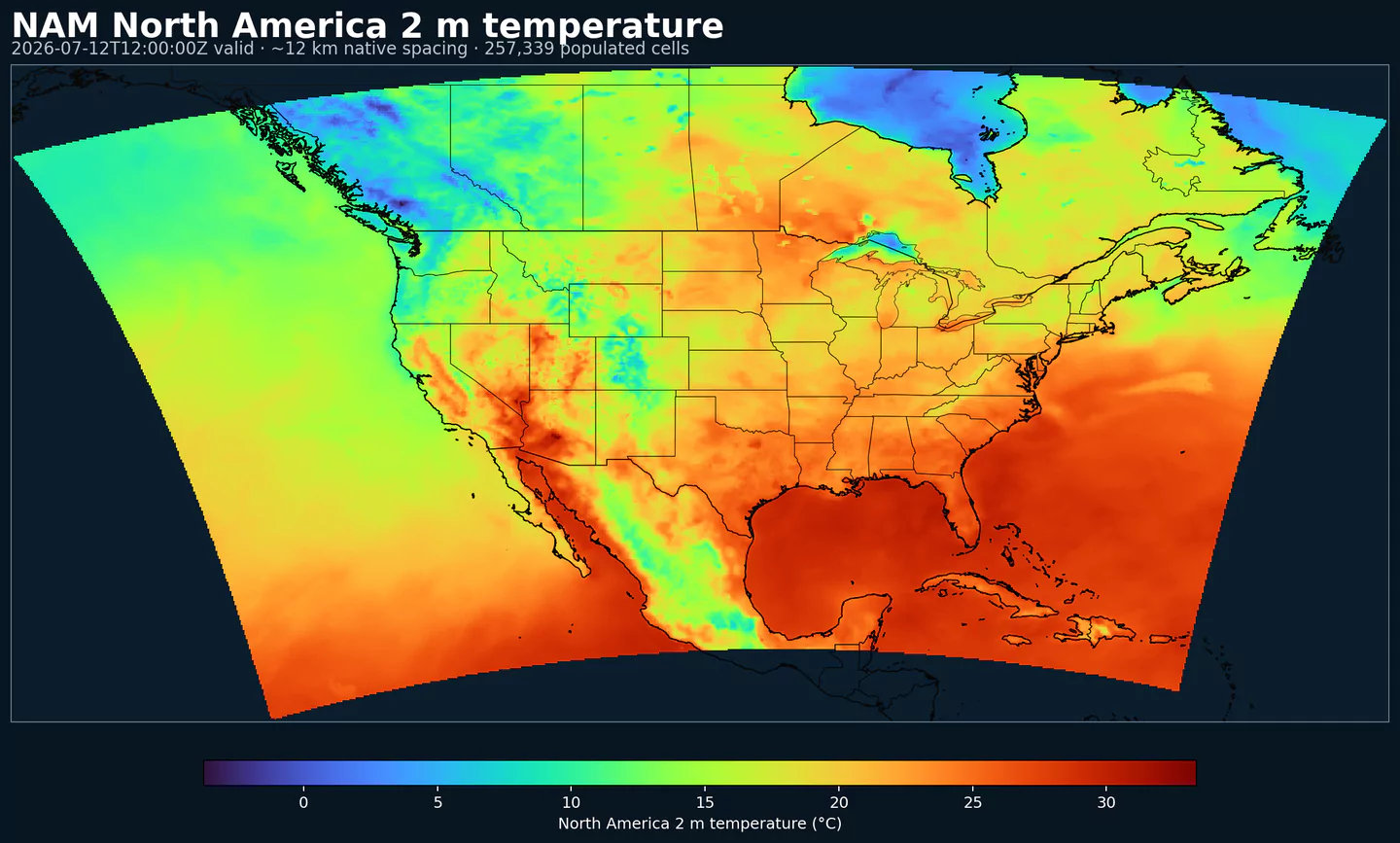
NAM 2 m temperature across the complete populated 12 km North American grid shared by these NAM products, with black boundaries. This coverage reference was generated from namawip12 for the namgoes218 page; available variables may differ.
NAM CONUS GOES-Simulated Brightness Temperatures ist der simulierte Satellitenanteil des NAM-CONUS-Feeds.
Das Produkt läuft auf demselben 12-km-Lambert-Grid wie die Kernprodukte für CONUS, liefert aber simulierte Helligkeitstemperaturen am Oberrand der Atmosphäre statt der üblichen meteorologischen NAM-Felder.
Nutzen Sie es, wenn Sie Wolkentop-Diagnostik, Feuchtefahnen oder ein GOES-ähnliches Feld benötigen, das direkt an die NAM-Vorhersagezyklen gebunden ist, ohne die vollständigen physikalischen Felder nachzuverarbeiten.
Abgedecktes Produkt: nam.tHHz.goes218FF.tm00.grib2 auf dem CONUS-Lambert-Grid 614x428.
GOES-simulierte Helligkeitstemperaturen für vier Kanäle, nicht die üblichen meteorologischen NAM-Felder.
Horizontale Auflösung von ungefähr 12.2 km, mit Läufen um 00z, 06z, 12z und 18z.
Stündliche Ausgabe bis 36 h, danach Ausgabe alle 3 Stunden bis 84 h; öffentliches Archiv seit 2024-04-15.
Auflösung: Ungefähr 12.2 km horizontaler Grid-Abstand.
Zeitliche Abdeckung: Vier Modellläufe pro Tag (00z, 06z, 12z, 18z); stündliche Ausgabe bis 36 h und danach alle 3 Stunden bis 84 h.
Hauptanwendungen: Wolkentop-Diagnostik, Feuchtefahnen, Vergleich mit Satellitenbildern, visuelle Validierung von NAM-Zyklen und Produkte, die ein satellitenähnliches Feld benötigen, ohne alle physikalischen Felder selbst zu verarbeiten.
Klicken Sie auf einen Parameter, um Varianten in einer kompakten Tabelle mit kopierbaren JSON-Selektoren zu sehen. Codes, Levels und Selector-Werte bleiben exakt so, wie die API sie ausgibt.
SBT122–Simulated Brightness Temperature for GOES 12, Channel 2 (K)
This field converts NAM-simulated top-of-atmosphere radiance into the equivalent GOES-12 channel 2 brightness temperature. It is used for model-to-satellite comparison rather than as a direct state variable.
Units: K.
Interpret it in the context of the channel's spectral response; it is not interchangeable with surface or cloud-top temperature.
Level
Info
Horizon
Introduced
Selector
top of atmosphere
0h-84h
2024-04-15
{"name":"SBT122","level":"top of atmosphere","info":""}
SBT123–Simulated Brightness Temperature for GOES 12, Channel 3 (K)
Simulated brightness temperature for GOES-12 channel 3 represents modeled radiance converted to an equivalent blackbody temperature. It supports satellite comparison and cloud diagnostics.
Units: K.
Level
Info
Horizon
Introduced
Selector
top of atmosphere
0h-84h
2024-04-15
{"name":"SBT123","level":"top of atmosphere","info":""}
SBT124–Simulated Brightness Temperature for GOES 12, Channel 4 (K)
Simulated brightness temperature for GOES-12 channel 4 represents modeled radiance converted to an equivalent blackbody temperature. It supports satellite comparison and cloud diagnostics.
Units: K.
Level
Info
Horizon
Introduced
Selector
top of atmosphere
0h-84h
2024-04-15
{"name":"SBT124","level":"top of atmosphere","info":""}
SBT126–Simulated Brightness Temperature for GOES 12, Channel 6 (K)
This field converts NAM-simulated top-of-atmosphere radiance into the equivalent GOES-12 channel 6 brightness temperature. It is used for model-to-satellite comparison rather than as a direct state variable.
Units: K.
Interpret it in the context of the channel's spectral response; it is not interchangeable with surface or cloud-top temperature.
Level
Info
Horizon
Introduced
Selector
top of atmosphere
0h-84h
2024-04-15
{"name":"SBT126","level":"top of atmosphere","info":""}