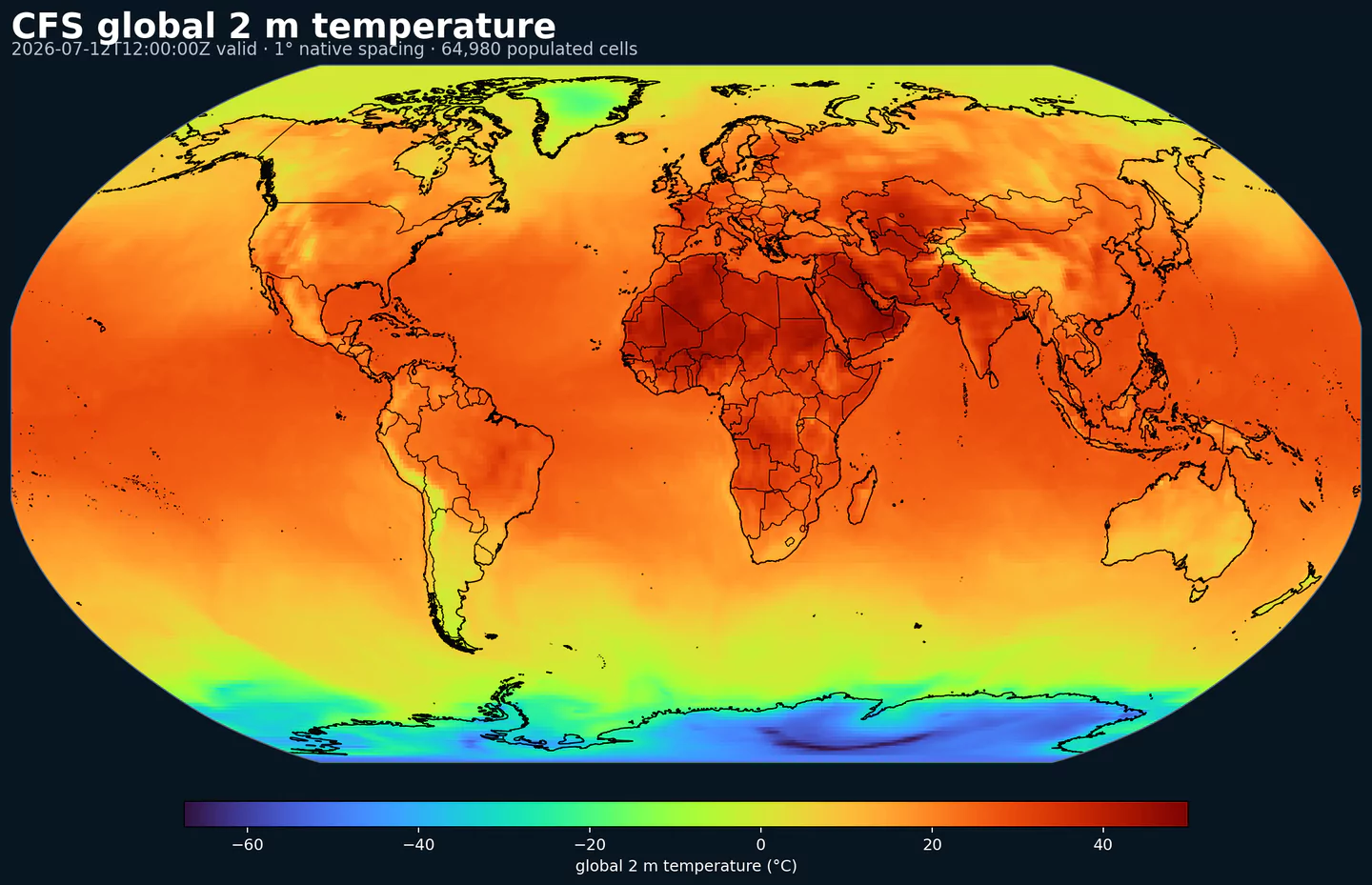
CFS 2 m temperature on the 1 degree global grid shared by this product family, with black country boundaries overlaid. This plot was generated from the cfsflxf dataset.
Aerodynamic conductance measures the efficiency of turbulent exchange of heat and moisture between the surface and atmosphere. It depends on wind speed, stability, and surface roughness and is used in surface energy balance and evapotranspiration calculations.
Units: m/s.
Higher values indicate stronger surface-atmosphere coupling and faster exchange.
Surface albedo is the fraction of incoming shortwave radiation reflected by the surface. Higher albedo means less solar energy absorbed and a cooler surface.
Units: percent.
Important for snow and ice feedbacks and surface energy balance.
Downward longwave (thermal) flux represents incoming energy at the surface. Clear-sky versions remove cloud effects to isolate the atmospheric background.
Upward longwave (thermal) flux represents outgoing energy at the surface. Clear-sky versions remove cloud effects to isolate the atmospheric background.
Upward shortwave (solar) flux represents outgoing energy at the surface. Clear-sky versions remove cloud effects to isolate the atmospheric background.
Units: W/m².
Level
Info
Horizon
Introduced
Selector
surface
0h-5160h
2018-10-31
{"name":"CSUSF","level":"surface","info":""}
top of atmosphere
0h-5160h
2018-10-31
{"name":"CSUSF","level":"top of atmosphere","info":""}
Cloud work function is an energy measure used by convection schemes to diagnose convective potential. Larger values generally indicate a more favorable environment for deep convection.
Units: J/kg.
Cloud fraction influences surface radiation and temperature.
Level
Info
Horizon
Introduced
Selector
entire atmosphere (considered as a single layer)
0h-5160h
2018-10-31
{"name":"CWORK","level":"entire atmosphere (considered as a single layer)","info":""}
Geopotential height is the altitude of a pressure surface in the atmosphere. It is the primary field for identifying ridges, troughs, and large‑scale flow patterns.
Surface roughness length is the effective height of surface obstacles that control drag. It strongly influences near-surface wind, turbulence, and exchange fluxes.
Units: m.
Level
Info
Horizon
Introduced
Selector
surface
0h-5160h
2018-10-31
{"name":"SFCR","level":"surface","info":""}
SFEXC–Exchange Coefficient at Surface (dimensionless)
Surface exchange coefficient is the bulk transfer coefficient used to compute turbulent heat and moisture fluxes. It depends on stability and roughness.
Soil type class used by the land-surface model. It controls infiltration, drainage, and heat/moisture storage, and strongly affects runoff and evapotranspiration.
Zonal gravity wave stress is the east-west component of momentum flux from unresolved gravity waves. It affects large-scale circulation and jet dynamics.
Meridional gravity wave stress is the north-south component of momentum flux from unresolved gravity waves. It affects large-scale circulation and jet dynamics.
Water runoff is the amount of water leaving the land surface as runoff during the period. It is useful for hydrology, flooding, and land-surface diagnostics.
Units: kg/m^2.
Level
Info
Horizon
Introduced
Selector
surface
0h-5160h
2018-10-31
{"name":"WATR","level":"surface","info":""}
WEASD–Water Equivalent of Accumulated Snow Depth (kg/m^2)