
GribStream Blog
DWD ICON-EU forecasts for Europe are now on GribStream
GribStream now supports DWD ICON-EU: approximately 7 km deterministic forecasts for Europe, eight daily cycles, 69 single-level fields, and five-day full forecast cycles.
GribStream now supports DWD ICON-EU as iconeu: approximately 7 km deterministic guidance across Europe, refreshed every three hours, with full 00/06/12/18 UTC cycles extending through five days.
ICON-EU is the higher-resolution European nest inside Deutscher Wetterdienst's global ICON forecasting system. DWD runs it with two-way interaction between the European nest and the global model, resolving European weather more densely while continuing to exchange information with the larger-scale model.
For products that cross national borders, ICON-EU fills an important operational gap. It adds more regional detail than a global grid while preserving the continental footprint needed by energy markets, transport networks, river basins, aviation, and marine operations.
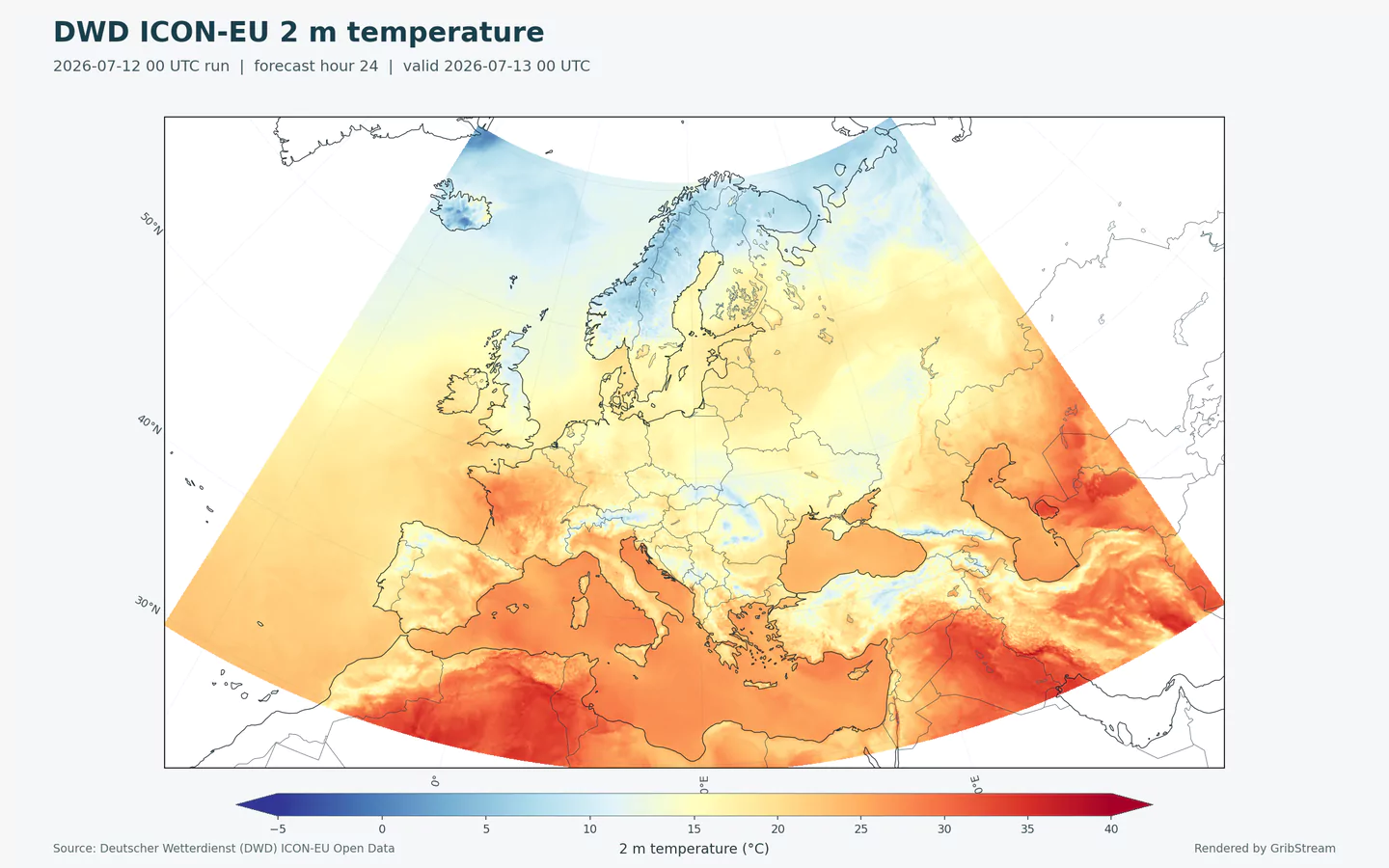
Where ICON-EU Fits
DWD's operational model chain uses global ICON for the broad atmospheric state and embeds ICON-EU over Europe. The regional nest has a native horizontal spacing of about 6.5 km; DWD publishes the regular latitude-longitude product at 0.0625 degrees, or approximately 7 km.
The published grid covers 29.5N to 70.5N and 23.5W to 62.5E. That reaches beyond the European landmass into the North Atlantic approaches, the Mediterranean and northern Africa, and western Asia. It is a practical footprint for cross-border products such as interconnected power markets, renewable portfolios, road and rail networks, river basins, aviation routes, and marine operations.
ICON-EU does not replace a global model or a finer local model. It serves a different job:
- use ECMWF IFS or GFS for global context and longer-range workflows
- use
iconeufor denser deterministic guidance across Europe through day five - use DMI HARMONIE DINI where 2 km Northwestern Europe surface detail is more important than continental coverage
- use ICON-2I for a 2.2 km Italy-centered regional view
That model hierarchy lets a product choose coverage and resolution deliberately instead of treating every forecast source as interchangeable.
Eight Daily Cycles, Two Operational Rhythms
ICON-EU updates every three hours, but the cycle depth is not identical throughout the day.
| Source cycles | Forecast range | Typical published time steps | Operational use |
|---|---|---|---|
| 00, 06, 12, 18 UTC | Through +120 hours | Hourly through +78, then every 3 hours | Five-day regional outlook and planning |
| 03, 09, 15, 21 UTC | Up to +51 hours, depending on the field | Hourly through +30 for many fields, then every 6 hours | Refreshing the first two days between full cycles |
DWD extended the intermediate ICON-EU runs to as much as +51 hours, depending on the field, and notes that many parameters are published every six hours after +30. GribStream indexes the lead times actually published for every field and cycle rather than imposing one schedule on the entire dataset.
This distinction matters in production. A forecasting application can use the newest intermediate run for short-range freshness, then fall back to the latest full cycle when it needs the complete five-day horizon.
A Broad Field Set For European Products
The first iconeu release includes 69 DWD single-level fields and always retains the latest five days. The inventory supports much more than a standard weather forecast:
- near-surface temperature, dew point, humidity, wind, pressure, and visibility
- total, low, middle, and high cloud cover, plus cloud-base and cloud-top diagnostics
- total, convective, grid-scale rain, and grid-scale snow accumulations
- direct and diffuse solar radiation, net short-wave and long-wave fluxes, and surface heat fluxes
- CAPE, CIN, lightning potential, 0 C isotherm height, and snowfall limit
- snow depth, snow water equivalent, snow density, sea-ice state, and runoff
- synthetic Meteosat SEVIRI brightness temperatures for cloud-imagery comparison and model diagnostics
This mix is particularly relevant to European renewable energy. Solar applications can work with direct and diffuse short-wave fields; wind and grid operations can combine 10 m flow, interval maximum wind, temperature, pressure, and cloud context; hydrology and agriculture products can use precipitation, snow, runoff, humidity, and land-surface fields from the same model cycle. It lets teams keep several operational signals on one model run and one spatial grid. The synthetic brightness temperatures are model-derived diagnostics, not satellite observations.
DWD Names And Time Statistics Stay Visible
GribStream exposes the DWD field names used by the source product. Customers query T_2M, TOT_PREC, ASWDIR_S, VMAX_10M, SNOWLMT, and the rest of the ICON vocabulary, so API selectors remain traceable to DWD's field listings and existing ICON workflows do not need an invented naming layer.
The inventory also distinguishes the time meaning of statistical fields:
| Field example | info |
Meaning |
|---|---|---|
T_2M |
"" |
Value at the valid time |
TOT_PREC |
"acc" |
Total precipitation accumulated from the start of the model run |
ASWDIR_S |
"ave" |
Direct short-wave flux averaged from run start to the valid time |
VMAX_10M |
"max" |
Maximum 10 m wind over the source-reported interval ending at the valid time |
TMIN_2M |
"min" |
Minimum 2 m temperature over the source-reported interval |
That distinction is important for energy totals, precipitation changes between forecast hours, and any workflow that compares values from different lead times. An ave field at hour 24 is a mean over a longer period than the same field at hour 6; an acc field is a run total, not an independent hourly amount.
The ICON-EU model page lists the exact name, level, and info tuple for every available field.
Access Through GribStream
Use the standard GribStream forecast endpoints:
/api/v2/iconeu/timeseriesfor coordinate-based time series/api/v2/iconeu/runsfor run-oriented and gridded extraction
The dataset always retains the latest five days. That window is designed for recent forecast access, run comparison, short backtests, operational dashboards, and feature generation where the original forecast cycle matters.
Open Access And Attribution
DWD Open Data does not require account registration. DWD permits reuse of its freely accessible geodata under CC BY 4.0 with source attribution. GribStream preserves DWD attribution in the catalog and model-page metadata.
Start Here
- DWD ICON-EU model page and parameter inventory
- ECMWF IFS model page
- GFS model page
- DMI HARMONIE DINI model page
- ICON-2I model page
- API documentation
Sources
- DWD numerical weather prediction data and ICON-EU overview: https://www.dwd.de/EN/ourservices/nwp_forecast_data/nwp_forecast_data.html
- DWD ICON-EU Open Data directory: https://opendata.dwd.de/weather/nwp/icon-eu/grib/
- DWD notice extending intermediate ICON-EU runs: https://www.dwd.de/DE/leistungen/opendata/neuigkeiten/opendata_februar2023_01.html
- DWD Open Data FAQ and CC BY 4.0 terms: https://www.dwd.de/DE/leistungen/opendata/faqs_opendata.html
- DWD ICON database documentation: https://www.dwd.de/DWD/forschung/nwv/fepub/icon_database_main.pdf