
GribStream Blog
ECMWF AIFS v3 will add hourly surface forecasts with HourGlass
ECMWF says HourGlass will join operational AIFS v3 later in 2026, producing coherent hourly surface forecasts for both AIFS Single and AIFS ENS.
ECMWF plans to bring hourly surface forecasts to both AIFS Single and AIFS ENS later in 2026 through HourGlass, a probabilistic temporal-downscaling system developed with MET Norway. ECMWF says the capability will become part of its operational forecasting system with AIFS v3.
This is a confirmed product direction, but it is not yet a data-feed launch. ECMWF has not announced an exact implementation date, a test or parallel period, the operational variable inventory, or whether the hourly fields will all appear in its Open Data service. The current operational AIFS v2 products remain six-hourly.
Reconstructing the hours between AIFS forecasts
Most global AI weather systems, including the current AIFS, predict atmospheric states at six-hour intervals. HourGlass takes the forecast states at the beginning and end of one of those windows and reconstructs the intervening hourly evolution.
That is more ambitious than drawing a smooth line between two values. HourGlass produces spatial weather fields and is trained to make the sequence evolve coherently. For prognostic variables, the six-hour boundary remains anchored to the underlying forecast. Diagnostic variables such as precipitation are generated by the downscaler itself.
The method produces all six times in a window together. A single coherent realization is generated for each upstream forecast member, allowing the same approach to operate on deterministic AIFS Single and each member of AIFS ENS.
Why HourGlass is probabilistic
Deterministic temporal downscalers trained with mean-squared error tend to blur small-scale structures, especially near the middle of the six-hour window where uncertainty is greatest. HourGlass instead uses variants of the continuous ranked probability score, together with loss terms that constrain the differences, minimum, maximum, and mean across the window.
The training data also come from continuous forecast trajectories rather than hourly states stitched across successive analysis or reanalysis cycles. That choice is intended to prevent the model from learning artificial jumps introduced at assimilation-cycle boundaries.
What the research evaluation found
The accompanying preprint evaluated the global HourGlass model on AIFS Single v1 and AIFS ENS v1, and a regional version on MET Norway's Bris ensemble. Verification against SYNOP observations from 2025 found that the hourly forecasts preserved the skill of the underlying systems while retaining realistic small-scale variability and coherent hour-to-hour evolution.
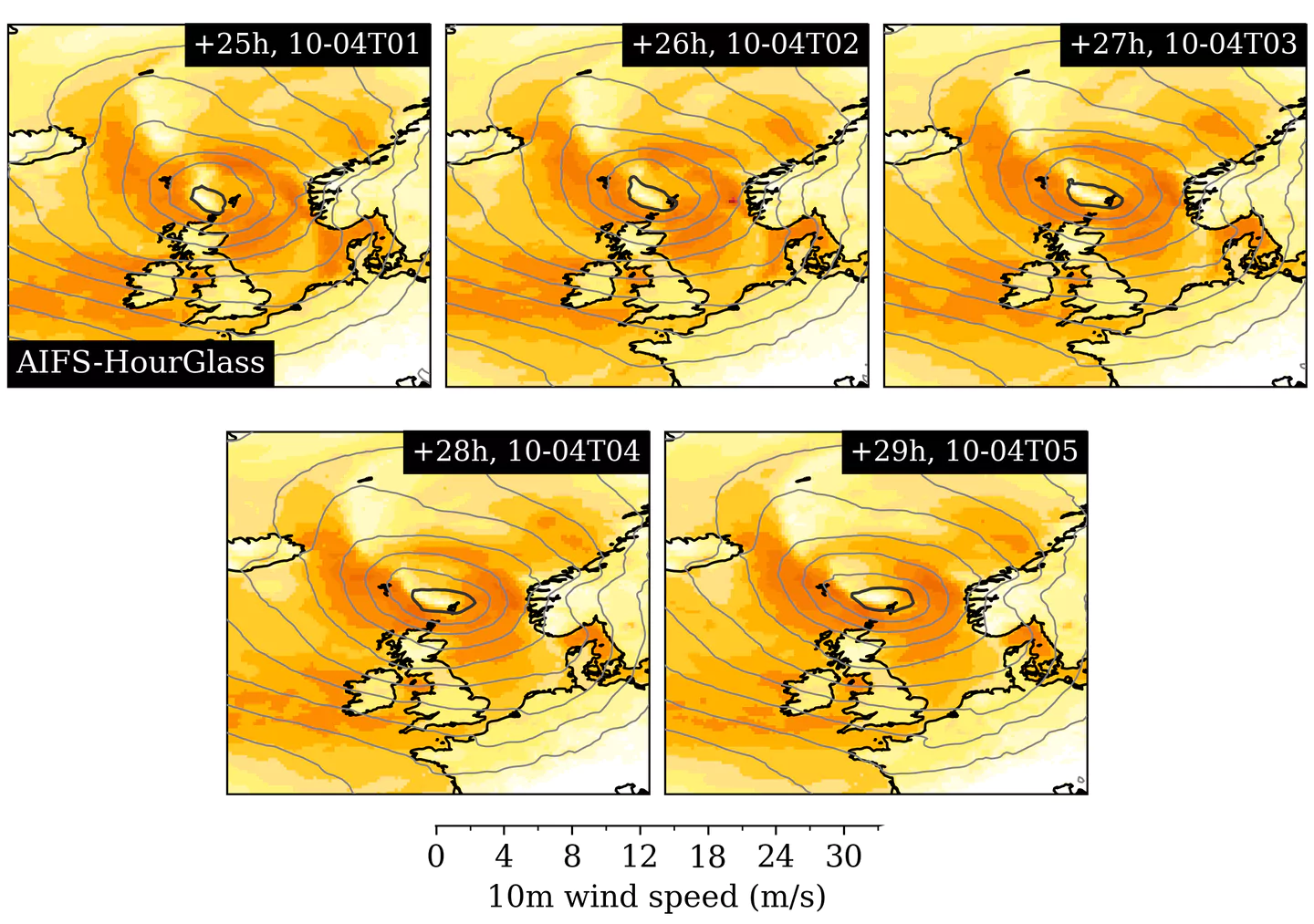
Storm Amy provides a useful stress test. In the sequence above, AIFS-HourGlass maintains the cyclone's broad wind and pressure structure as it evolves between the original forecast times. The paper also reports important limits: its wind gradients near the cyclone centre were weaker than IFS, and it missed some wind-speed maxima west of Norway. Those differences persisted throughout the window and were attributed mainly to limitations in the coarser upstream AIFS forecast.
The evaluation is evidence for the method, not verification of the final AIFS v3 configuration. ECMWF has not yet published operational-v3 scores, the final model setup, or an implementation inventory.
Hourly precipitation remains the hardest field
HourGlass improves the spatial realism of precipitation compared with smoother AI outputs, but it still underestimates the most intense hourly rainfall. In the global experiments, precipitation is a diagnostic field: the downscaler predicts it from the atmospheric state rather than receiving precipitation from the six-hourly AIFS forecast as an input.
Case studies found broadly coherent rainband movement, but also broader gradients and difficulty with local extremes. Hourly output will be valuable for examining when rainfall changes within a six-hour window, but the current evidence does not support treating HourGlass as a solved extreme-precipitation forecast.
Why hourly AIFS output matters
Six-hourly states are sufficient for many medium-range applications, but they can miss the timing of fast changes and daily extrema between forecast steps. ECMWF highlights flood forecasting, renewable-energy operations, and rapidly evolving weather as important uses for finer temporal detail. The paper also finds that HourGlass can better represent 24-hour temperature and wind maxima than the original six-hourly sequence or a cubic-spline baseline in its regional evaluation.
Operational AIFS v3 will provide hourly forecasts for key surface variables in AIFS Single and AIFS ENS. ECMWF has not said that every AIFS field or pressure level will become hourly, so the announcement should not yet be read as a sixfold expansion of the complete AIFS catalogue.
What GribStream users should watch
GribStream currently serves ECMWF's operational AIFS products through AIFS Operational (aifsoper) and AIFS Ensemble (aifsenfo). If ECMWF publishes the HourGlass fields through the normal AIFS distribution, they should remain updates to those model families rather than become a separate dataset.
The next useful milestone is an ECMWF implementation page, test data, or an updated dissemination and Open Data inventory. Before adding the fields, we need to confirm:
- the exact implementation and any parallel dates
- which surface variables, forecast steps, horizons, and ensemble products are hourly
- the stream, filename, parameter, and accumulation conventions
- whether the hourly products appear in the public Open Data subset
- whether AIFS v3 keeps the current grid and licence terms
Current AIFS v2 output is available in GRIB2 on a regular 0.25-degree grid and is licensed under CC BY 4.0 for redistribution and commercial use with attribution. ECMWF has not documented the future HourGlass fields separately, so those current access terms should not be projected onto AIFS v3 until its catalogue is published.
HourGlass is the second concrete AIFS v3 development ECMWF has disclosed this month, following its urban heat-island forcing-field preview. The new announcement goes further by tying HourGlass to an operational release later in 2026, while leaving the exact production and data-access contract open.
Sources
- ECMWF: HourGlass—filling in the gaps between forecasts, August 20, 2026
- Ingstad et al.: HourGlass—A Probabilistic Data-Driven Temporal Downscaler for Hourly Global and Regional Weather Forecasting, July 13, 2026
- ECMWF AIFS Machine Learning data
- AIFS Operational on GribStream
- AIFS Ensemble on GribStream