
GribStream Blog
ECMWF previews AIFS v3 with an urban heat-island forcing field
ECMWF has named AIFS v3 and shown a prototype that learns urban warming from impervious-surface fraction, while operational timing and output details remain open.
ECMWF has publicly named the next version of its Artificial Intelligence Forecasting System: AIFS v3. A development prototype is set to receive a static map of urban extent as model forcing, giving the system information about where roads and buildings cover the land surface.
The work remains a development preview. ECMWF has not published an AIFS v3 operational date, test-data schedule, final resolution, or output inventory. The current operational versions are still AIFS Single v2 and AIFS ENS v2.
Update (August 24, 2026): ECMWF has since announced that HourGlass will bring hourly forecasts of key surface variables to AIFS Single and AIFS ENS as part of operational AIFS v3 later in 2026. An exact date, test-data plan, output inventory, and Open Data coverage are still pending. Read the HourGlass announcement and what it means for GribStream.
Giving AIFS information about cities
The new input is an impervious-surface fraction: the proportion of each grid box covered by built surfaces such as roads and buildings. It is a fixed environmental field rather than a weather observation that changes from one forecast cycle to the next.
ECMWF tested the signal by running the same prototype twice from identical initial conditions. One run used the normal urban field; the other set urban extent to zero everywhere. Subtracting the two forecasts isolates the response the model learned from the urban input.
The experiment covered nine ten-day forecasts between January and July 2026, including the European heatwaves. It ran at N320, roughly 30 km grid spacing. At that scale, a single cell can mix a city centre with parks, suburbs, rivers, and surrounding countryside, so the urban fraction is heavily diluted.
A small but coherent warming signal
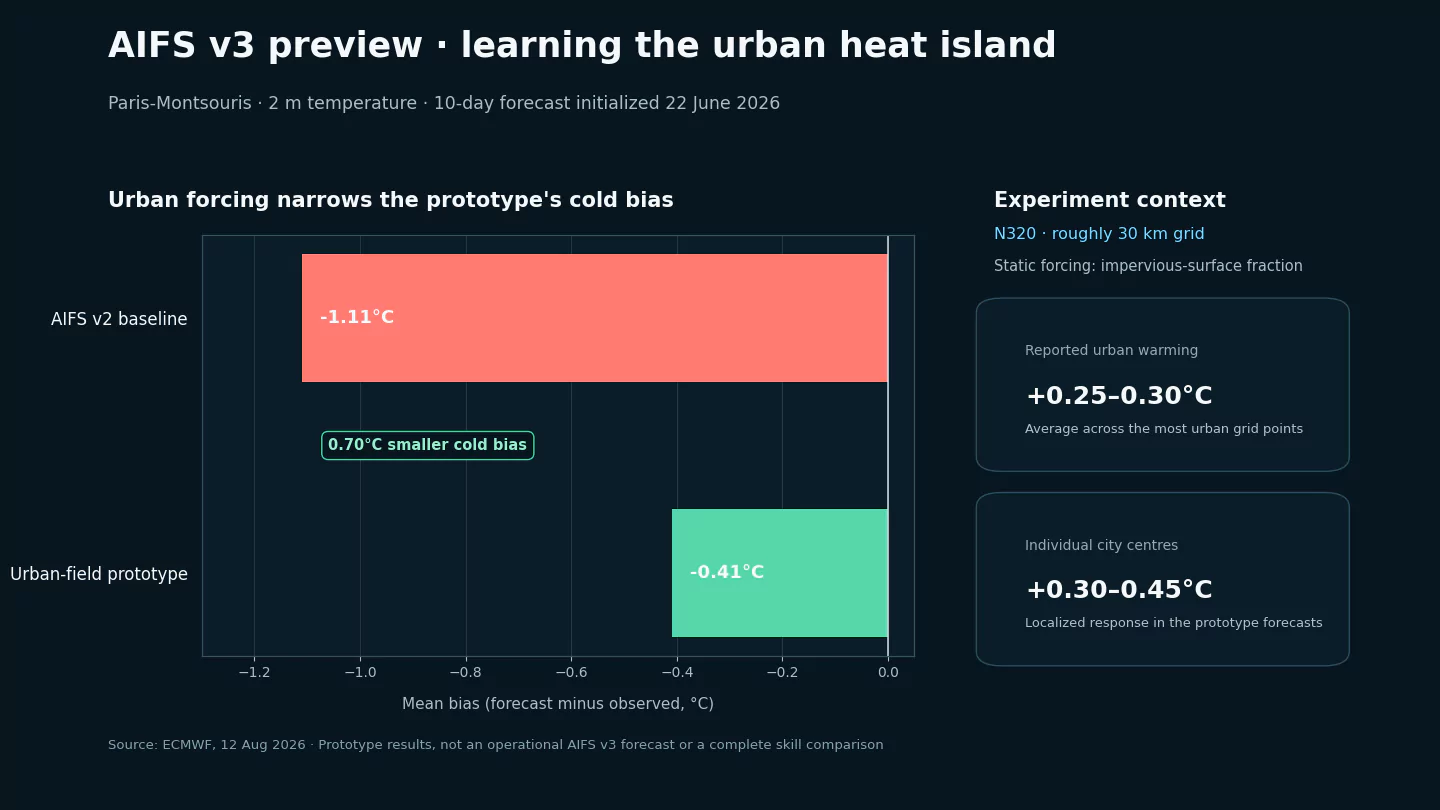
Despite that coarse representation, the prototype produced warming that followed the urban-fraction map. ECMWF reports average warming of about 0.25–0.30°C across the most urban grid points and 0.30–0.45°C at individual city centres. The response strengthened as the built-up fraction increased and appeared across seasons and forecast lead times.
Those values are grid-box averages. ECMWF expects the signal to become more pronounced as AIFS moves to finer grids that represent cities with less surrounding non-urban land mixed into each cell.
Paris shows the promise and the limit
For the ten-day forecast initialized on June 22, 2026, the urban-field prototype reduced the mean 2 m temperature cold bias at Paris-Montsouris from −1.11°C to −0.41°C. That is a 0.70°C reduction in cold-bias magnitude during the late-June heatwave.
The case does not establish a broad skill gain. ECMWF reports no statistically significant station-score improvement against the current AIFS version across the experiment. At Paris, the additional warmth slightly overshot some later peaks, RMSE changed little, and the physics-based IFS remained closest to the observations. The clearest benefit was the reduction in systematic cold bias at urban locations.
How this fits the wider AIFS v3 work
The urban field is one disclosed part of a broader AIFS v3 development programme. In May 2026, ECMWF described how AIFS v2 had adapted to the changed analyses introduced with IFS Cycle 50r1. Near-surface temperature remained a difficult area, especially where snow, sea ice, and ocean coupling changed the characteristics of the analysis.
ECMWF found that greater exposure to Cycle 50r1 data should help future training and said that result would inform AIFS v3 development. The August urban experiment adds a more concrete planned input: a static surface field that lets the model associate built environments with their characteristic temperature response.
What GribStream users should watch
GribStream currently serves the operational AIFS v2 products through AIFS Operational (aifsoper) and AIFS Ensemble (aifsenfo). Current ECMWF AIFS output is public GRIB2, and ECMWF licenses the operational data for commercial reuse under CC BY 4.0 with attribution.
AIFS v3 access and licensing have not been published separately. Before any GribStream transition, the practical questions are:
- when ECMWF will provide test data and begin any parallel period
- whether AIFS Single and AIFS ENS will move together
- whether grid resolution, forecast cadence, or horizon will change
- which surface, pressure-level, wave, ensemble, or diagnostic fields will be published
- whether the public open-data inventory and licence will continue unchanged
The next firm milestone should be an ECMWF implementation or test-data page. Until then, aifsoper and aifsenfo continue to describe the current operational AIFS v2 feeds.