
GribStream Blog
Pre-operational NOAA RRFS forecasts are now available on GribStream
GribStream now serves NOAA's pre-operational 3 km CONUS RRFS pressure-level and 2D forecasts from eight daily cycles, with guidance through 84 hours ahead of the planned October 6 operational transition.
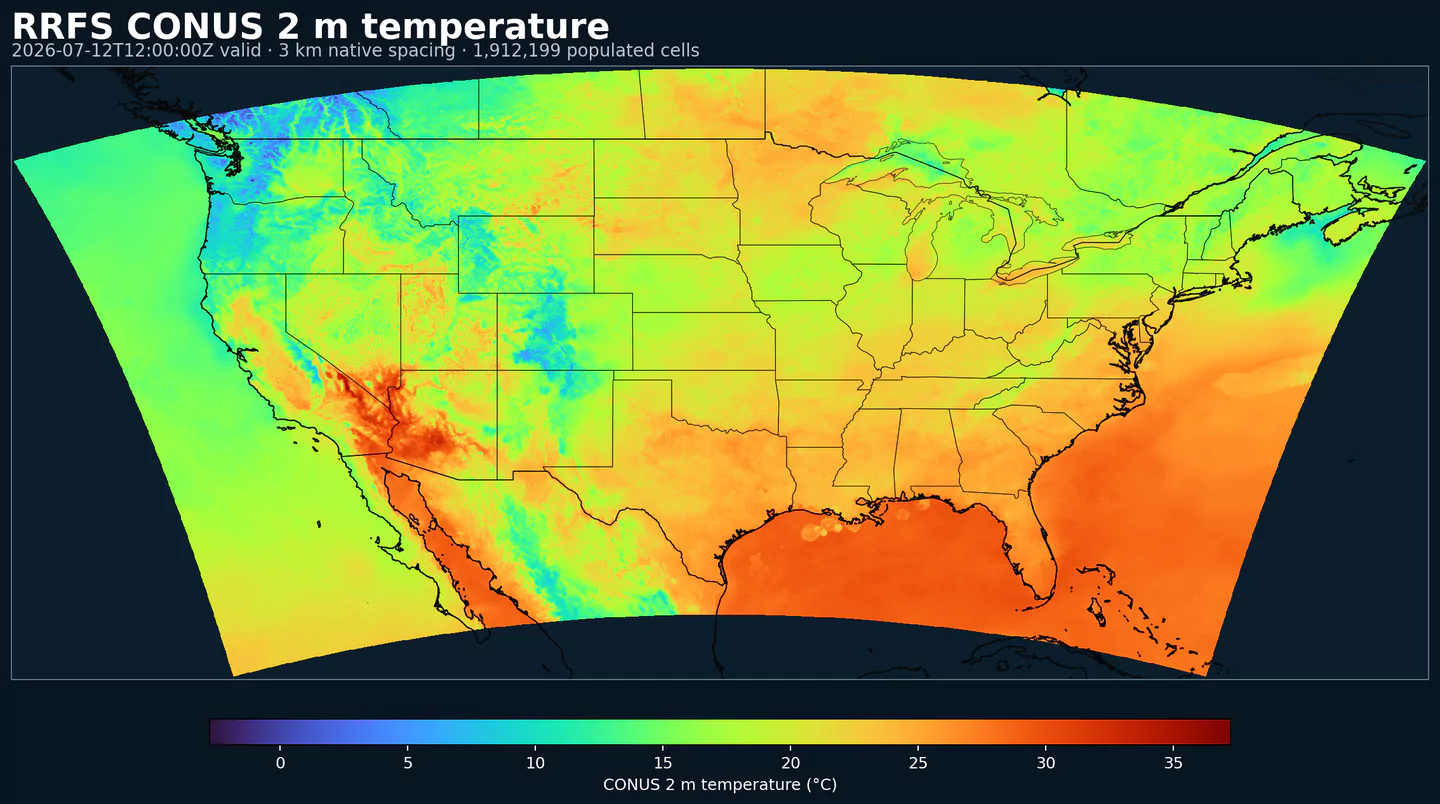
GribStream now serves NOAA's pre-operational Rapid Refresh Forecast System (RRFS) through two deterministic datasets: RRFS 2D Fields and RRFS Pressure Levels. They bring frequently updated, convection-allowing guidance for the contiguous United States into the GribStream catalog.
Two datasets from one forecast system
RRFS is NOAA's next-generation regional forecast system for rapidly evolving, high-impact weather. The two GribStream datasets preserve the product split published by NOAA:
rrfs2dfldcovers surface and near-surface weather, precipitation, clouds, radiation, soil, fire-weather variables, and storm diagnostics.rrfsprslevcovers upper-air temperature, wind, humidity, geopotential height, vertical motion, vorticity, and cloud or hydrometeor fields on pressure levels.
Both currently expose the 3 km CONUS output. The separate RRFS domains for Alaska, Hawaii, Puerto Rico, North America, and the relocatable fire-weather run are not included in these two dataset codes.
Eight current cycles and the planned hourly schedule
The pre-operational standard CONUS products currently available through these two datasets arrive in eight cycles per day. The 00, 06, 12, and 18 UTC cycles extend through forecast hour 84, while the 03, 09, 15, and 21 UTC cycles extend through hour 18.
NOAA's planned operational RRFS schedule expands deterministic forecasts to every hour. Under that schedule, the four main cycles continue through hour 84 and the other hourly cycles continue through hour 18. The current eight-cycle feed already supports frequently refreshed short-range applications and longer windows from the four main cycles; GribStream will revalidate the cadence at the operational transition.
The 3 km grid is designed for storm-scale structure. Useful workflows include severe-convection monitoring, precipitation timing, winter-weather transitions, aviation hazards, wind and visibility guidance, and localized inputs for operational dashboards or machine-learning systems. RRFS is still a model forecast: users should validate the variables and lead times that matter to their application, and compare high-impact decisions with observations and ensemble guidance.
REFS members are not part of this launch
The historical RRFS Ensemble dataset exposed individual experimental members from NOAA's former distribution. That source stopped updating during the parallel-feed handoff, and NOAA's replacement distribution instead publishes derived REFS families such as means, spread, probability-matched means, probabilities, and ensemble-agreement products.
Those products are scientifically different from individual members, so GribStream will not silently remap them into refsprslev. The historical dataset is now deprecated and receives no new forecasts. The derived REFS products and the separate relocatable fire-weather output are candidates for future datasets, each with its own documented product and grid contract.
Pre-operational until NOAA completes the transition
The current files are a real-time parallel feed, not an early operational implementation. NWS Service Change Notice 26-48 schedules RRFS and REFS to become operational on October 6, 2026 at 12 UTC, when they are also scheduled to replace NAM, SREF, HREF, and most HiresW domains. Severe-weather or other operational constraints can postpone that transition.
GribStream will revalidate the production products when NOAA completes the change. Until then, treat these RRFS datasets as pre-operational: product contents and availability may still change, even though the stable GribStream dataset codes let applications begin testing now.