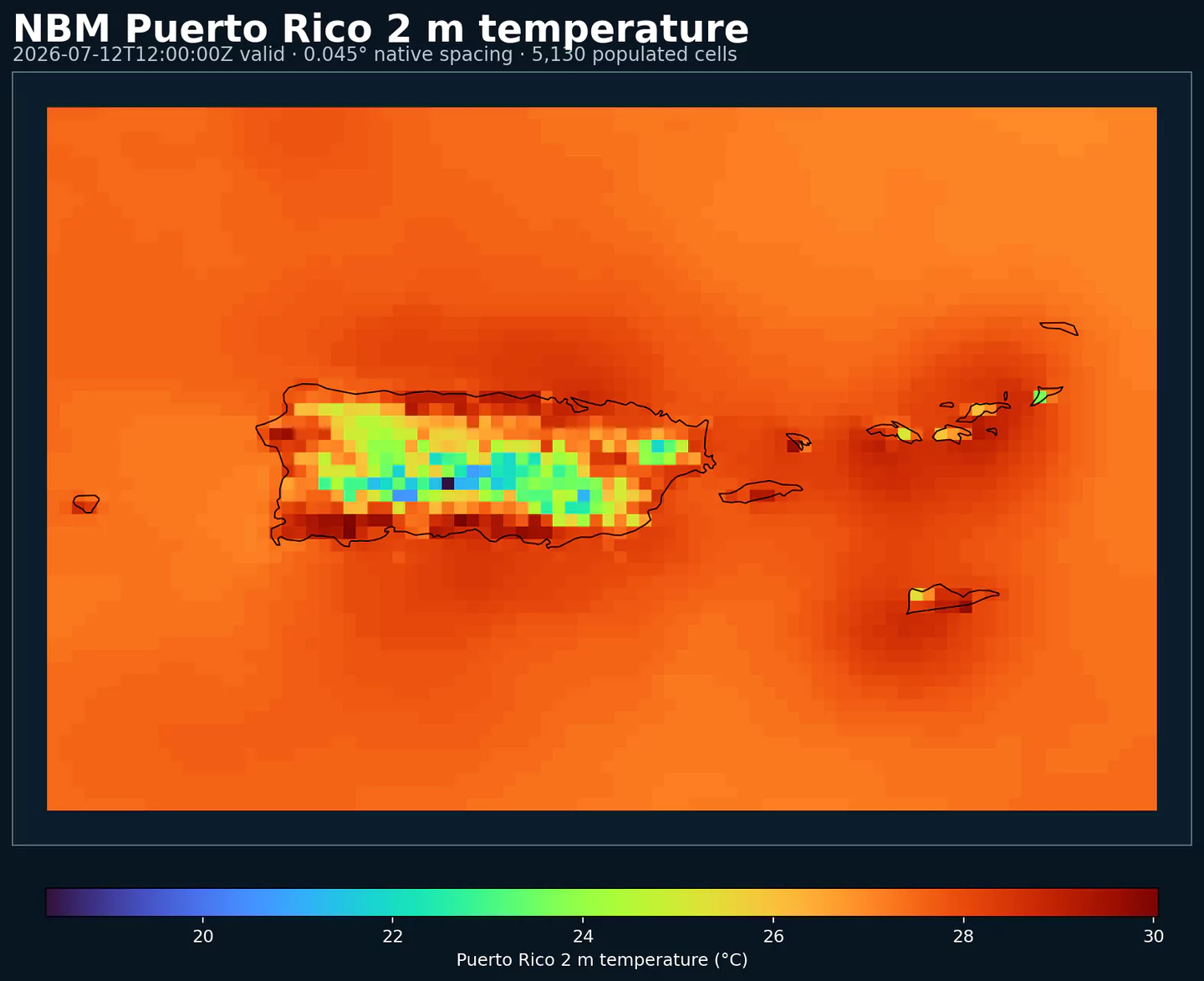
NBM-v5-Status: NBM v5 ist in diesem Dataset jetzt operativ. Im GribStream-Archiv enthalten Läufe vor 2026-05-05 12:00 UTC die vorherige operative NBM-Version; Läufe ab 2026-05-05 12:00 UTC verwenden NBM v5.
Akkumulationsfelder wie APCP, ASNOW und FICEAC laufen, sofern sie vorhanden sind, durch den erweiterten stündlichen Bereich von NBM v5 und gehen danach in /timeseries mit längeren Akkumulationsperioden weiter, ohne Lücken oder doppelte Zeitfenster.
Beschreibung
NBM Puerto Rico ist die regionale Ausgabe des National Blend of Models für Puerto Rico. Sie bringt NOAAs operatives Postprocessing auf ein Grid, das auf diese Domain zugeschnitten ist, statt die CONUS-Hauptdomain zu verwenden.
NBM kombiniert mehrere Vorhersagequellen und kalibriert sie statistisch, um konsistentere Felder zu erzeugen als ein einzelnes unkalibriertes Modell. Der Zweck ist eine stabilere Vorhersagebasis für operative Produkte und Entscheidungen, bei denen Wetterrisiko zählt.
Das System nutzt Techniken wie Model Output Statistics (MOS), Quantile Mapping und Ensemble-Gewichtung. In den regionalen Domains bleibt der API-Workflow gleich: Sie wählen das regionale NBM-Dataset und verwenden die Katalogselektoren wie bei anderen NBM-Codes.
In GribStream behält nbmpr die Variablencodes, Levels und info-Werte des Katalogs. Sie können dieselben Endpoints und Selector-Muster verwenden und nur den Modellcode wechseln.
Erweitert die operative NBM-v5-Vorhersagebasis auf eine regionale NBM-Domain außerhalb des CONUS-Hauptgrids.
Veröffentlicht stündliche Zyklen für Produkte, die häufige Aktualisierungen benötigen.
Kombiniert globale, regionale, deterministische und Ensemble-Modelle zu einer kalibrierten Ausgabe.
Nutzt dieselben GribStream-Abfragemuster wie NBM CONUS, aber mit eigenem Dataset-Code.
Auflösung: Ungefähr 2.5 km auf dem regionalen Puerto-Rico-Grid.
Zeitliche Abdeckung: Stündliche Aktualisierungen; Vorhersagehorizonte reichen bis 264 h, also ungefähr 11 Tage, wenn die Quelle diese Lead Times veröffentlicht.
Hauptanwendungen: Operationen in Puerto Rico und der nahen Karibik, Energie, Notfallmanagement, Luftfahrt, lokale Hydrologie, Tourismus und Entscheidungsprodukte für Regen, Wind und Temperatur.
Klicken Sie auf einen Parameter, um Varianten in einer kompakten Tabelle mit kopierbaren JSON-Selektoren zu sehen. Codes, Levels und Selector-Werte bleiben exakt so, wie die API sie ausgibt.
Accumulated precipitation represents the total water-equivalent amount of rain and snow during the output period. It is a primary field for hydrologic impacts and event totals.
Units: kg/m^2.
Use with the model time interval to interpret totals and compare to gauges.
Apparent temperature combines air temperature, humidity, and wind to estimate how hot or cold it feels to humans. It is useful for heat and cold stress assessments.
Units: K.
Level
Info
Horizon
Introduced
Selector
2 m above ground
1h-264h
2020-10-01
{"name":"APTMP","level":"2 m above ground","info":""}
Convective Available Potential Energy (CAPE) quantifies buoyant energy available to rising air parcels. Larger values generally imply stronger potential updrafts and greater convective intensity.
Units: J/kg.
Often used with CIN and lifting mechanisms to assess thunderstorm potential.
Ceiling height is the altitude of the lowest cloud base that covers a significant portion of the sky. It is a key aviation and surface-visibility metric.
Distance to feature is the horizontal distance to the named hazard or boundary in the source product. It is used to map proximity to key features like fronts or hazards.
Units: km.
Level
Info
Horizon
Introduced
Selector
surface - 610 m above ground
1h-36h
2020-10-01
{"name":"DIST","level":"surface - 610 m above ground","info":""}
Ellrod index is a diagnostic for clear-air turbulence based on deformation and vertical wind shear. Higher values indicate greater turbulence potential for aviation.
Fosberg fire weather index combines temperature, humidity, and wind to estimate potential fire spread. Higher values indicate more favorable wildfire conditions.
Haines Index combines atmospheric stability and dryness to estimate the potential for large fire growth. Higher values indicate a more favorable environment for extreme fire behavior.
Units: Numeric.
Typically used in wildfire forecasting and risk monitoring.
Level
Info
Horizon
Introduced
Selector
entire atmosphere (considered as a single layer)
6h-264h
2020-10-01
{"name":"HINDEX","level":"entire atmosphere (considered as a single layer)","info":""}
Hourly maximum simulated reflectivity at 1 km AGL captures the strongest modeled reflectivity near the surface. It is used to identify peak convective intensity and heavy precipitation cores.
Units: dBZ.
Level
Info
Horizon
Introduced
Selector
1000 m above ground
1h-48h
2020-10-01
{"name":"MAXREF","level":"1000 m above ground","info":""}