GribStream

NOAA National Blend of Models - Guam

Codice GribStream: nbmgu

Altre griglie NBM: nbm, nbmak, nbmhi, nbmpr, nbmoc

Status NBM v5: NBM v5 è già operativo in questo dataset. Nell'archivio GribStream, i run precedenti a 2026-05-05 12:00 UTC contengono la versione operativa precedente di NBM; i run da 2026-05-05 12:00 UTC in poi usano NBM v5.

I campi di accumulo come APCP, ASNOW e FICEAC, quando presenti, continuano nella finestra oraria estesa di NBM v5 e poi proseguono in /timeseries con periodi di accumulo più lunghi, senza lacune o finestre duplicate.

Descrizione

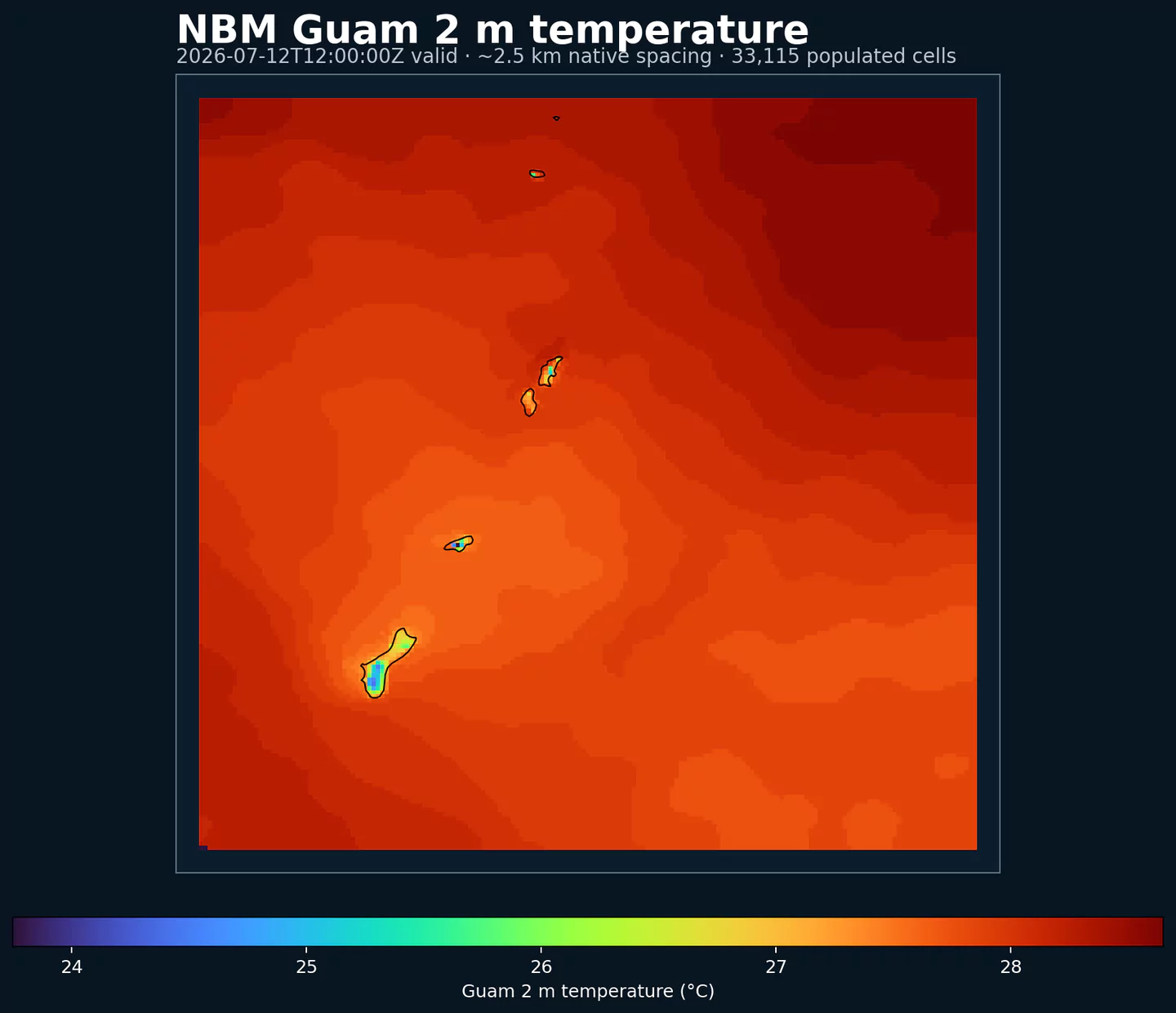
NBM Guam è il prodotto regionale del National Blend of Models per Guam. Porta la post-elaborazione operativa NOAA su una griglia dedicata al dominio, invece di usare la griglia CONUS principale.

NBM combina più fonti di previsione e applica calibrazione statistica per produrre campi più consistenti di quelli di un singolo modello non calibrato. L'obiettivo è offrire una base previsionale più stabile per prodotti operativi e decisioni sensibili al rischio meteo.

Il sistema usa tecniche come Model Output Statistics (MOS), Quantile Mapping e pesatura ensemble. Nei domini regionali, questo blend mantiene un contesto locale utile senza cambiare il modo in cui si interroga l'API.

In GribStream, nbmgu preserva codici variabile, livelli e valori di info del catalogo. Puoi usare gli stessi endpoint e selettori degli altri codici NBM, cambiando solo il codice del modello.

Dettagli

Dataset correlati

Parametri

0 parametri

Fai clic su un parametro per vedere le varianti in una tabella compatta con selettori JSON pronti da copiare. Codici, livelli e valori dei selettori restano esattamente come li espone l'API.

APCP –Accumulated Precipitation (kg/m^2)
2 variants

Accumulated precipitation represents the total water-equivalent amount of rain and snow during the output period. It is a primary field for hydrologic impacts and event totals.

  • Units: kg/m^2.
  • Use with the model time interval to interpret totals and compare to gauges.
Level Info Horizon Introduced Selector
surface 1h-264h 2020-10-01
{"name":"APCP","level":"surface","info":""}
surface prob >0.254 1h-264h 2020-10-01
{"name":"APCP","level":"surface","info":"prob >0.254"}
CAPE –Convective Available Potential Energy (J/kg)
2 variants

Convective Available Potential Energy (CAPE) quantifies buoyant energy available to rising air parcels. Larger values generally imply stronger potential updrafts and greater convective intensity.

  • Units: J/kg.
  • Often used with CIN and lifting mechanisms to assess thunderstorm potential.
Level Info Horizon Introduced Selector
surface 1h-264h 2020-10-01
{"name":"CAPE","level":"surface","info":""}
surface ens std dev 1h-264h 2020-10-01
{"name":"CAPE","level":"surface","info":"ens std dev"}
CEIL –Ceiling Height (m)
2 variants

Ceiling height is the altitude of the lowest cloud base that covers a significant portion of the sky. It is a key aviation and surface-visibility metric.

  • Units: m.
Level Info Horizon Introduced Selector
cloud base 1h-84h 2020-10-01
{"name":"CEIL","level":"cloud base","info":""}
cloud ceiling 1h-48h 2020-10-01
{"name":"CEIL","level":"cloud ceiling","info":""}
DPT –Dew Point Temperature (K)
2 variants

Dew point temperature is the temperature at which the air becomes saturated. It is a direct measure of moisture content.

  • Units: K.
  • When dew point is close to air temperature, fog or low cloud potential increases.
Level Info Horizon Introduced Selector
2 m above ground 1h-264h 2020-10-01
{"name":"DPT","level":"2 m above ground","info":""}
2 m above ground ens std dev 1h-264h 2020-10-01
{"name":"DPT","level":"2 m above ground","info":"ens std dev"}
GUST –Wind Speed (Gust) (m/s)
2 variants

Wind gust is the peak short-duration wind speed. It captures brief, hazardous bursts that can exceed sustained winds.

  • Units: m/s.
Level Info Horizon Introduced Selector
10 m above ground 1h-264h 2020-10-01
{"name":"GUST","level":"10 m above ground","info":""}
10 m above ground ens std dev 1h-264h 2020-10-01
{"name":"GUST","level":"10 m above ground","info":"ens std dev"}
HTSGW –Significant Wave Height (m)
5 variants

Significant wave height represents the average height of the highest third of waves. It is the standard metric for sea state and marine hazards.

  • Units: m.
Level Info Horizon Introduced Selector
surface 1h-240h 2020-10-01
{"name":"HTSGW","level":"surface","info":""}
surface 10% level 1h-240h 2023-01-16
{"name":"HTSGW","level":"surface","info":"10% level"}
surface 50% level 1h-240h 2023-01-16
{"name":"HTSGW","level":"surface","info":"50% level"}
surface 90% level 1h-240h 2023-01-16
{"name":"HTSGW","level":"surface","info":"90% level"}
surface ens std dev 1h-240h 2020-10-01
{"name":"HTSGW","level":"surface","info":"ens std dev"}
MAXREF –Hourly Maximum of Simulated Reflectivity at 1 km AGL (dBZ)
1 variant

Hourly maximum simulated reflectivity at 1 km AGL captures the strongest modeled reflectivity near the surface. It is used to identify peak convective intensity and heavy precipitation cores.

  • Units: dBZ.
Level Info Horizon Introduced Selector
1000 m above ground 1h-48h 2020-10-01
{"name":"MAXREF","level":"1000 m above ground","info":""}
MAXRH –Maximum Relative Humidity (percent)
1 variant

Maximum relative humidity is the highest RH reached during the period. It can indicate peak cloud or fog potential.

  • Units: percent.
  • Higher values indicate more atmospheric moisture and greater cloud or precip potential.
Level Info Horizon Introduced Selector
2 m above ground 18h-264h 2020-10-01
{"name":"MAXRH","level":"2 m above ground","info":""}
MINRH –Minimum Relative Humidity (percent)
1 variant

Minimum relative humidity is the lowest RH reached during the period. It is used in fire‑weather and drying assessments.

  • Units: percent.
  • Higher values indicate more atmospheric moisture and greater cloud or precip potential.
Level Info Horizon Introduced Selector
2 m above ground 18h-264h 2020-10-01
{"name":"MINRH","level":"2 m above ground","info":""}
RETOP –Radar Echo Top Height (m)
1 variant

Echo top height is the altitude of the highest reflectivity in the column. It is a proxy for storm depth and convective vigor.

  • Units: m.
Level Info Horizon Introduced Selector
cloud top 1h-48h 2020-10-01
{"name":"RETOP","level":"cloud top","info":""}
RH –Relative Humidity (percent)
1 variant

Relative humidity describes how close the air is to saturation at the specified level. High values favor cloud formation.

  • Units: percent.
  • Higher values indicate more atmospheric moisture and greater cloud or precip potential.
Level Info Horizon Introduced Selector
2 m above ground 1h-264h 2020-10-01
{"name":"RH","level":"2 m above ground","info":""}
TCDC –Total Cloud Cover (percent)
3 variants

Total cloud cover is the fraction of the grid cell covered by clouds at any level. It influences radiation, temperature, and visibility.

  • Units: percent.
  • Cloud fraction influences surface radiation and temperature.
Level Info Horizon Introduced Selector
surface 1h-264h 2020-10-01
{"name":"TCDC","level":"surface","info":""}
surface ens std dev 1h-48h 2020-10-01
{"name":"TCDC","level":"surface","info":"ens std dev"}
surface unknown derived fcst 37h-264h 2020-10-01
{"name":"TCDC","level":"surface","info":"unknown derived fcst"}
TMAX –Maximum Temperature (K)
1 variant

Maximum temperature is the highest temperature reached during the output period. It is commonly used for heat stress and daily extremes.

  • Units: K.
Level Info Horizon Introduced Selector
2 m above ground 18h-264h 2020-10-01
{"name":"TMAX","level":"2 m above ground","info":""}
TMIN –Minimum Temperature (K)
1 variant

Minimum temperature is the lowest temperature reached during the output period. It is commonly used for frost and cold-stress assessment.

  • Units: K.
Level Info Horizon Introduced Selector
2 m above ground 18h-264h 2020-10-01
{"name":"TMIN","level":"2 m above ground","info":""}
TMP –Temperature (K)
2 variants

Air temperature is the thermal state of the atmosphere at the specified level. It influences density, stability, and energy exchange.

  • Units: K.
Level Info Horizon Introduced Selector
2 m above ground 1h-264h 2020-10-01
{"name":"TMP","level":"2 m above ground","info":""}
2 m above ground ens std dev 1h-264h 2020-10-01
{"name":"TMP","level":"2 m above ground","info":"ens std dev"}
TPWDIR –Total Precipitable Water Transport Direction (degrees)
1 variant

Total precipitable water transport direction is the direction of column‑integrated moisture flux. It indicates moisture transport pathways.

  • Units: degrees.
Level Info Horizon Introduced Selector
10 m above ground 1h-167h 2024-04-16
{"name":"TPWDIR","level":"10 m above ground","info":""}
TPWSPD –Total Precipitable Water Transport Speed (m/s)
1 variant

Total precipitable water transport speed is the magnitude of column‑integrated moisture transport. It highlights atmospheric river strength.

  • Units: m/s.
Level Info Horizon Introduced Selector
10 m above ground 1h-167h 2024-04-16
{"name":"TPWSPD","level":"10 m above ground","info":""}
VIL –Vertically-Integrated Liquid Water (kg/m^2)
1 variant

Vertically‑integrated liquid water is the total column liquid water content. It is used as a proxy for precipitation intensity and hail potential.

  • Units: kg/m^2.
Level Info Horizon Introduced Selector
entire atmosphere 1h-48h 2020-10-01
{"name":"VIL","level":"entire atmosphere","info":""}
VIS –Visibility (m)
1 variant

Horizontal visibility at the surface. Lower values indicate reduced visibility due to fog, precipitation, or aerosols.

  • Units: m.
Level Info Horizon Introduced Selector
surface 1h-84h 2020-10-01
{"name":"VIS","level":"surface","info":""}
WDIR –Wind Direction (degrees)
3 variants

Wind direction indicates the direction from which the wind is blowing at the specified level.

  • Units: degrees.
Level Info Horizon Introduced Selector
10 m above ground 1h-264h 2020-10-01
{"name":"WDIR","level":"10 m above ground","info":""}
30 m above ground 1h-264h 2020-10-01
{"name":"WDIR","level":"30 m above ground","info":""}
80 m above ground 1h-264h 2020-10-01
{"name":"WDIR","level":"80 m above ground","info":""}
WIND –Wind Speed (m/s)
4 variants

Wind speed is the magnitude of the horizontal wind at the specified level. It is used for transport, mixing, and hazards.

  • Units: m/s.
Level Info Horizon Introduced Selector
10 m above ground 1h-264h 2020-10-01
{"name":"WIND","level":"10 m above ground","info":""}
10 m above ground ens std dev 1h-264h 2020-10-01
{"name":"WIND","level":"10 m above ground","info":"ens std dev"}
30 m above ground 1h-264h 2020-10-01
{"name":"WIND","level":"30 m above ground","info":""}
80 m above ground 1h-264h 2020-10-01
{"name":"WIND","level":"80 m above ground","info":""}

Nessun parametro corrisponde alla ricerca.