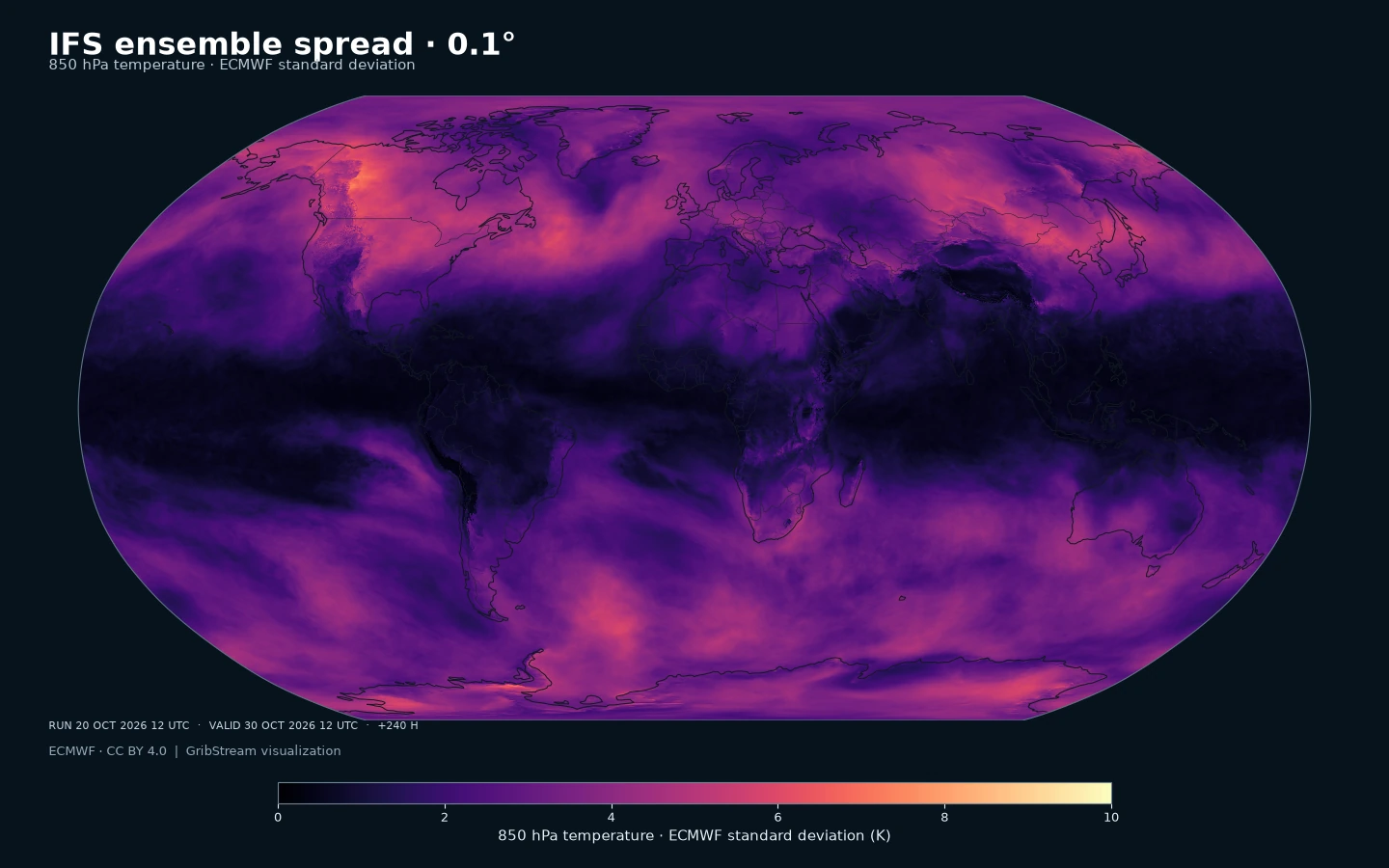
ifsenfospread0p1 · ECMWF temperature standard deviation at 850 hPa in K. Historical example: run 20 October 2026 12 UTC; valid 30 October 2026 12 UTC (+240 h). Nearest-cell rendering of the 0.1° output grid. Source: ECMWF, CC BY 4.0; visualization: GribStream.
About this forecast
ECMWF ensemble spread at 0.1°: standard deviation of temperature, wind speed, geopotential height and pressure for medium-range uncertainty analysis.
What is ECMWF IFS?
IFS stands for Integrated Forecasting System. Developed by the European Centre for Medium-Range Weather Forecasts (ECMWF) in cooperation with Météo-France, it combines observations through data assimilation and advances a global Earth-system model using physical equations. Its atmosphere, land, ocean and wave components exchange information. These products belong to the short- and medium-range forecast family, extending to 15 days; ECMWF also develops the separate, machine-learning-based AIFS family. ECMWF documentation.
What this product is for
Ensemble spread measures how strongly the member forecasts disagree at a location and valid time. ECMWF publishes it as standard deviation. Larger spread highlights scenarios that diverge, such as uncertain trough positions or temperature boundaries. It is useful alongside the ensemble mean, but does not by itself give a calibrated forecast error or the probability of crossing a threshold. ECMWF documentation.
Nine selectors matching the mean product: temperature at 250, 500 and 850 hPa; wind speed at 250 and 850 hPa; geopotential height at 300, 500 and 1000 hPa; mean sea-level pressure.
Spread has the physical units of its field and no member dimension. Temperature spread in kelvin is a temperature difference: a 2 K spread is a 2°C spread, without subtracting 273.15.
The 0.1° latitude–longitude grid samples the same IFS forecast as the 0.25° products. It has 3,600 × 1,801 points, with about 11 km north–south spacing. ECMWF’s atmospheric model runs at approximately 9 km. Finer output spacing preserves more spatial detail but does not itself establish local accuracy. The 0.1° distribution follows 0.25° by about two hours. ECMWF documentation.
Resolution: 0.1° · 3600 × 1801
Temporal coverage: 00 and 12 UTC: +0–144 h every 3 h, then +150–360 h every 6 h (15 days).
Primary uses: Forecast confidence assessment, identifying sensitive regions and prioritizing closer examination of ensemble scenarios.
00 and 12 UTC: +0–144 h every 3 h, then +150–360 h every 6 h (15 days).