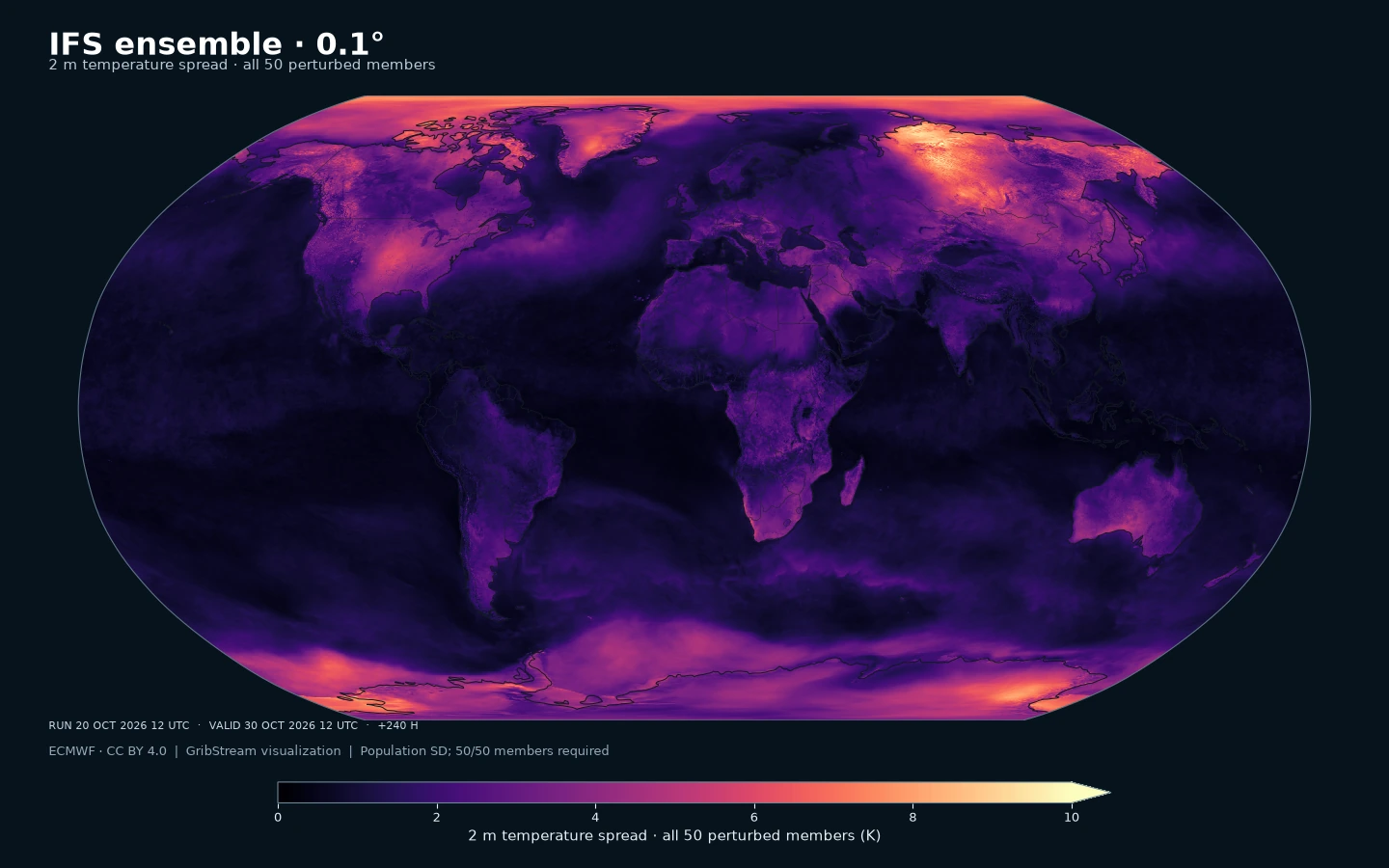
ifsenfo0p1 · 2 m temperature spread in K, calculated by GribStream as population standard deviation across all 50 perturbed members; cells require 50 valid values. Historical example: run 20 October 2026 12 UTC; valid 30 October 2026 12 UTC (+240 h). Nearest-cell rendering of the 0.1° output grid. Source: ECMWF, CC BY 4.0; visualization: GribStream.
About this forecast
Explore 50 ECMWF IFS ensemble members at 0.1° for global weather scenarios, forecast uncertainty and surface, soil and upper-air guidance to 15 days.
What is ECMWF IFS?
IFS stands for Integrated Forecasting System. Developed by the European Centre for Medium-Range Weather Forecasts (ECMWF) in cooperation with Météo-France, it combines observations through data assimilation and advances a global Earth-system model using physical equations. Its atmosphere, land, ocean and wave components exchange information. These products belong to the short- and medium-range forecast family, extending to 15 days; ECMWF also develops the separate, machine-learning-based AIFS family. ECMWF documentation.
What this product is for
ENS is ECMWF’s ensemble forecast. Each perturbed member starts from a slightly different initial state and represents uncertainty in model physics. Together they describe plausible weather scenarios. GribStream exposes members 1–50 here; the unperturbed control is in the deterministic dataset. Member-by-member output supports custom percentiles, event probabilities and scenario analysis. ECMWF documentation.
57 parameters and 180 parameter/level combinations per member, including surface weather, four soil layers and upper-air fields on 14 pressure levels.
Members retain coherent forecast trajectories. For threshold or impact calculations, evaluate each member before summarizing the results. Published mean, spread and probabilities are also available as separate datasets.
The 0.1° latitude–longitude grid samples the same IFS forecast as the 0.25° products. It has 3,600 × 1,801 points, with about 11 km north–south spacing. ECMWF’s atmospheric model runs at approximately 9 km. Finer output spacing preserves more spatial detail but does not itself establish local accuracy. The 0.1° distribution follows 0.25° by about two hours. ECMWF documentation.
Resolution: 0.1° · 3600 × 1801
Temporal coverage: 00 and 12 UTC: +0–144 h every 3 h, then +150–360 h every 6 h (15 days). 06 and 18 UTC: +0–144 h every 3 h (6 days). Cycle times are initializations; delivery follows later.
Primary uses: Weather-risk assessment, energy portfolio scenarios, agricultural exposure and uncertainty-aware planning.
00 and 12 UTC: +0–144 h every 3 h, then +150–360 h every 6 h (15 days). 06 and 18 UTC: +0–144 h every 3 h (6 days). Cycle times are initializations; delivery follows later.
Maximum 3‑second wind gust at 10 m height over the previous 3 hours.
ECMWF estimates gusts within each time step using surface stress, friction, wind shear, and stability, then selects the maximum over the 3‑hour window.
Comparisons to observations require care because observations are point measurements.
Lowest 2 m temperature observed over the previous 3 hours.
2 m temperature is derived by interpolating between the lowest model level and the surface.
Units are kelvin (K); to convert to degrees Celsius (deg C), subtract 273.15.
Completed three-hour temperature extrema start at +3h. Anomalous +0h source records are excluded: the audited launch cycles contain 0 K placeholders with contradictory interval metadata. Timeseries can select a prior run's completed interval when eligible under asOf and lead bounds; otherwise it remains missing. Completed intervals and initialization exclusions
Level
Info
Horizon
Selector
sfc
3h-144h
{"name":"mn2t3","level":"sfc","info":""}
mn2t6–Minimum temperature at 2 metres in the last 6 hours (K)
Highest 2 m temperature observed over the previous 3 hours.
2 m temperature is derived by interpolating between the lowest model level and the surface.
Units are kelvin (K); to convert to degrees Celsius (deg C), subtract 273.15.
Completed three-hour temperature extrema start at +3h. Anomalous +0h source records are excluded: the audited launch cycles contain 0 K placeholders with contradictory interval metadata. Timeseries can select a prior run's completed interval when eligible under asOf and lead bounds; otherwise it remains missing. Completed intervals and initialization exclusions
Level
Info
Horizon
Selector
sfc
3h-144h
{"name":"mx2t3","level":"sfc","info":""}
mx2t6–Maximum temperature at 2 metres in the last 6 hours (K)