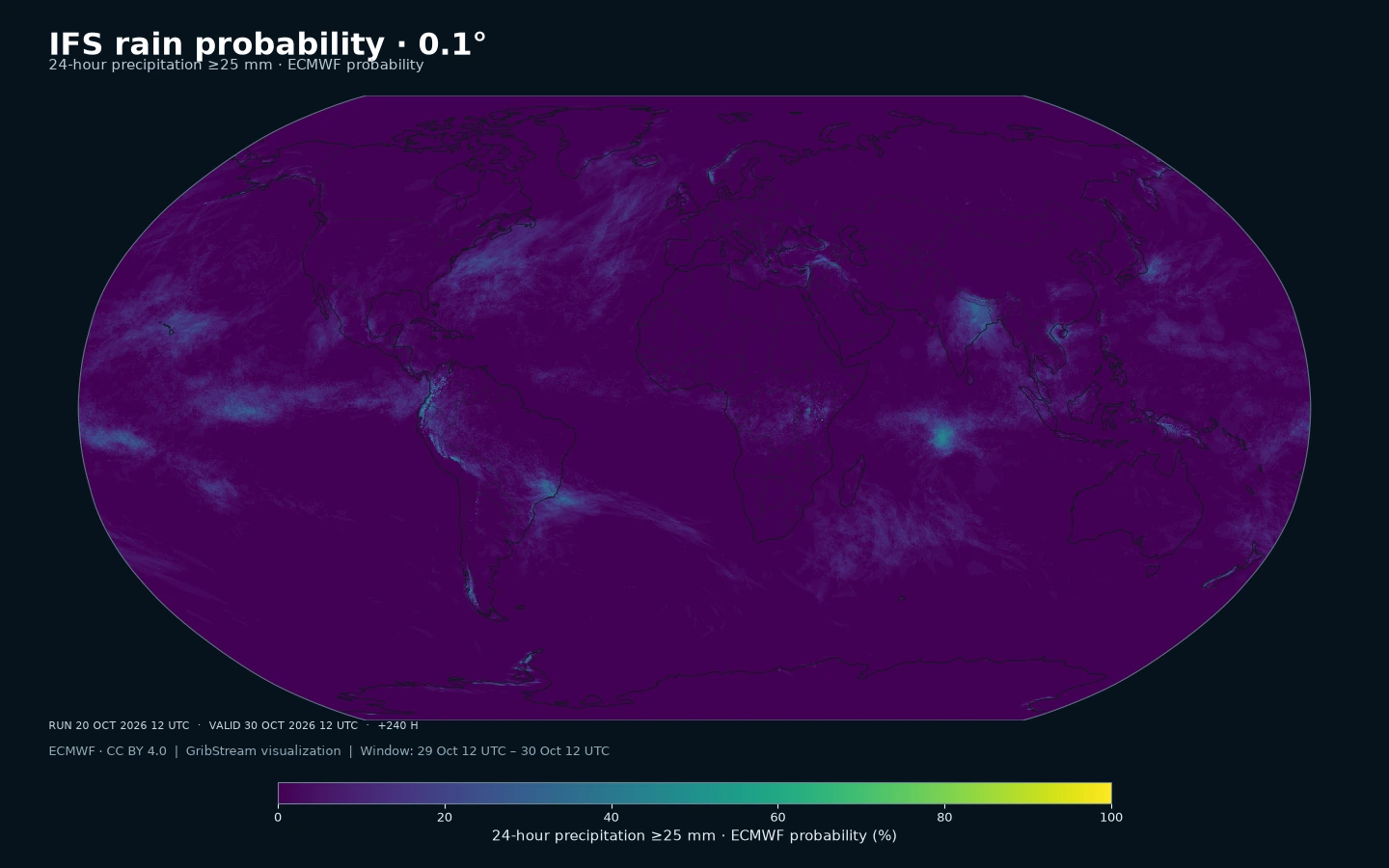
ifsenfoprob0p1 · ECMWF probability (%) of at least 25 mm precipitation during 29 October 12 UTC–30 October 12 UTC (24 hours). Historical example: run 20 October 2026 12 UTC; valid 30 October 2026 12 UTC (+240 h). Nearest-cell rendering of the 0.1° output grid. Source: ECMWF, CC BY 4.0; visualization: GribStream.
About this forecast
ECMWF weather-event probabilities at 0.1° for 24-hour rain and gust thresholds and 850 hPa temperature anomalies, with guidance to 15 days.
What is ECMWF IFS?
IFS stands for Integrated Forecasting System. Developed by the European Centre for Medium-Range Weather Forecasts (ECMWF) in cooperation with Météo-France, it combines observations through data assimilation and advances a global Earth-system model using physical equations. Its atmosphere, land, ocean and wave components exchange information. These products belong to the short- and medium-range forecast family, extending to 15 days; ECMWF also develops the separate, machine-learning-based AIFS family. ECMWF documentation.
What this product is for
This product turns the IFS ensemble into probabilities for defined weather events. It answers threshold questions directly, such as the chance of at least 25 mm of rain in a 24-hour period. Temperature-anomaly probabilities describe departures from model climatology at 850 hPa, helping identify unusually warm or cold air masses. ECMWF documentation.
16 probability fields: seven precipitation thresholds (1–100 mm), three 10 m gust thresholds (10, 15 and 25 m/s), and six temperature-anomaly thresholds (±1, ±1.5 and ±2 standard deviations).
Values are percentages from 0 to 100. Daily rain and gust events use info="24h" with the timestamp at the window’s end. Instantaneous anomaly events use empty info. Anomaly thresholds are standardized departures, not degrees Celsius.
The 0.1° latitude–longitude grid samples the same IFS forecast as the 0.25° products. It has 3,600 × 1,801 points, with about 11 km north–south spacing. ECMWF’s atmospheric model runs at approximately 9 km. Finer output spacing preserves more spatial detail but does not itself establish local accuracy. The 0.1° distribution follows 0.25° by about two hours. ECMWF documentation.
Resolution: 0.1° · 3600 × 1801
Temporal coverage: 00 and 12 UTC, every 12 h to +360 h. Instantaneous events begin at +12 h; 24-hour events end at +24, +36, …, +360 h, so adjacent windows overlap by 12 h.
Primary uses: Rain and wind risk screening, threshold-based alerts and medium-range warm/cold anomaly outlooks.
00 and 12 UTC, every 12 h to +360 h. Instantaneous events begin at +12 h; 24-hour events end at +24, +36, …, +360 h, so adjacent windows overlap by 12 h.
Percentage of the ensemble reaching the stated gust threshold over the preceding 24 hours.
Values are percentages (0–100). Daily event selectors use info=24h and are timestamped at the end of a rolling 24-hour window; consecutive windows overlap by 12 hours. Instantaneous anomaly selectors use empty info.
Level
Info
Horizon
Selector
sfc
24h
24h-360h
{"name":"10fgg10","level":"sfc","info":"24h"}
10fgg15–Probability of 24-hour maximum 10 m wind gust at least 15 m/s (%)
Percentage of the ensemble reaching the stated gust threshold over the preceding 24 hours.
Values are percentages (0–100). Daily event selectors use info=24h and are timestamped at the end of a rolling 24-hour window; consecutive windows overlap by 12 hours. Instantaneous anomaly selectors use empty info.
Level
Info
Horizon
Selector
sfc
24h
24h-360h
{"name":"10fgg15","level":"sfc","info":"24h"}
10fgg25–Probability of 24-hour maximum 10 m wind gust at least 25 m/s (%)
Percentage of the ensemble reaching the stated gust threshold over the preceding 24 hours.
Values are percentages (0–100). Daily event selectors use info=24h and are timestamped at the end of a rolling 24-hour window; consecutive windows overlap by 12 hours. Instantaneous anomaly selectors use empty info.
Level
Info
Horizon
Selector
sfc
24h
24h-360h
{"name":"10fgg25","level":"sfc","info":"24h"}
ptsa_gt_1p5stdev–Probability of temperature standardized anomaly greater than 1.5 standard deviations (%)
Instantaneous probability at 850 hPa, expressed in percent. The threshold applies to the standardized anomaly, not absolute temperature.
Values are percentages (0–100). Daily event selectors use info=24h and are timestamped at the end of a rolling 24-hour window; consecutive windows overlap by 12 hours. Instantaneous anomaly selectors use empty info.
Percentage of the ensemble reaching the stated precipitation threshold over the preceding 24 hours.
Values are percentages (0–100). Daily event selectors use info=24h and are timestamped at the end of a rolling 24-hour window; consecutive windows overlap by 12 hours. Instantaneous anomaly selectors use empty info.
Level
Info
Horizon
Selector
sfc
24h
24h-360h
{"name":"tpg1","level":"sfc","info":"24h"}
tpg10–Probability of 24-hour total precipitation at least 10 mm (%)
Percentage of the ensemble reaching the stated precipitation threshold over the preceding 24 hours.
Values are percentages (0–100). Daily event selectors use info=24h and are timestamped at the end of a rolling 24-hour window; consecutive windows overlap by 12 hours. Instantaneous anomaly selectors use empty info.
Level
Info
Horizon
Selector
sfc
24h
24h-360h
{"name":"tpg10","level":"sfc","info":"24h"}
tpg100–Probability of 24-hour total precipitation at least 100 mm (%)
Percentage of the ensemble reaching the stated precipitation threshold over the preceding 24 hours.
Values are percentages (0–100). Daily event selectors use info=24h and are timestamped at the end of a rolling 24-hour window; consecutive windows overlap by 12 hours. Instantaneous anomaly selectors use empty info.
Level
Info
Horizon
Selector
sfc
24h
24h-360h
{"name":"tpg100","level":"sfc","info":"24h"}
tpg20–Probability of 24-hour total precipitation at least 20 mm (%)
Percentage of the ensemble reaching the stated precipitation threshold over the preceding 24 hours.
Values are percentages (0–100). Daily event selectors use info=24h and are timestamped at the end of a rolling 24-hour window; consecutive windows overlap by 12 hours. Instantaneous anomaly selectors use empty info.
Level
Info
Horizon
Selector
sfc
24h
24h-360h
{"name":"tpg20","level":"sfc","info":"24h"}
tpg25–Probability of 24-hour total precipitation at least 25 mm (%)
Percentage of the ensemble reaching the stated precipitation threshold over the preceding 24 hours.
Values are percentages (0–100). Daily event selectors use info=24h and are timestamped at the end of a rolling 24-hour window; consecutive windows overlap by 12 hours. Instantaneous anomaly selectors use empty info.
Level
Info
Horizon
Selector
sfc
24h
24h-360h
{"name":"tpg25","level":"sfc","info":"24h"}
tpg5–Probability of 24-hour total precipitation at least 5 mm (%)
Percentage of the ensemble reaching the stated precipitation threshold over the preceding 24 hours.
Values are percentages (0–100). Daily event selectors use info=24h and are timestamped at the end of a rolling 24-hour window; consecutive windows overlap by 12 hours. Instantaneous anomaly selectors use empty info.
Level
Info
Horizon
Selector
sfc
24h
24h-360h
{"name":"tpg5","level":"sfc","info":"24h"}
tpg50–Probability of 24-hour total precipitation at least 50 mm (%)
Percentage of the ensemble reaching the stated precipitation threshold over the preceding 24 hours.
Values are percentages (0–100). Daily event selectors use info=24h and are timestamped at the end of a rolling 24-hour window; consecutive windows overlap by 12 hours. Instantaneous anomaly selectors use empty info.