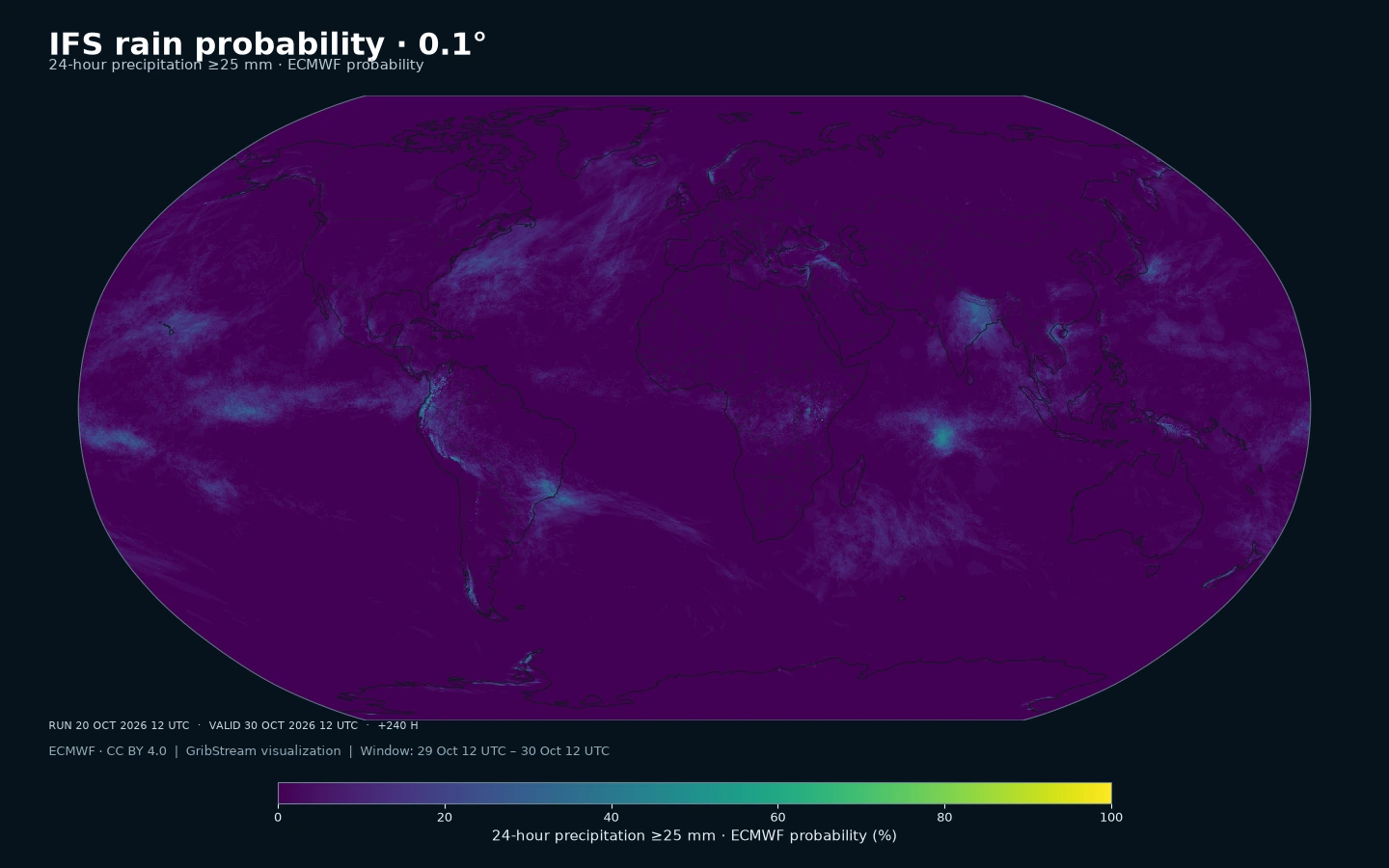
ifsenfoprob0p1 · ECMWF-Wahrscheinlichkeit (%) für mindestens 25 mm Niederschlag vom 29. Oktober 12 UTC bis 30. Oktober 12 UTC (24 Stunden). Historisches Beispiel: Lauf vom 20. Oktober 2026, 12 UTC; gültig am 30. Oktober, 12 UTC (+240 h). Darstellung mit der nächstgelegenen Zelle des 0.1°-Ausgabegitters. Quelle: ECMWF, CC BY 4.0; Grafik: GribStream.
Über diese Vorhersage
ECMWF-Wahrscheinlichkeiten mit 0.1° für 24-Stunden-Regen und Böen sowie Temperaturanomalien auf 850 hPa bis 15 Tage.
Was ist ECMWF IFS?
IFS steht für Integrated Forecasting System. Das Europäische Zentrum für mittelfristige Wettervorhersage (EZMW, englisch ECMWF) entwickelt es in Zusammenarbeit mit Météo-France. Datenassimilation verbindet Beobachtungen mit dem Modellzustand; physikalische Gleichungen beschreiben die weitere Entwicklung des Erdsystems. Atmosphäre, Land, Ozean und Wellen tauschen dabei Informationen aus. Diese Produkte gehören zur kurz- und mittelfristigen Vorhersage bis 15 Tage. Daneben entwickelt das EZMW die auf maschinellem Lernen basierende AIFS-Familie. ECMWF-Dokumentation.
Wofür sich dieses Produkt eignet
Dieses Produkt fasst das IFS-Ensemble für definierte Ereignisse zusammen, beispielsweise mindestens 25 mm Regen in 24 Stunden. Temperaturanomalien auf 850 hPa sind Abweichungen von der Modellklimatologie und zeigen ungewöhnlich warme oder kalte Luftmassen. ECMWF-Dokumentation.
16 Felder: sieben Niederschlagsschwellen (1–100 mm), drei 10-m-Böenschwellen (10, 15 und 25 m/s) und sechs Temperaturanomalien (±1, ±1.5 und ±2 Standardabweichungen).
Werte von 0 bis 100%. Regen und Böen verwenden info="24h" mit dem Zeitpunkt am Fensterende; momentane Anomalien verwenden leeres info. Anomalieschwellen sind keine Celsiuswerte.
Das 0.1°-Breiten-Längen-Gitter bildet dieselbe IFS-Vorhersage ab wie die 0.25°-Produkte. Es umfasst 3.600 × 1.801 Punkte mit etwa 11 km Abstand in Nord-Süd-Richtung. Das Atmosphärenmodell rechnet mit rund 9 km Auflösung. Das feinere Ausgabegitter erhält mehr räumliche Details, belegt aber allein keine höhere lokale Genauigkeit. Die 0.1°-Daten folgen der 0.25°-Verteilung etwa zwei Stunden später. ECMWF-Dokumentation.
Auflösung: 0.1° · 3600 × 1801
Zeitliche Abdeckung: 00 und 12 UTC, alle 12 h bis +360 h. Momentane Ereignisse beginnen bei +12 h; 24-Stunden-Fenster enden bei +24, +36, …, +360 h und überlappen sich um 12 h.
Hauptanwendungen: Regen- und Windrisiken, schwellenbasierte Hinweise und mittelfristige Wärme- oder Kälteanomalien.
00 und 12 UTC, alle 12 h bis +360 h. Momentane Ereignisse beginnen bei +12 h; 24-Stunden-Fenster enden bei +24, +36, …, +360 h und überlappen sich um 12 h.
Klicken Sie auf einen Parameter, um Varianten in einer kompakten Tabelle mit kopierbaren JSON-Selektoren zu sehen. Codes, Levels und Selector-Werte bleiben exakt so, wie die API sie ausgibt.
10fgg10–Probability of 24-hour maximum 10 m wind gust at least 10 m/s (%)
Percentage of the ensemble reaching the stated gust threshold over the preceding 24 hours.
Values are percentages (0–100). Daily event selectors use info=24h and are timestamped at the end of a rolling 24-hour window; consecutive windows overlap by 12 hours. Instantaneous anomaly selectors use empty info.
Level
Info
Horizon
Selector
sfc
24h
24h-360h
{"name":"10fgg10","level":"sfc","info":"24h"}
10fgg15–Probability of 24-hour maximum 10 m wind gust at least 15 m/s (%)
Percentage of the ensemble reaching the stated gust threshold over the preceding 24 hours.
Values are percentages (0–100). Daily event selectors use info=24h and are timestamped at the end of a rolling 24-hour window; consecutive windows overlap by 12 hours. Instantaneous anomaly selectors use empty info.
Level
Info
Horizon
Selector
sfc
24h
24h-360h
{"name":"10fgg15","level":"sfc","info":"24h"}
10fgg25–Probability of 24-hour maximum 10 m wind gust at least 25 m/s (%)
Percentage of the ensemble reaching the stated gust threshold over the preceding 24 hours.
Values are percentages (0–100). Daily event selectors use info=24h and are timestamped at the end of a rolling 24-hour window; consecutive windows overlap by 12 hours. Instantaneous anomaly selectors use empty info.
Level
Info
Horizon
Selector
sfc
24h
24h-360h
{"name":"10fgg25","level":"sfc","info":"24h"}
ptsa_gt_1p5stdev–Probability of temperature standardized anomaly greater than 1.5 standard deviations (%)
Instantaneous probability at 850 hPa, expressed in percent. The threshold applies to the standardized anomaly, not absolute temperature.
Values are percentages (0–100). Daily event selectors use info=24h and are timestamped at the end of a rolling 24-hour window; consecutive windows overlap by 12 hours. Instantaneous anomaly selectors use empty info.
Percentage of the ensemble reaching the stated precipitation threshold over the preceding 24 hours.
Values are percentages (0–100). Daily event selectors use info=24h and are timestamped at the end of a rolling 24-hour window; consecutive windows overlap by 12 hours. Instantaneous anomaly selectors use empty info.
Level
Info
Horizon
Selector
sfc
24h
24h-360h
{"name":"tpg1","level":"sfc","info":"24h"}
tpg10–Probability of 24-hour total precipitation at least 10 mm (%)
Percentage of the ensemble reaching the stated precipitation threshold over the preceding 24 hours.
Values are percentages (0–100). Daily event selectors use info=24h and are timestamped at the end of a rolling 24-hour window; consecutive windows overlap by 12 hours. Instantaneous anomaly selectors use empty info.
Level
Info
Horizon
Selector
sfc
24h
24h-360h
{"name":"tpg10","level":"sfc","info":"24h"}
tpg100–Probability of 24-hour total precipitation at least 100 mm (%)
Percentage of the ensemble reaching the stated precipitation threshold over the preceding 24 hours.
Values are percentages (0–100). Daily event selectors use info=24h and are timestamped at the end of a rolling 24-hour window; consecutive windows overlap by 12 hours. Instantaneous anomaly selectors use empty info.
Level
Info
Horizon
Selector
sfc
24h
24h-360h
{"name":"tpg100","level":"sfc","info":"24h"}
tpg20–Probability of 24-hour total precipitation at least 20 mm (%)
Percentage of the ensemble reaching the stated precipitation threshold over the preceding 24 hours.
Values are percentages (0–100). Daily event selectors use info=24h and are timestamped at the end of a rolling 24-hour window; consecutive windows overlap by 12 hours. Instantaneous anomaly selectors use empty info.
Level
Info
Horizon
Selector
sfc
24h
24h-360h
{"name":"tpg20","level":"sfc","info":"24h"}
tpg25–Probability of 24-hour total precipitation at least 25 mm (%)
Percentage of the ensemble reaching the stated precipitation threshold over the preceding 24 hours.
Values are percentages (0–100). Daily event selectors use info=24h and are timestamped at the end of a rolling 24-hour window; consecutive windows overlap by 12 hours. Instantaneous anomaly selectors use empty info.
Level
Info
Horizon
Selector
sfc
24h
24h-360h
{"name":"tpg25","level":"sfc","info":"24h"}
tpg5–Probability of 24-hour total precipitation at least 5 mm (%)
Percentage of the ensemble reaching the stated precipitation threshold over the preceding 24 hours.
Values are percentages (0–100). Daily event selectors use info=24h and are timestamped at the end of a rolling 24-hour window; consecutive windows overlap by 12 hours. Instantaneous anomaly selectors use empty info.
Level
Info
Horizon
Selector
sfc
24h
24h-360h
{"name":"tpg5","level":"sfc","info":"24h"}
tpg50–Probability of 24-hour total precipitation at least 50 mm (%)
Percentage of the ensemble reaching the stated precipitation threshold over the preceding 24 hours.
Values are percentages (0–100). Daily event selectors use info=24h and are timestamped at the end of a rolling 24-hour window; consecutive windows overlap by 12 hours. Instantaneous anomaly selectors use empty info.