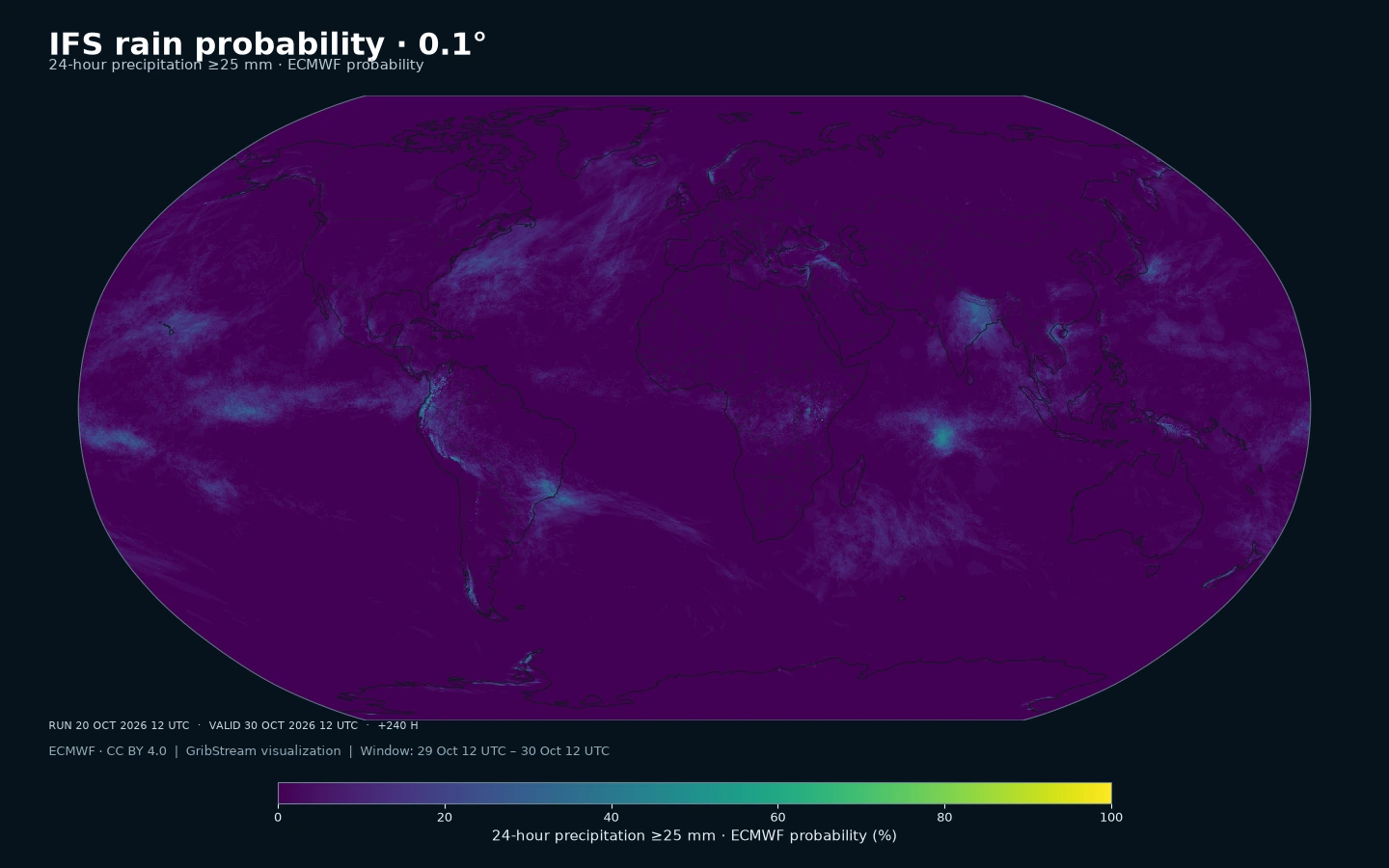
ifsenfoprob0p1 · Probabilité ECMWF (%) d’au moins 25 mm de précipitations du 29 octobre à 12 UTC au 30 octobre à 12 UTC (24 heures). Exemple historique : cycle du 20 octobre 2026 à 12 UTC ; valide le 30 octobre à 12 UTC (+240 h). Rendu par cellule la plus proche sur la grille de 0.1°. Source : ECMWF, CC BY 4.0 ; visualisation : GribStream.
À propos de cette prévision
Probabilités ECMWF à 0.1° de pluie et de rafales sur 24 heures et d’anomalies thermiques à 850 hPa, jusqu’à 15 jours.
Qu’est-ce que l’IFS du CEPMMT ?
IFS signifie Integrated Forecasting System, ou système intégré de prévision. Développé par le Centre européen pour les prévisions météorologiques à moyen terme (CEPMMT, ECMWF en anglais) en coopération avec Météo-France, il assimile les observations et simule l’évolution du système Terre à l’aide d’équations physiques. Ses composantes atmosphère, sol, océan et vagues échangent des informations. Ces produits couvrent le court et le moyen terme, jusqu’à 15 jours ; le CEPMMT développe aussi la famille AIFS, fondée sur l’apprentissage automatique. Documentation du CEPMMT.
À quoi sert ce produit ?
Ce produit exprime l’ensemble IFS en probabilités d’événements définis, par exemple au moins 25 mm de pluie en 24 heures. Les anomalies de température à 850 hPa décrivent un écart à la climatologie du modèle et repèrent les masses d’air inhabituellement chaudes ou froides. Documentation du CEPMMT.
16 champs : sept seuils de pluie (1–100 mm), trois seuils de rafales à 10 m (10, 15 et 25 m/s) et six anomalies thermiques (±1, ±1.5 et ±2 écarts-types).
Valeurs de 0 à 100%. Pluie et rafales utilisent info="24h", avec l’heure de fin de période ; les anomalies instantanées utilisent info vide. Les seuils d’anomalie ne sont pas des degrés Celsius.
La grille latitude–longitude de 0.1° représente la même prévision IFS que les produits à 0.25°. Elle compte 3 600 × 1 801 points, espacés d’environ 11 km du nord au sud. Le modèle atmosphérique fonctionne à environ 9 km. La sortie plus fine conserve davantage de détails spatiaux, sans démontrer à elle seule une meilleure précision locale. La distribution à 0.1° suit celle à 0.25° d’environ deux heures. Documentation du CEPMMT.
Résolution: 0.1° · 3600 × 1801
Couverture temporelle: 00 et 12 UTC, toutes les 12 h jusqu’à +360 h. Les événements instantanés commencent à +12 h ; les périodes de 24 heures se terminent à +24, +36, …, +360 h et se chevauchent sur 12 h.
Usages principaux: Évaluation des risques de pluie et de vent, alertes par seuil et perspectives d’anomalies chaudes ou froides.
00 et 12 UTC, toutes les 12 h jusqu’à +360 h. Les événements instantanés commencent à +12 h ; les périodes de 24 heures se terminent à +24, +36, …, +360 h et se chevauchent sur 12 h.
Cliquez sur un paramètre pour voir ses variantes dans une table compacte avec des sélecteurs JSON prêts à copier. Les codes, niveaux et valeurs de sélecteur restent exactement tels que l'API les expose.
10fgg10–Probability of 24-hour maximum 10 m wind gust at least 10 m/s (%)
Percentage of the ensemble reaching the stated gust threshold over the preceding 24 hours.
Values are percentages (0–100). Daily event selectors use info=24h and are timestamped at the end of a rolling 24-hour window; consecutive windows overlap by 12 hours. Instantaneous anomaly selectors use empty info.
Level
Info
Horizon
Selector
sfc
24h
24h-360h
{"name":"10fgg10","level":"sfc","info":"24h"}
10fgg15–Probability of 24-hour maximum 10 m wind gust at least 15 m/s (%)
Percentage of the ensemble reaching the stated gust threshold over the preceding 24 hours.
Values are percentages (0–100). Daily event selectors use info=24h and are timestamped at the end of a rolling 24-hour window; consecutive windows overlap by 12 hours. Instantaneous anomaly selectors use empty info.
Level
Info
Horizon
Selector
sfc
24h
24h-360h
{"name":"10fgg15","level":"sfc","info":"24h"}
10fgg25–Probability of 24-hour maximum 10 m wind gust at least 25 m/s (%)
Percentage of the ensemble reaching the stated gust threshold over the preceding 24 hours.
Values are percentages (0–100). Daily event selectors use info=24h and are timestamped at the end of a rolling 24-hour window; consecutive windows overlap by 12 hours. Instantaneous anomaly selectors use empty info.
Level
Info
Horizon
Selector
sfc
24h
24h-360h
{"name":"10fgg25","level":"sfc","info":"24h"}
ptsa_gt_1p5stdev–Probability of temperature standardized anomaly greater than 1.5 standard deviations (%)
Instantaneous probability at 850 hPa, expressed in percent. The threshold applies to the standardized anomaly, not absolute temperature.
Values are percentages (0–100). Daily event selectors use info=24h and are timestamped at the end of a rolling 24-hour window; consecutive windows overlap by 12 hours. Instantaneous anomaly selectors use empty info.
Percentage of the ensemble reaching the stated precipitation threshold over the preceding 24 hours.
Values are percentages (0–100). Daily event selectors use info=24h and are timestamped at the end of a rolling 24-hour window; consecutive windows overlap by 12 hours. Instantaneous anomaly selectors use empty info.
Level
Info
Horizon
Selector
sfc
24h
24h-360h
{"name":"tpg1","level":"sfc","info":"24h"}
tpg10–Probability of 24-hour total precipitation at least 10 mm (%)
Percentage of the ensemble reaching the stated precipitation threshold over the preceding 24 hours.
Values are percentages (0–100). Daily event selectors use info=24h and are timestamped at the end of a rolling 24-hour window; consecutive windows overlap by 12 hours. Instantaneous anomaly selectors use empty info.
Level
Info
Horizon
Selector
sfc
24h
24h-360h
{"name":"tpg10","level":"sfc","info":"24h"}
tpg100–Probability of 24-hour total precipitation at least 100 mm (%)
Percentage of the ensemble reaching the stated precipitation threshold over the preceding 24 hours.
Values are percentages (0–100). Daily event selectors use info=24h and are timestamped at the end of a rolling 24-hour window; consecutive windows overlap by 12 hours. Instantaneous anomaly selectors use empty info.
Level
Info
Horizon
Selector
sfc
24h
24h-360h
{"name":"tpg100","level":"sfc","info":"24h"}
tpg20–Probability of 24-hour total precipitation at least 20 mm (%)
Percentage of the ensemble reaching the stated precipitation threshold over the preceding 24 hours.
Values are percentages (0–100). Daily event selectors use info=24h and are timestamped at the end of a rolling 24-hour window; consecutive windows overlap by 12 hours. Instantaneous anomaly selectors use empty info.
Level
Info
Horizon
Selector
sfc
24h
24h-360h
{"name":"tpg20","level":"sfc","info":"24h"}
tpg25–Probability of 24-hour total precipitation at least 25 mm (%)
Percentage of the ensemble reaching the stated precipitation threshold over the preceding 24 hours.
Values are percentages (0–100). Daily event selectors use info=24h and are timestamped at the end of a rolling 24-hour window; consecutive windows overlap by 12 hours. Instantaneous anomaly selectors use empty info.
Level
Info
Horizon
Selector
sfc
24h
24h-360h
{"name":"tpg25","level":"sfc","info":"24h"}
tpg5–Probability of 24-hour total precipitation at least 5 mm (%)
Percentage of the ensemble reaching the stated precipitation threshold over the preceding 24 hours.
Values are percentages (0–100). Daily event selectors use info=24h and are timestamped at the end of a rolling 24-hour window; consecutive windows overlap by 12 hours. Instantaneous anomaly selectors use empty info.
Level
Info
Horizon
Selector
sfc
24h
24h-360h
{"name":"tpg5","level":"sfc","info":"24h"}
tpg50–Probability of 24-hour total precipitation at least 50 mm (%)
Percentage of the ensemble reaching the stated precipitation threshold over the preceding 24 hours.
Values are percentages (0–100). Daily event selectors use info=24h and are timestamped at the end of a rolling 24-hour window; consecutive windows overlap by 12 hours. Instantaneous anomaly selectors use empty info.