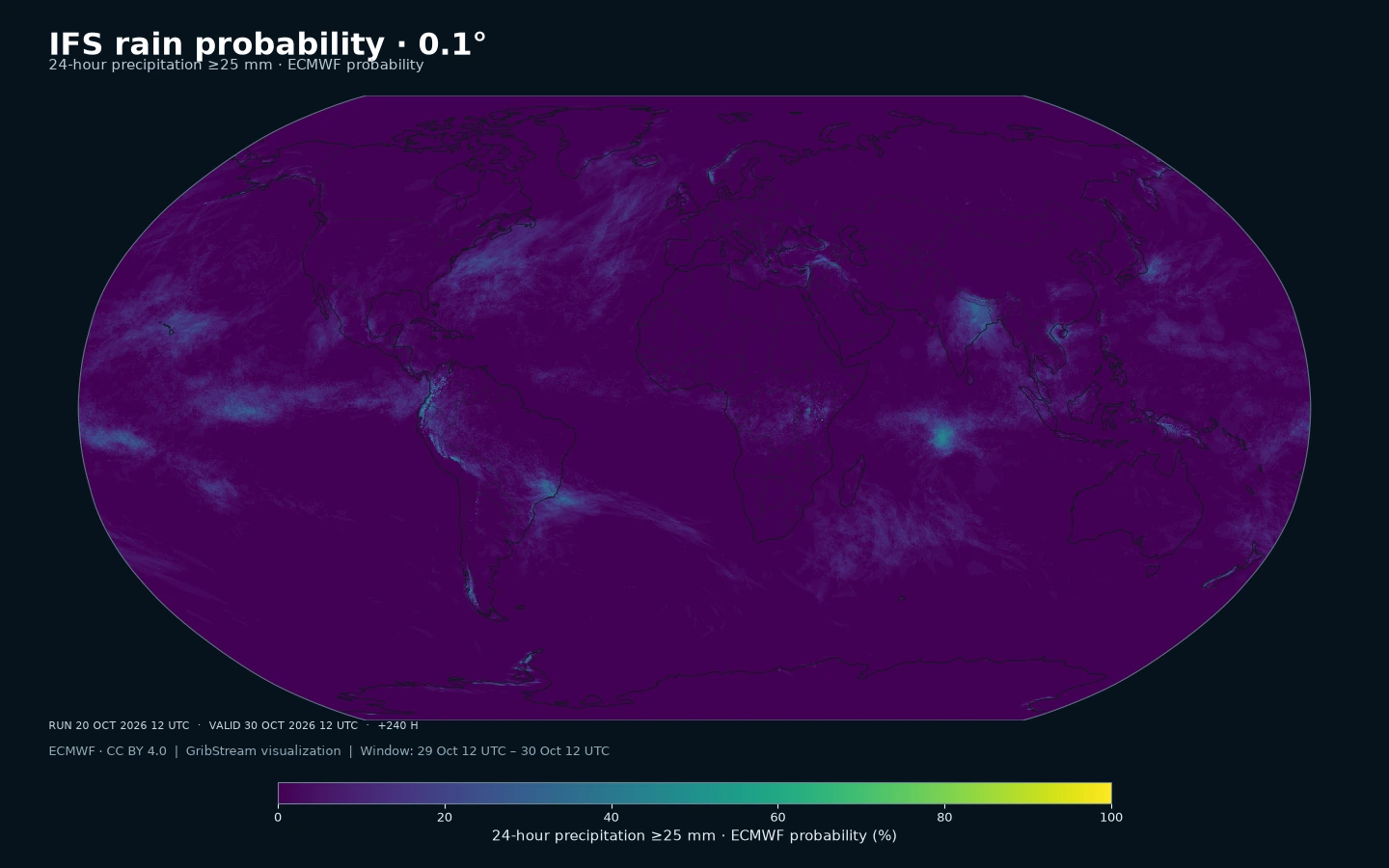
ifsenfoprob0p1 · Probabilidad ECMWF (%) de al menos 25 mm de precipitación entre el 29 de octubre a las 12 UTC y el 30 a las 12 UTC (24 horas). Ejemplo histórico: ciclo del 20 de octubre de 2026 a las 12 UTC; válido el 30 de octubre a las 12 UTC (+240 h). Representación por celda más cercana de la grilla de 0.1°. Fuente: ECMWF, CC BY 4.0; gráfico: GribStream.
Sobre este pronóstico
Probabilidades ECMWF a 0.1° de lluvia y ráfagas en 24 horas y anomalías de temperatura a 850 hPa, hasta 15 días.
¿Qué es ECMWF IFS?
IFS significa Integrated Forecasting System, o Sistema Integrado de Predicción. Lo desarrolla el Centro Europeo de Predicción Meteorológica a Plazo Medio (ECMWF) en colaboración con Météo-France. Integra observaciones mediante asimilación de datos y calcula la evolución del sistema terrestre con ecuaciones físicas. Sus componentes de atmósfera, suelo, océano y oleaje intercambian información. Estos productos cubren el corto y medio plazo, hasta 15 días; ECMWF también desarrolla la familia AIFS, basada en aprendizaje automático. Documentación de ECMWF.
Para qué sirve este producto
Este producto resume el ensemble IFS como probabilidades de eventos definidos, por ejemplo al menos 25 mm de lluvia en 24 horas. Las anomalías térmicas expresan desviaciones respecto de la climatología del modelo a 850 hPa, útiles para identificar masas de aire inusualmente cálidas o frías. Documentación de ECMWF.
16 campos: siete umbrales de precipitación (1–100 mm), tres de ráfagas a 10 m (10, 15 y 25 m/s) y seis de anomalía térmica (±1, ±1.5 y ±2 desviaciones estándar).
Valores de 0 a 100%. Los eventos de lluvia y ráfagas usan info="24h" y la hora final del intervalo; las anomalías instantáneas usan info vacío. Los umbrales de anomalía no se expresan en grados Celsius.
La grilla de latitud y longitud de 0.1° representa el mismo pronóstico IFS que los productos de 0.25°. Contiene 3.600 × 1.801 puntos, separados unos 11 km de norte a sur. El modelo atmosférico trabaja a unos 9 km. La salida más fina conserva más detalle espacial, pero por sí sola no demuestra mayor precisión local. La distribución de 0.1° llega unas dos horas después de la de 0.25°. Documentación de ECMWF.
Resolución: 0.1° · 3600 × 1801
Cobertura temporal: 00 y 12 UTC, cada 12 h hasta +360 h. Los eventos instantáneos empiezan en +12 h; los de 24 horas terminan en +24, +36, …, +360 h, con 12 h de superposición entre ventanas.
Usos principales: Evaluación de riesgo de lluvia y viento, alertas por umbral y perspectivas de anomalías cálidas o frías.
00 y 12 UTC, cada 12 h hasta +360 h. Los eventos instantáneos empiezan en +12 h; los de 24 horas terminan en +24, +36, …, +360 h, con 12 h de superposición entre ventanas.
Haz clic en un parámetro para ver sus variantes en una tabla compacta con selectores JSON listos para copiar. Los códigos, niveles y valores de selector se mantienen exactamente como los expone la API.
10fgg10–Probability of 24-hour maximum 10 m wind gust at least 10 m/s (%)
Percentage of the ensemble reaching the stated gust threshold over the preceding 24 hours.
Values are percentages (0–100). Daily event selectors use info=24h and are timestamped at the end of a rolling 24-hour window; consecutive windows overlap by 12 hours. Instantaneous anomaly selectors use empty info.
Level
Info
Horizon
Selector
sfc
24h
24h-360h
{"name":"10fgg10","level":"sfc","info":"24h"}
10fgg15–Probability of 24-hour maximum 10 m wind gust at least 15 m/s (%)
Percentage of the ensemble reaching the stated gust threshold over the preceding 24 hours.
Values are percentages (0–100). Daily event selectors use info=24h and are timestamped at the end of a rolling 24-hour window; consecutive windows overlap by 12 hours. Instantaneous anomaly selectors use empty info.
Level
Info
Horizon
Selector
sfc
24h
24h-360h
{"name":"10fgg15","level":"sfc","info":"24h"}
10fgg25–Probability of 24-hour maximum 10 m wind gust at least 25 m/s (%)
Percentage of the ensemble reaching the stated gust threshold over the preceding 24 hours.
Values are percentages (0–100). Daily event selectors use info=24h and are timestamped at the end of a rolling 24-hour window; consecutive windows overlap by 12 hours. Instantaneous anomaly selectors use empty info.
Level
Info
Horizon
Selector
sfc
24h
24h-360h
{"name":"10fgg25","level":"sfc","info":"24h"}
ptsa_gt_1p5stdev–Probability of temperature standardized anomaly greater than 1.5 standard deviations (%)
Instantaneous probability at 850 hPa, expressed in percent. The threshold applies to the standardized anomaly, not absolute temperature.
Values are percentages (0–100). Daily event selectors use info=24h and are timestamped at the end of a rolling 24-hour window; consecutive windows overlap by 12 hours. Instantaneous anomaly selectors use empty info.
Percentage of the ensemble reaching the stated precipitation threshold over the preceding 24 hours.
Values are percentages (0–100). Daily event selectors use info=24h and are timestamped at the end of a rolling 24-hour window; consecutive windows overlap by 12 hours. Instantaneous anomaly selectors use empty info.
Level
Info
Horizon
Selector
sfc
24h
24h-360h
{"name":"tpg1","level":"sfc","info":"24h"}
tpg10–Probability of 24-hour total precipitation at least 10 mm (%)
Percentage of the ensemble reaching the stated precipitation threshold over the preceding 24 hours.
Values are percentages (0–100). Daily event selectors use info=24h and are timestamped at the end of a rolling 24-hour window; consecutive windows overlap by 12 hours. Instantaneous anomaly selectors use empty info.
Level
Info
Horizon
Selector
sfc
24h
24h-360h
{"name":"tpg10","level":"sfc","info":"24h"}
tpg100–Probability of 24-hour total precipitation at least 100 mm (%)
Percentage of the ensemble reaching the stated precipitation threshold over the preceding 24 hours.
Values are percentages (0–100). Daily event selectors use info=24h and are timestamped at the end of a rolling 24-hour window; consecutive windows overlap by 12 hours. Instantaneous anomaly selectors use empty info.
Level
Info
Horizon
Selector
sfc
24h
24h-360h
{"name":"tpg100","level":"sfc","info":"24h"}
tpg20–Probability of 24-hour total precipitation at least 20 mm (%)
Percentage of the ensemble reaching the stated precipitation threshold over the preceding 24 hours.
Values are percentages (0–100). Daily event selectors use info=24h and are timestamped at the end of a rolling 24-hour window; consecutive windows overlap by 12 hours. Instantaneous anomaly selectors use empty info.
Level
Info
Horizon
Selector
sfc
24h
24h-360h
{"name":"tpg20","level":"sfc","info":"24h"}
tpg25–Probability of 24-hour total precipitation at least 25 mm (%)
Percentage of the ensemble reaching the stated precipitation threshold over the preceding 24 hours.
Values are percentages (0–100). Daily event selectors use info=24h and are timestamped at the end of a rolling 24-hour window; consecutive windows overlap by 12 hours. Instantaneous anomaly selectors use empty info.
Level
Info
Horizon
Selector
sfc
24h
24h-360h
{"name":"tpg25","level":"sfc","info":"24h"}
tpg5–Probability of 24-hour total precipitation at least 5 mm (%)
Percentage of the ensemble reaching the stated precipitation threshold over the preceding 24 hours.
Values are percentages (0–100). Daily event selectors use info=24h and are timestamped at the end of a rolling 24-hour window; consecutive windows overlap by 12 hours. Instantaneous anomaly selectors use empty info.
Level
Info
Horizon
Selector
sfc
24h
24h-360h
{"name":"tpg5","level":"sfc","info":"24h"}
tpg50–Probability of 24-hour total precipitation at least 50 mm (%)
Percentage of the ensemble reaching the stated precipitation threshold over the preceding 24 hours.
Values are percentages (0–100). Daily event selectors use info=24h and are timestamped at the end of a rolling 24-hour window; consecutive windows overlap by 12 hours. Instantaneous anomaly selectors use empty info.