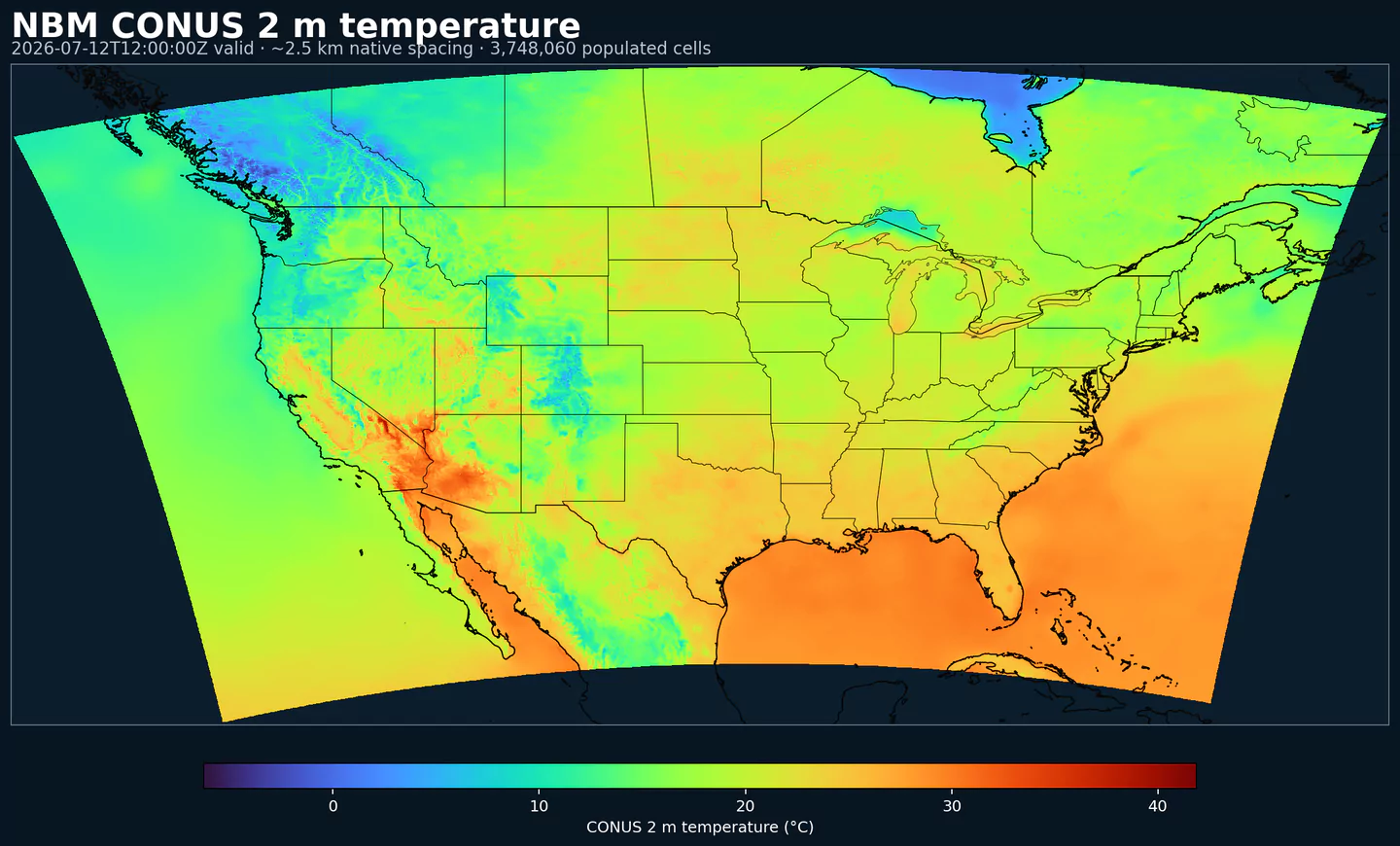
NBM 2 m temperature across the complete populated approximately 2.5 km CONUS product grid shared by these NBM products, with black boundaries. This coverage reference was generated from nbm for the nbmpar page; available variables may differ.
Status: NBM v5 ist in GribStream jetzt unter nbm operativ. In nbm enthalten Läufe vor 2026-05-05 06:00 UTC die vorherige operative NBM-Version; Läufe ab 2026-05-05 06:00 UTC verwenden NBM v5. Für Produktionsintegrationen mit NBM v5 nutzen Sie nbm; die Datasets nbmpar* bleiben für zukünftige experimentelle NBM-Iterationen reserviert, falls NOAA sie wieder über die parallele Linie veröffentlicht.
Der Quell-Bucket ist noaa-nbm-para-pds. GribStream hält die parallele Linie unter eigenen Dataset-Codes, damit Sie sie mit der operativen NBM-Familie vergleichen können, ohne sie mit dem Archiv Ihrer laufenden Integrationen zu vermischen.
NBM Parallel CONUS ist die öffentliche parallele Ausgabe des National Blend of Models für das CONUS-Hauptgrid. Sie ist für Vergleich und Validierung gedacht, wenn NOAA eine experimentelle Linie neben der operativen Version veröffentlicht.
Für Produktion mit NBM v5 ist nbm das empfohlene Dataset. nbmpar bleibt als Vergleichsreferenz und als Platz für zukünftige experimentelle Iterationen erhalten, die NOAA in der parallelen Linie veröffentlichen könnte.
NBM v5 war nicht nur eine Parameteraktualisierung. NOAA erweiterte einen großen Teil der stündlichen Vorhersagebasis von 36 h auf 48 h und überarbeitete die Mischung mit mehr Quantile Mapping, Änderungen bei deterministischem Wind und Böen sowie höher aufgelösten ECMWF- und kanadischen Eingaben.
Für CONUS fügte NBM v5 QM-gewichtete QPF und PoP, neue kalibrierte Schneeschwellen-Wahrscheinlichkeiten für 24/48/72 h, Schneehöhe, deterministisches und probabilistisches precipitable water (niederschlagbares Wasser), gemeinsame Feuerwetter-Wahrscheinlichkeiten und CAPE-Perzentile hinzu.
In GribStream behält nbmpar stabile Selektoren: Die Werte von name, level und info werden exakt aus dem Katalog kopiert und nicht übersetzt.
Ermöglicht den Vergleich der öffentlichen parallelen NBM-Linie mit der operativen Version, wenn NOAA parallele Daten veröffentlicht.
Die Quelle hält nur eine kurze Retention; diese Linie ist für Validierung gedacht, nicht für Produktion oder ein langfristiges historisches Archiv.
Nutzt dieselben GribStream-Endpoints wie die operative NBM-Familie, aber unter eigenem Dataset-Code.
Erhält die Variablencodes, Levels und info-Werte aus dem Katalog von nbmpar.
Auflösung: Ungefähr 2.5 km auf dem CONUS-Grid.
Zeitliche Abdeckung: Stündliche Zyklen; Lead Time (Vorhersagehorizont) von 1 bis 264 h, wenn die Quelle diese Horizonte veröffentlicht. Die parallele Linie bewahrt hauptsächlich die letzten 5 Tage auf.
Hauptanwendungen: Vergleich gegen operatives NBM, Validierung von Versionsänderungen und Prüfung von Niederschlag, Schnee, Wind, Temperatur und Feuerwetterrisiko, bevor eine Integration in Produktion geht.
Klicken Sie auf einen Parameter, um Varianten in einer kompakten Tabelle mit kopierbaren JSON-Selektoren zu sehen. Codes, Levels und Selector-Werte bleiben exakt so, wie die API sie ausgibt.
Accumulated precipitation represents the total water-equivalent amount of rain and snow during the output period. It is a primary field for hydrologic impacts and event totals.
Units: kg/m^2.
Use with the model time interval to interpret totals and compare to gauges.
Apparent temperature combines air temperature, humidity, and wind to estimate how hot or cold it feels to humans. It is useful for heat and cold stress assessments.
Units: K.
Level
Info
Horizon
Introduced
Selector
2 m above ground
1h-264h
5 days ago
{"name":"APTMP","level":"2 m above ground","info":""}
Convective Available Potential Energy (CAPE) quantifies buoyant energy available to rising air parcels. Larger values generally imply stronger potential updrafts and greater convective intensity.
Units: J/kg.
Often used with CIN and lifting mechanisms to assess thunderstorm potential.
Ceiling height is the altitude of the lowest cloud base that covers a significant portion of the sky. It is a key aviation and surface-visibility metric.
Craven-Wiedenfeld aggregate severe parameter combines instability and wind shear to indicate severe weather potential. Higher values suggest a higher risk of organized severe storms.
Distance to feature is the horizontal distance to the named hazard or boundary in the source product. It is used to map proximity to key features like fronts or hazards.
Units: km.
Level
Info
Horizon
Introduced
Selector
surface - 610 m above ground
1h-36h
5 days ago
{"name":"DIST","level":"surface - 610 m above ground","info":""}
Dry thunderstorm probability indicates the chance of thunderstorms with little or no rainfall. It is used for wildfire ignition risk and lightning without wetting rain.
Ellrod index is a diagnostic for clear-air turbulence based on deformation and vertical wind shear. Higher values indicate greater turbulence potential for aviation.
Fosberg fire weather index combines temperature, humidity, and wind to estimate potential fire spread. Higher values indicate more favorable wildfire conditions.
Joint fire weather probability expresses the chance that combined fire-weather criteria are met during the valid period. It is intended for elevated wildfire-spread and rapid-growth risk assessment.
Units: %.
Interpret this as a probability field rather than a categorical flag.
Level
Info
Horizon
Introduced
Selector
surface
1h-264h
5 days ago
{"name":"JFWPRB","level":"surface","info":""}
MAXREF–Hourly Maximum of Simulated Reflectivity at 1 km AGL (dBZ)
Hourly maximum simulated reflectivity at 1 km AGL captures the strongest modeled reflectivity near the surface. It is used to identify peak convective intensity and heavy precipitation cores.
Units: dBZ.
Level
Info
Horizon
Introduced
Selector
1000 m above ground
1h-48h
5 days ago
{"name":"MAXREF","level":"1000 m above ground","info":""}
Coded surface precipitation type derived from model precipitation and near-surface thermodynamics. It distinguishes rain, snow, freezing rain, mixed types, and related categories.
Units: coded.
Interpret together with precipitation rate or accumulation.
Predominant weather encodes the most likely weather type for the grid cell and valid period. It is used for compact categorical weather guidance such as rain, snow, ice, fog, or thunder-related outcomes.
Units: coded.
Code meanings depend on the model or product's weather-category mapping.
Wet bulb globe temperature combines temperature, humidity, radiation, and wind effects into a single heat-stress metric. It is commonly used for outdoor exposure and occupational heat-risk assessment.
Units: K.
Use it as a composite heat-stress indicator rather than a standard air-temperature field.