GribStream

NOAA Global Ensemble Forecast System - Atmospheric Members (GEFS Atmos)

Codice GribStream: gefsatmos

Descrizione

GEFS Atmos è l'ensemble atmosferico globale NOAA/NCEP. Invece di una sola previsione, produce un run di controllo e membri perturbati che descrivono scenari atmosferici plausibili.

In GribStream gefsatmos espone i membri atmosferici globali su griglia da 0.25 gradi. Puoi interrogare singoli membri, confrontare dispersione e costruire probabilità o percentili senza scaricare file GRIB completi.

GEFS è utile quando il prodotto deve comunicare rischio, non solo una traiettoria singola: soglie di precipitazione, vento, temperatura, idrologia, energia, rotte e rischio operativo a medio termine.

Per una previsione centrale più stabile usa GEFS Atmos Mean. Per onde e chimica atmosferica, usa GEFS Wave Prob e GEFS Chem.

Dettagli

Dataset correlati

Parametri

0 parametri

Fai clic su un parametro per vedere le varianti in una tabella compatta con selettori JSON pronti da copiare. Codici, livelli e valori dei selettori restano esattamente come li espone l'API.

CAPE –Convective Available Potential Energy (J/kg)
2 variants

Convective Available Potential Energy (CAPE) quantifies buoyant energy available to rising air parcels. Larger values generally imply stronger potential updrafts and greater convective intensity.

  • Units: J/kg.
  • Often used with CIN and lifting mechanisms to assess thunderstorm potential.
Level Info Horizon Introduced Selector
180-0 mb above ground 0h-240h 2020-10-01
{"name":"CAPE","level":"180-0 mb above ground","info":""}
surface 0h-240h 2020-10-01
{"name":"CAPE","level":"surface","info":""}
CIN –Convective Inhibition (J/kg)
2 variants

Convective Inhibition (CIN) measures the energy barrier that must be overcome to initiate convection. More negative values indicate a stronger cap that can suppress storms.

  • Units: J/kg.
  • When CIN is weak and CAPE is high, convection is more likely.
Level Info Horizon Introduced Selector
180-0 mb above ground 0h-240h 2020-10-01
{"name":"CIN","level":"180-0 mb above ground","info":""}
surface 0h-240h 2020-10-01
{"name":"CIN","level":"surface","info":""}
DPT –Dew Point Temperature (K)
1 variant

Dew point temperature is the temperature at which the air becomes saturated. It is a direct measure of moisture content.

  • Units: K.
  • When dew point is close to air temperature, fog or low cloud potential increases.
Level Info Horizon Introduced Selector
2 m above ground 0h-240h 2020-10-01
{"name":"DPT","level":"2 m above ground","info":""}
GUST –Wind Speed (Gust) (m/s)
1 variant

Wind gust is the peak short-duration wind speed. It captures brief, hazardous bursts that can exceed sustained winds.

  • Units: m/s.
Level Info Horizon Introduced Selector
surface 0h-240h 2020-10-01
{"name":"GUST","level":"surface","info":""}
HGT –Geopotential Height (gpm)
2 variants

Geopotential height is the altitude of a pressure surface in the atmosphere. It is the primary field for identifying ridges, troughs, and large‑scale flow patterns.

  • Units: gpm.
Level Info Horizon Introduced Selector
cloud ceiling 0h-240h 2022-10-18
{"name":"HGT","level":"cloud ceiling","info":""}
surface 0h 2020-10-01
{"name":"HGT","level":"surface","info":""}
HLCY –Storm Relative Helicity (m^2/s^2)
1 variant

Storm-relative helicity measures the potential for streamwise vorticity to be ingested by a storm updraft. Higher values suggest a greater likelihood of rotating updrafts.

  • Units: m^2/s^2.
  • Commonly evaluated in the lowest 1 to 3 km layer.
Level Info Horizon Introduced Selector
3000-0 m above ground 0h-240h 2020-10-01
{"name":"HLCY","level":"3000-0 m above ground","info":""}
ICETK –Ice Thickness (m)
1 variant

Ice thickness is the physical thickness of sea or lake ice. It is important for marine navigation and heat exchange.

  • Units: m.
Level Info Horizon Introduced Selector
surface 0h-240h 2020-10-01
{"name":"ICETK","level":"surface","info":""}
PRES –Pressure (Pa)
1 variant

Pressure is the atmospheric pressure at the specified level. It is a fundamental mass-field variable for dynamics and thermodynamics.

  • Units: Pa.
Level Info Horizon Introduced Selector
surface 0h-240h 2020-10-01
{"name":"PRES","level":"surface","info":""}
PRMSL –Pressure Reduced to Mean Sea Level (Pa)
1 variant

Pressure reduced to mean sea level is MSLP computed from surface pressure and temperature. It is used to locate highs and lows.

  • Units: Pa.
Level Info Horizon Introduced Selector
mean sea level 0h-240h 2020-10-01
{"name":"PRMSL","level":"mean sea level","info":""}
PWAT –Precipitable Water (kg/m^2)
1 variant

Precipitable water is the total column water vapor from the surface to the top of the atmosphere. It is a key moisture indicator.

  • Units: kg/m^2.
Level Info Horizon Introduced Selector
entire atmosphere (considered as a single layer) 0h-240h 2020-10-01
{"name":"PWAT","level":"entire atmosphere (considered as a single layer)","info":""}
RH –Relative Humidity (percent)
1 variant

Relative humidity describes how close the air is to saturation at the specified level. High values favor cloud formation.

  • Units: percent.
  • Higher values indicate more atmospheric moisture and greater cloud or precip potential.
Level Info Horizon Introduced Selector
2 m above ground 0h-240h 2020-10-01
{"name":"RH","level":"2 m above ground","info":""}
SNOD –Snow Depth (m)
1 variant

Snow depth is the physical thickness of the snowpack. It is distinct from snow water equivalent, which measures water content.

  • Units: m.
Level Info Horizon Introduced Selector
surface 0h-240h 2020-10-01
{"name":"SNOD","level":"surface","info":""}
SOILW –Volumetric Soil Moisture Content (Fraction)
1 variant

Volumetric soil moisture is the fraction of soil volume occupied by water. It is commonly used in hydrology and drought monitoring.

  • Units: Fraction.
  • Soil state affects evapotranspiration and boundary-layer moisture.
Level Info Horizon Introduced Selector
0-0.1 m below ground 0h-240h 2020-10-01
{"name":"SOILW","level":"0-0.1 m below ground","info":""}
TMAX –Maximum Temperature (K)
1 variant

Maximum temperature is the highest temperature reached during the output period. It is commonly used for heat stress and daily extremes.

  • Units: K.
Level Info Horizon Introduced Selector
2 m above ground 0h-240h 2020-10-01
{"name":"TMAX","level":"2 m above ground","info":""}
TMIN –Minimum Temperature (K)
1 variant

Minimum temperature is the lowest temperature reached during the output period. It is commonly used for frost and cold-stress assessment.

  • Units: K.
Level Info Horizon Introduced Selector
2 m above ground 0h-240h 2020-10-01
{"name":"TMIN","level":"2 m above ground","info":""}
TMP –Temperature (K)
1 variant

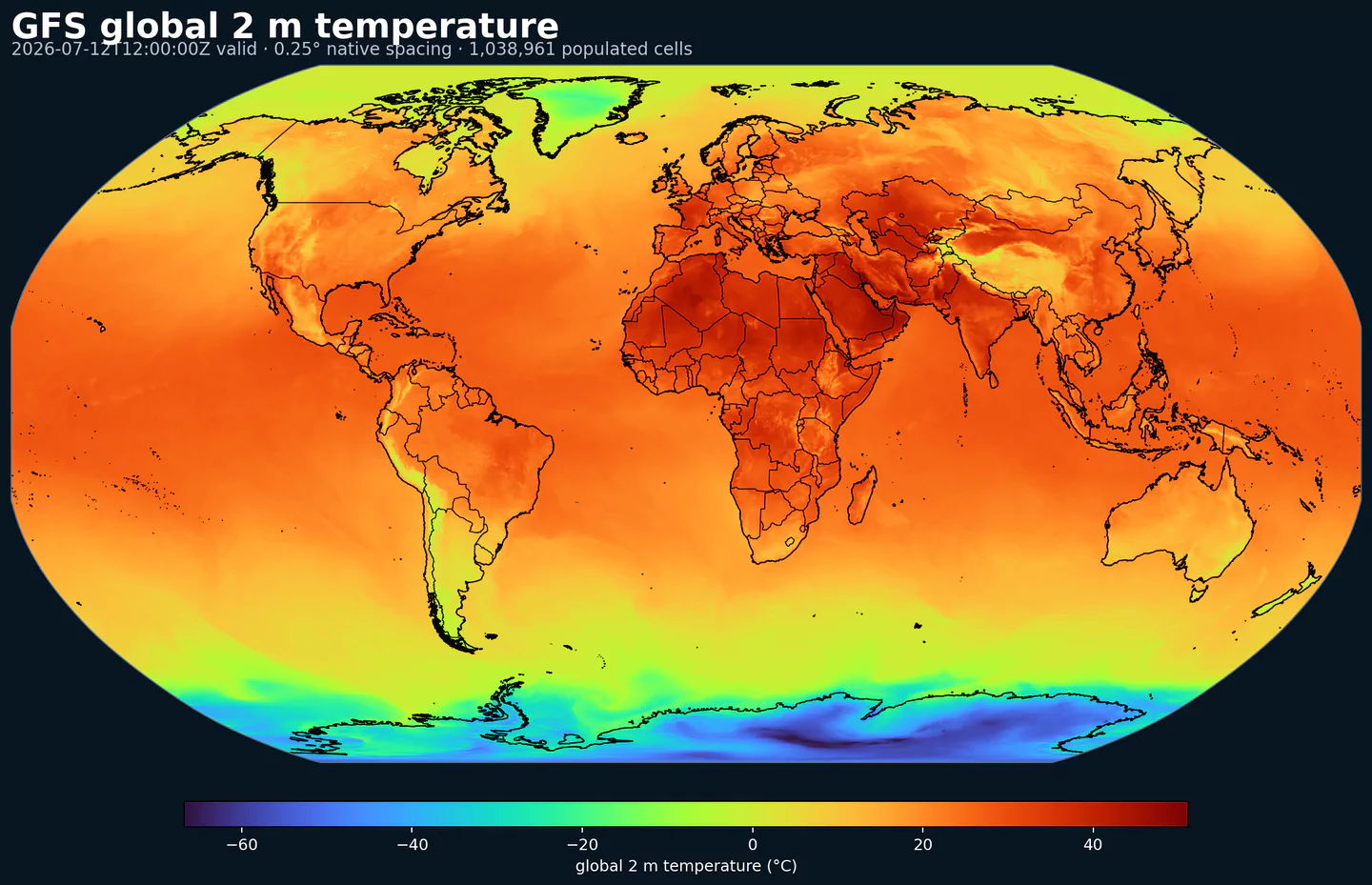
Air temperature is the thermal state of the atmosphere at the specified level. It influences density, stability, and energy exchange.

  • Units: K.
Level Info Horizon Introduced Selector
2 m above ground 0h-240h 2020-10-01
{"name":"TMP","level":"2 m above ground","info":""}
TSOIL –Soil Temperature (K)
1 variant

Soil temperature describes the thermal state of the soil layer. It affects ground heat flux and freeze/thaw processes.

  • Units: K.
  • Soil state affects evapotranspiration and boundary-layer moisture.
Level Info Horizon Introduced Selector
0-0.1 m below ground 0h-240h 2020-10-01
{"name":"TSOIL","level":"0-0.1 m below ground","info":""}
UGRD –U-Component of Wind (m/s)
1 variant

U‑component of wind is the east‑west component of the horizontal wind. Combine with v for speed and direction.

  • Units: m/s.
  • Combine u and v components to compute speed and direction.
Level Info Horizon Introduced Selector
10 m above ground 0h-240h 2020-10-01
{"name":"UGRD","level":"10 m above ground","info":""}
VGRD –V-Component of Wind (m/s)
1 variant

V‑component of wind is the north‑south component of the horizontal wind. Combine with u for speed and direction.

  • Units: m/s.
  • Combine u and v components to compute speed and direction.
Level Info Horizon Introduced Selector
10 m above ground 0h-240h 2020-10-01
{"name":"VGRD","level":"10 m above ground","info":""}
WEASD –Water Equivalent of Accumulated Snow Depth (kg/m^2)
1 variant

Snow water equivalent (SWE) is the total liquid water stored in the snowpack. It integrates depth and density of existing snow.

  • Units: kg/m^2.
  • Accumulations represent water-equivalent depth over the output interval; rates describe intensity.
Level Info Horizon Introduced Selector
surface 0h-240h 2020-10-01
{"name":"WEASD","level":"surface","info":""}

Nessun parametro corrisponde alla ricerca.