
GribStream Blog
ECMWF IFS at 0.1°: finer forecasts, the same GribStream API
Explore ECMWF's new 0.1° atmospheric and wave forecasts, with 50-member ensembles, complete parameter inventories and familiar GribStream queries.
ECMWF's 0.1° IFS feeds are now available in GribStream as eight atmospheric and wave datasets. The first published cycle starts on 20 October 2026 at 06 UTC. Each product has its own dataset ID, complete parameter inventory and familiar runs and timeseries endpoints.
This is the release we discussed in our September preview. The useful distinction is now concrete: ECMWF runs IFS at approximately 9 km and distributes these new fields on a regular 0.1° output grid, about 11 km north to south. AIFS continues at 0.25°. ECMWF's release details.
More of the forecast's spatial detail
The 0.1° and 0.25° products come from the same underlying forecast. The new grid has 2.5 times finer spacing along each axis, or roughly 6.25 times as many points over the same area. That lets applications sample more of the spatial structure already present in IFS.
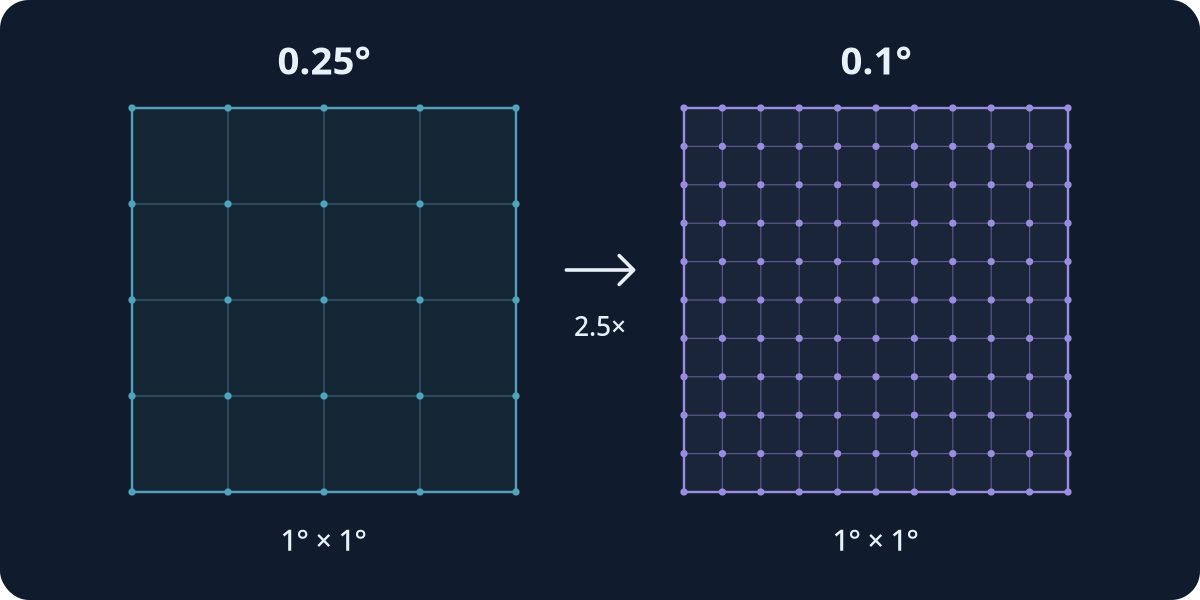
For a wind portfolio, that creates more opportunities to distinguish coastal and inland sites. For temperature-sensitive demand or agricultural exposure, it provides more sampling locations across a region. These are reasons to evaluate the finer product against your observations and decision deadlines; grid spacing alone is not a measured improvement in local forecast accuracy.
Eight datasets, every published field
Atmospheric deterministic forecast
ifsoper0p1
- Parameters
- 60
- Exact parameter/level selectors
- 197
Atmospheric ensemble
ifsenfo0p1
- Parameters
- 57
- Exact parameter/level selectors
- 180
Wave deterministic forecast
ifswave0p1
- Parameters
- 13
- Exact parameter/level selectors
- 13
Wave ensemble
ifswaef0p1
- Parameters
- 13
- Exact parameter/level selectors
- 13
Ensemble mean
ifsenfomean0p1
- Parameters
- 4
- Exact parameter/level selectors
- 9
Ensemble spread
ifsenfospread0p1
- Parameters
- 4
- Exact parameter/level selectors
- 9
Atmospheric probabilities
ifsenfoprob0p1
- Parameters
- 16
- Exact parameter/level selectors
- 16
Wave probabilities
ifswaefprob0p1
- Parameters
- 4
- Exact parameter/level selectors
- 4
These counts cover the source inventories from 06 and 12 UTC. Raw ensembles contain 50 perturbed members (1–50); their control forecasts are the corresponding deterministic products. Means, spreads and probabilities each have their own dataset, with no member dimension.
The atmospheric inventories cover surface weather and 14 pressure levels, from 1000 to 10 hPa, including temperature, winds, moisture and dynamical fields. They also include precipitation, radiation, cloud and ocean-surface variables where published. Wave products include height, period and direction. The linked model pages list every exact selector, its units and observed lead-time range.
The 12 UTC inventory adds soil temperature and volumetric soil water at four levels (sol 1–4), plus six-hour minimum and maximum 2 m temperature (mn2t6 and mx2t6) from +150h. Soil fields are absent from the first 06 UTC run. Each level and interval keeps its own selector.
We checked 810 source indexes containing 1,282,470 field/member/lead records across the first two cycles. Parameter completeness and historical coverage are separate: raw 0.1° forecasts begin on 20 October 2026 at 06 UTC, and the statistics begin at 12 UTC. The existing 0.25° datasets retain their own histories.
Ensemble means and spreads are published for 00 and 12 UTC cycles, at three-hour steps through +144h and six-hour steps from +150h to +360h. Spread is the provider-computed standard deviation in each field’s physical units. Temperature spread is a difference in kelvin: do not subtract 273.15.
Probabilities also come from 00 and 12 UTC cycles. Instantaneous events use empty info, with values every 12 hours from +12h to +360h. Daily events use info="24h" for windows ending at +24h, +36h, …, +360h; adjacent windows overlap by 12 hours. The timestamp marks the window’s end. Temperature-anomaly thresholds are ±1, ±1.5 and ±2 standard deviations.
Forecast steps and arrival time
The launch 06 UTC cycle contains three-hour steps from +0h through +144h in all four raw products. ECMWF specifies three-hour steps through +144h and six-hour steps from +150h to +360h for 00/12 UTC cycles. The diagram shows the schedule; each selector's inventory records the lead times actually observed.

The finer distribution arrives about two hours after the 0.25° distribution. This is a gap between product deliveries, not a promise of availability two hours after forecast initialization. The choice between the two grids therefore includes a timing tradeoff. ECMWF distribution documentation.
Launch-day source requests have intermittently returned 503 SlowDown. Successful retries have recovered source files in our checks; request throttling can still delay availability. We will keep checking complete cycle coverage as the new distribution settles.
Use the same API and exact selectors
A surface temperature selector remains {"name":"2t","level":"sfc","info":""}. At 850 hPa, temperature uses {"name":"t","level":"pl 850","info":""}. Change the dataset ID to select the 0.1° product, and use the catalog to choose the exact fields you need.
For example, this request selects two valid times from the launch forecast at Berlin:
curl 'https://gribstream.com/api/v2/ifsoper0p1/timeseries' \
  -H "Authorization: Bearer $GRIBSTREAM_API_TOKEN" \
  -H 'Content-Type: application/json' \
  -H 'Accept: application/json' \
  -d '{
    "timesList": ["2026-10-20T09:00:00Z", "2026-10-20T12:00:00Z"],
    "minLeadTime": "3h",
    "maxLeadTime": "6h",
    "coordinates": [{"lat": 52.5, "lon": 13.4, "name": "Berlin"}],
    "variables": [
      {"name": "2t", "level": "sfc", "info": "", "alias": "temperature_2m"},
      {"name": "t", "level": "pl 850", "info": "", "alias": "temperature_850hpa"}
    ]
  }'
Both temperatures are returned in kelvin. The date-specific example requires those source files to remain available. Native-coordinate discovery exposes the 3,600 × 1,801 grid, and the same selectors are discoverable through the catalog, MCP integration and MySQL interface.
The anomalous +0h mn2t3 and mx2t3 source records are excluded. They contain initialization placeholders (0 K), not completed three-hour extrema. These selectors start at +3h. Timeseries can select a prior run’s completed interval when allowed by asOf and lead bounds; otherwise the extrema remain missing. Other source values, including valid zeros, are unchanged.
Start with the operational model inventory or ensemble inventory, then choose the resolution and delivery timing that suit your application.
ECMWF open data is distributed under CC BY 4.0 and ECMWF's terms of use. Forecast data: ECMWF; API integration and source-inventory checks: GribStream.