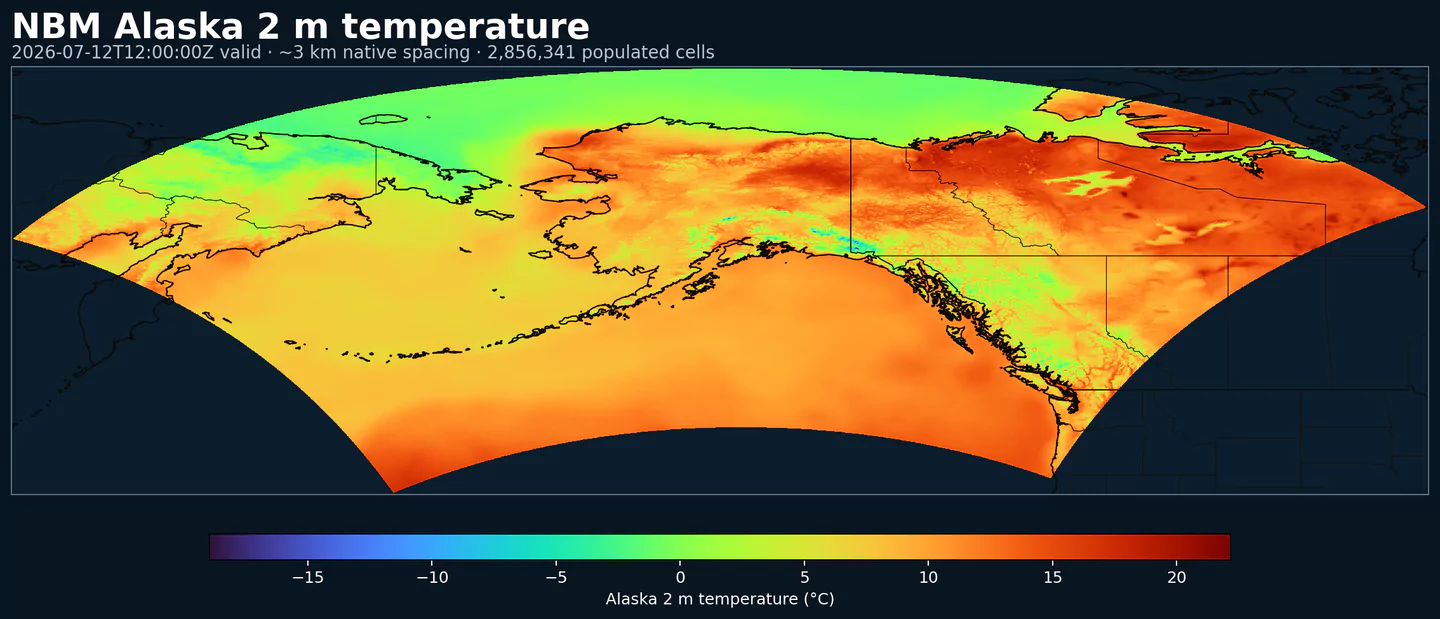
Representative Alaska coverage: NBM 2 m temperature across the complete populated grid at approximately 3 km spacing, with black country boundaries. This plot was generated from the nbmak dataset.
NBM v5 status: NBM v5 is now operational in this dataset. In the GribStream archive, runs before 2026-05-05 12:00 UTC contain the previous operational NBM version; runs from 2026-05-05 12:00 UTC onward use NBM v5. Accumulation fields such as APCP, ASNOW, and FICEAC now continue through the expanded NBM v5 hourly range, then proceed with longer accumulation periods in /timeseries without gaps or duplicate windows.
Description
NBM (National Blend of Models) is NOAA’s flagship post-processing system for gridded forecasts across the United States. This dataset exposes the Alaska NBM core grid through the same GribStream API used for CONUS and global models.
The blending is performed with statistically sophisticated techniques such as Model Output Statistics (MOS), quantile mapping,
and ensemble weighting. Forecasts are bias-corrected against analyses such as URMA (where applicable), ensuring consistency
and reliability.
Accumulated precipitation represents the total water-equivalent amount of rain and snow during the output period. It is a primary field for hydrologic impacts and event totals.
Units: kg/m^2.
Use with the model time interval to interpret totals and compare to gauges.
Apparent temperature combines air temperature, humidity, and wind to estimate how hot or cold it feels to humans. It is useful for heat and cold stress assessments.
Units: K.
Level
Info
Horizon
Introduced
Selector
2 m above ground
1h-264h
2020-10-01
{"name":"APTMP","level":"2 m above ground","info":""}
Convective Available Potential Energy (CAPE) quantifies buoyant energy available to rising air parcels. Larger values generally imply stronger potential updrafts and greater convective intensity.
Units: J/kg.
Often used with CIN and lifting mechanisms to assess thunderstorm potential.
Ceiling height is the altitude of the lowest cloud base that covers a significant portion of the sky. It is a key aviation and surface-visibility metric.
Distance to feature is the horizontal distance to the named hazard or boundary in the source product. It is used to map proximity to key features like fronts or hazards.
Units: km.
Level
Info
Horizon
Introduced
Selector
surface - 610 m above ground
1h-36h
2020-10-01
{"name":"DIST","level":"surface - 610 m above ground","info":""}
Ellrod index is a diagnostic for clear-air turbulence based on deformation and vertical wind shear. Higher values indicate greater turbulence potential for aviation.
Fosberg fire weather index combines temperature, humidity, and wind to estimate potential fire spread. Higher values indicate more favorable wildfire conditions.
Haines Index combines atmospheric stability and dryness to estimate the potential for large fire growth. Higher values indicate a more favorable environment for extreme fire behavior.
Units: Numeric.
Typically used in wildfire forecasting and risk monitoring.
Level
Info
Horizon
Introduced
Selector
entire atmosphere (considered as a single layer)
6h-264h
2020-10-01
{"name":"HINDEX","level":"entire atmosphere (considered as a single layer)","info":""}
Hourly maximum simulated reflectivity at 1 km AGL captures the strongest modeled reflectivity near the surface. It is used to identify peak convective intensity and heavy precipitation cores.
Units: dBZ.
Level
Info
Horizon
Introduced
Selector
1000 m above ground
1h-48h
2020-10-01
{"name":"MAXREF","level":"1000 m above ground","info":""}
Coded surface precipitation type derived from model precipitation and near-surface thermodynamics. It distinguishes rain, snow, freezing rain, mixed types, and related categories.
Units: coded.
Interpret together with precipitation rate or accumulation.