Ceiling height is the altitude of the lowest cloud base that covers a significant portion of the sky. It is a key aviation and surface-visibility metric.
- Units: m.

Code GribStream: urma
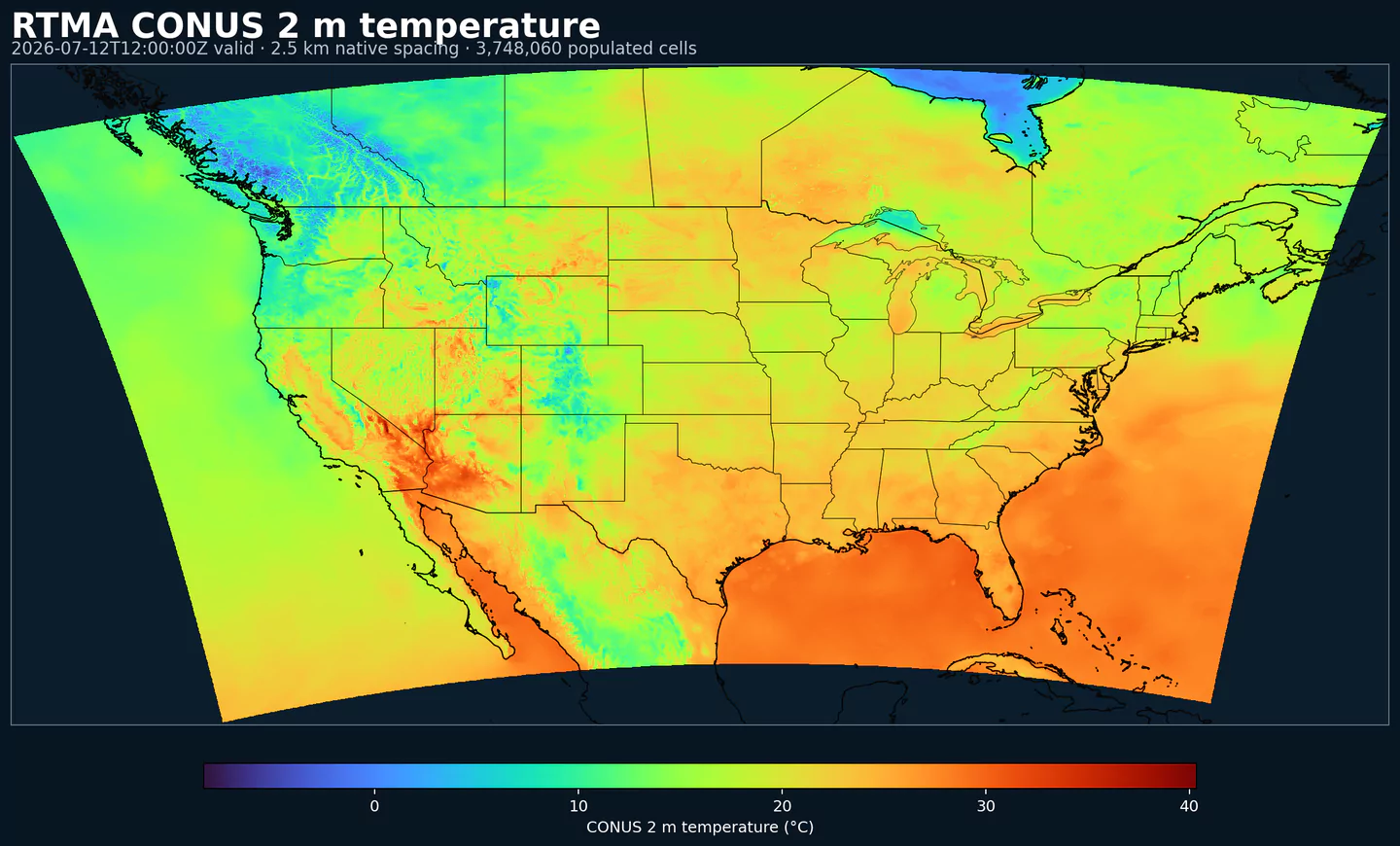
URMA (Unrestricted Mesoscale Analysis) est l'analyse horaire haute résolution de la NOAA pour les conditions proches de la surface. Elle sert d'analyse de référence : le système RTMA est relancé environ six heures après chaque heure valide, en intégrant observations conventionnelles, mesonet, bouées, navires et données radar arrivées trop tard pour RTMA.
URMA utilise une assimilation variationnelle bidimensionnelle (2D-Var) avec covariances statiques d'erreur de fond, via GSI, pour combiner observations et premier champ estimé par le modèle. Elle fonctionne sur plusieurs grilles Lambert NDFD : 2.5 km pour CONUS, environ 3 km pour Alaska, et domaines pour Hawaii, Puerto Rico et Guam.
Le dataset inclut des champs standards proches de la surface, comme température à 2 m, point de rosée, humidité spécifique, vent à 10 m, pression de surface, visibilité, plafond nuageux et précipitation. Il intègre aussi des champs de hauteur de vague au large et des températures minimales et maximales quotidiennes.
URMA peut utiliser des observations et contrôles qualité qui n'arrivent pas à temps pour le cycle basse latence de RTMA. Les mélanges radar-pluviomètre de précipitation, QPE MRMS/Multi-Radar, les réseaux mesonet supplémentaires et les mises à jour de neige NOHRSC aident à produire une référence plus complète pour évaluation et entraînement.
Parmi les améliorations documentées de la famille URMA, on trouve le remplacement de l'ancienne entrée Stage II de précipitation par MRMS/Multi-Radar QPE et l'intégration de l'analyse de neige NOHRSC, avec des méthodes comme le Whittaker blending pour combiner les champs d'analyse.
URMA privilégie la complétude et la qualité, pas la latence minimale. C'est pourquoi elle sert de source de référence pour vérification, correction de biais de NBM, backtesting et entraînement de modèles. En Alaska, des entrées URMA ont aussi alimenté AORC pour améliorer le downscaling de température, humidité, pression et vent.
Cliquez sur un paramètre pour voir ses variantes dans une table compacte avec des sélecteurs JSON prêts à copier. Les codes, niveaux et valeurs de sélecteur restent exactement tels que l'API les expose.
Ceiling height is the altitude of the lowest cloud base that covers a significant portion of the sky. It is a key aviation and surface-visibility metric.
| Level | Info | Horizon | Introduced | Selector |
|---|---|---|---|---|
cloud ceiling |
0h | 2017-05-01 |
{"name":"CEIL","level":"cloud ceiling","info":""}
|
Dew point temperature is the temperature at which the air becomes saturated. It is a direct measure of moisture content.
| Level | Info | Horizon | Introduced | Selector |
|---|---|---|---|---|
2 m above ground |
0h | 2017-05-01 |
{"name":"DPT","level":"2 m above ground","info":""}
|
Wind gust is the peak short-duration wind speed. It captures brief, hazardous bursts that can exceed sustained winds.
| Level | Info | Horizon | Introduced | Selector |
|---|---|---|---|---|
10 m above ground |
0h | 2017-05-01 |
{"name":"GUST","level":"10 m above ground","info":""}
|
Geopotential height is the altitude of a pressure surface in the atmosphere. It is the primary field for identifying ridges, troughs, and large‑scale flow patterns.
| Level | Info | Horizon | Introduced | Selector |
|---|---|---|---|---|
surface |
0h | 2017-05-01 |
{"name":"HGT","level":"surface","info":""}
|
Pressure is the atmospheric pressure at the specified level. It is a fundamental mass-field variable for dynamics and thermodynamics.
| Level | Info | Horizon | Introduced | Selector |
|---|---|---|---|---|
surface |
0h | 2017-05-01 |
{"name":"PRES","level":"surface","info":""}
|
Specific humidity is the mass of water vapor per mass of air at the specified level. It is central to moisture transport.
| Level | Info | Horizon | Introduced | Selector |
|---|---|---|---|---|
2 m above ground |
0h | 2017-05-01 |
{"name":"SPFH","level":"2 m above ground","info":""}
|
Air temperature is the thermal state of the atmosphere at the specified level. It influences density, stability, and energy exchange.
| Level | Info | Horizon | Introduced | Selector |
|---|---|---|---|---|
2 m above ground |
0h | 2017-05-01 |
{"name":"TMP","level":"2 m above ground","info":""}
|
U‑component of wind is the east‑west component of the horizontal wind. Combine with v for speed and direction.
| Level | Info | Horizon | Introduced | Selector |
|---|---|---|---|---|
10 m above ground |
0h | 2017-05-01 |
{"name":"UGRD","level":"10 m above ground","info":""}
|
V‑component of wind is the north‑south component of the horizontal wind. Combine with u for speed and direction.
| Level | Info | Horizon | Introduced | Selector |
|---|---|---|---|---|
10 m above ground |
0h | 2017-05-01 |
{"name":"VGRD","level":"10 m above ground","info":""}
|
Horizontal visibility at the surface. Lower values indicate reduced visibility due to fog, precipitation, or aerosols.
| Level | Info | Horizon | Introduced | Selector |
|---|---|---|---|---|
surface |
0h | 2017-05-01 |
{"name":"VIS","level":"surface","info":""}
|
Wind direction indicates the direction from which the wind is blowing at the specified level.
| Level | Info | Horizon | Introduced | Selector |
|---|---|---|---|---|
10 m above ground |
0h | 2017-05-01 |
{"name":"WDIR","level":"10 m above ground","info":""}
|
Wind speed is the magnitude of the horizontal wind at the specified level. It is used for transport, mixing, and hazards.
| Level | Info | Horizon | Introduced | Selector |
|---|---|---|---|---|
10 m above ground |
0h | 2017-05-01 |
{"name":"WIND","level":"10 m above ground","info":""}
|
Aucun paramètre ne correspond à la recherche.