Best (4-layer) lifted index uses parcels from the lowest four model layers to assess stability at 500 hPa. More negative values indicate greater instability.
- Units: K.
- Often used alongside CAPE and CIN in convective forecasting.

GribStream Code: hrrrsubh
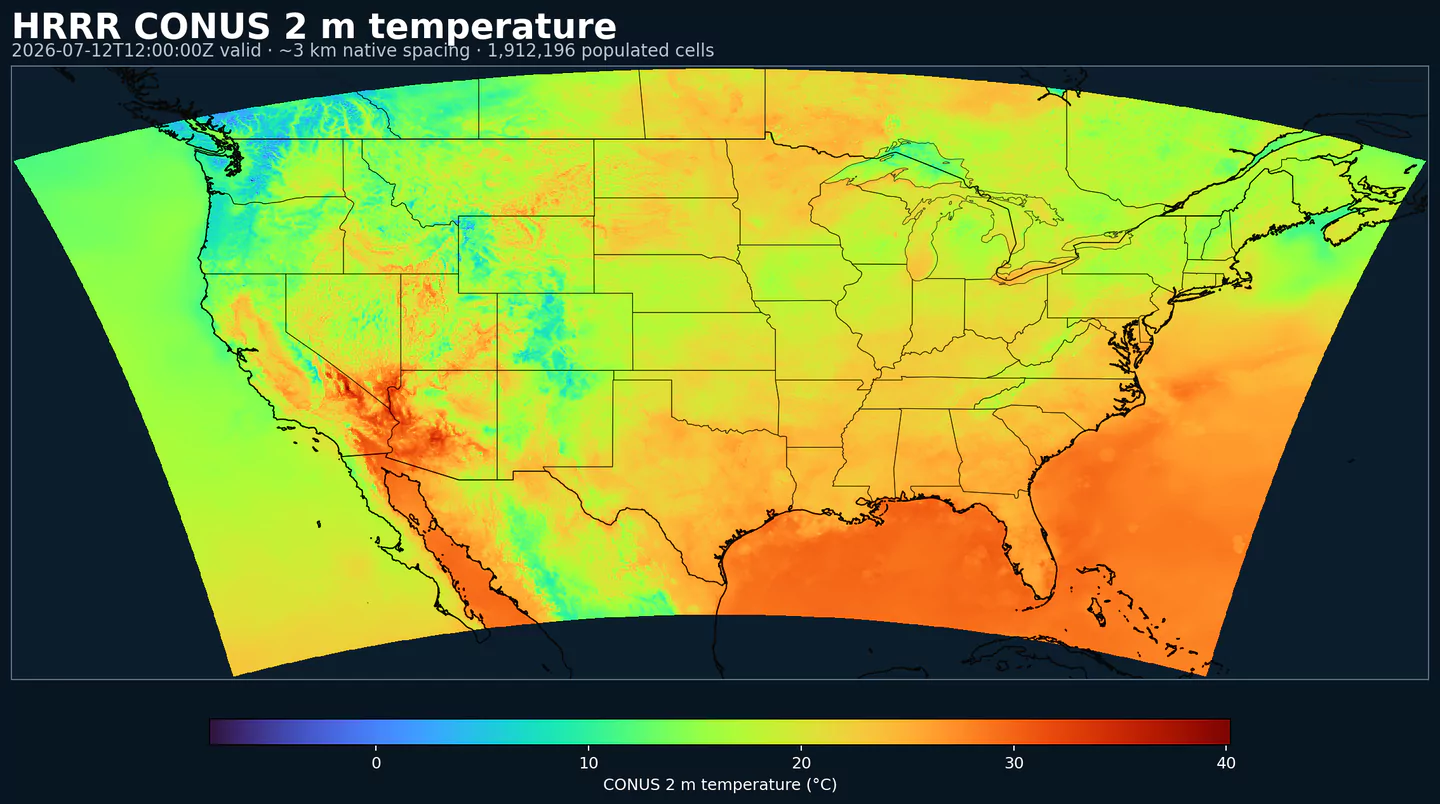
HRRR Sub-hourly exposes high-frequency surface output from NOAA/NCEP's High-Resolution Rapid Refresh model. It is designed for workflows that care about intrahour ramps and sharp gradients: power markets (wind/solar ramp and load), aviation (winds, ceilings, visibility), and fast-evolving mesoscale weather.
This dataset is a focused subset of HRRR (the wrfsubhf product family): 15-minute valid times out to 18 hours. It is useful when an hourly value would hide a ramp, boundary, or short-lived surface signal.
For the full hourly HRRR archive, additional fields, and longer horizons, use HRRR. For analysis-style near-real-time surface fields rather than forecast valid times, compare with RTMA Rapid Update.
Click a parameter to reveal variants in a compact table with ready-to-copy JSON selectors.
Best (4-layer) lifted index uses parcels from the lowest four model layers to assess stability at 500 hPa. More negative values indicate greater instability.
| Level | Info | Horizon | Introduced | Selector |
|---|---|---|---|---|
180-0 mb above ground |
3h-15h | 2014-08-01 |
{"name":"4LFTX","level":"180-0 mb above ground","info":""}
|
Accumulated precipitation represents the total water-equivalent amount of rain and snow during the output period. It is a primary field for hydrologic impacts and event totals.
| Level | Info | Horizon | Introduced | Selector |
|---|---|---|---|---|
surface |
0m-18h | 2020-12-02 |
{"name":"APCP","level":"surface","info":""}
|
|
surface |
acc-15m |
15m-18h | 2020-12-02 |
{"name":"APCP","level":"surface","info":"acc-15m"}
|
Convective Available Potential Energy (CAPE) quantifies buoyant energy available to rising air parcels. Larger values generally imply stronger potential updrafts and greater convective intensity.
| Level | Info | Horizon | Introduced | Selector |
|---|---|---|---|---|
180-0 mb above ground |
3h-15h | 2014-08-01 |
{"name":"CAPE","level":"180-0 mb above ground","info":""}
|
|
255-0 mb above ground |
3h-15h | 2014-08-01 |
{"name":"CAPE","level":"255-0 mb above ground","info":""}
|
|
90-0 mb above ground |
3h-15h | 2014-08-01 |
{"name":"CAPE","level":"90-0 mb above ground","info":""}
|
|
surface |
3h-15h | 2014-08-01 |
{"name":"CAPE","level":"surface","info":""}
|
Convective cloud cover is the fraction of the grid cell covered by clouds produced by the convective parameterization. It is useful when you need to separate parameterized convective cloud from stratiform or total cloud amount.
| Level | Info | Horizon | Introduced | Selector |
|---|---|---|---|---|
convective cloud layer |
3h-15h | 2014-08-01 |
{"name":"CDCON","level":"convective cloud layer","info":""}
|
Categorical indicator of freezing rain occurrence at the surface during the output period.
| Level | Info | Horizon | Introduced | Selector |
|---|---|---|---|---|
surface |
0m-18h | 2014-07-30 |
{"name":"CFRZR","level":"surface","info":""}
|
Categorical indicator of ice pellet (sleet) occurrence at the surface during the output period.
| Level | Info | Horizon | Introduced | Selector |
|---|---|---|---|---|
surface |
0m-18h | 2014-07-30 |
{"name":"CICEP","level":"surface","info":""}
|
Convective Inhibition (CIN) measures the energy barrier that must be overcome to initiate convection. More negative values indicate a stronger cap that can suppress storms.
| Level | Info | Horizon | Introduced | Selector |
|---|---|---|---|---|
180-0 mb above ground |
3h-15h | 2014-08-01 |
{"name":"CIN","level":"180-0 mb above ground","info":""}
|
|
255-0 mb above ground |
3h-15h | 2014-08-01 |
{"name":"CIN","level":"255-0 mb above ground","info":""}
|
|
90-0 mb above ground |
3h-15h | 2014-08-01 |
{"name":"CIN","level":"90-0 mb above ground","info":""}
|
|
surface |
3h-15h | 2014-08-01 |
{"name":"CIN","level":"surface","info":""}
|
Percent frozen precipitation indicates the fraction of total precipitation that is falling in frozen form. It helps distinguish mixed-phase and winter precipitation impacts.
| Level | Info | Horizon | Introduced | Selector |
|---|---|---|---|---|
surface |
0m-18h | 2014-07-30 |
{"name":"CPOFP","level":"surface","info":""}
|
Categorical indicator of rain occurrence at the surface during the output period. Useful as a yes/no mask for rain.
| Level | Info | Horizon | Introduced | Selector |
|---|---|---|---|---|
surface |
0m-18h | 2014-07-30 |
{"name":"CRAIN","level":"surface","info":""}
|
Categorical indicator of snow occurrence at the surface during the output period.
| Level | Info | Horizon | Introduced | Selector |
|---|---|---|---|---|
surface |
0m-18h | 2014-07-30 |
{"name":"CSNOW","level":"surface","info":""}
|
Downward longwave (thermal) flux represents incoming energy at the surface. It is a key driver of surface heating and cooling.
| Level | Info | Horizon | Introduced | Selector |
|---|---|---|---|---|
surface |
0m-18h | 2016-08-22 |
{"name":"DLWRF","level":"surface","info":""}
|
Dew point temperature is the temperature at which the air becomes saturated. It is a direct measure of moisture content.
| Level | Info | Horizon | Introduced | Selector |
|---|---|---|---|---|
1000 mb |
3h-15h | 2014-08-01 |
{"name":"DPT","level":"1000 mb","info":""}
|
|
2 m above ground |
0m-18h | 2014-07-30 |
{"name":"DPT","level":"2 m above ground","info":""}
|
|
500 mb |
0m-15h | 2014-08-01 |
{"name":"DPT","level":"500 mb","info":""}
|
|
700 mb |
0m-15h | 2014-08-01 |
{"name":"DPT","level":"700 mb","info":""}
|
|
850 mb |
0m-15h | 2014-08-01 |
{"name":"DPT","level":"850 mb","info":""}
|
|
925 mb |
0m-15h | 2014-08-01 |
{"name":"DPT","level":"925 mb","info":""}
|
Downward radiative flux represents incoming energy at the surface. It is a key driver of surface heating and cooling.
| Level | Info | Horizon | Introduced | Selector |
|---|---|---|---|---|
surface |
0m-18h | 2014-07-30 |
{"name":"DSWRF","level":"surface","info":""}
|
|
surface |
ave-0h |
0m | 2016-08-22 |
{"name":"DSWRF","level":"surface","info":"ave-0h"}
|
surface |
ave-15m |
15m-18h | 2016-08-22 |
{"name":"DSWRF","level":"surface","info":"ave-15m"}
|
Freezing rain accumulation is the water-equivalent amount of freezing rain during the period. It relates directly to ice accretion risk.
| Level | Info | Horizon | Introduced | Selector |
|---|---|---|---|---|
surface |
0m-18h | 2020-12-02 |
{"name":"FROZR","level":"surface","info":""}
|
|
surface |
acc-15m |
15m-18h | 2020-12-02 |
{"name":"FROZR","level":"surface","info":"acc-15m"}
|
Wind gust is the peak short-duration wind speed. It captures brief, hazardous bursts that can exceed sustained winds.
| Level | Info | Horizon | Introduced | Selector |
|---|---|---|---|---|
surface |
0m-18h | 2014-07-30 |
{"name":"GUST","level":"surface","info":""}
|
High cloud cover is the fraction of the grid cell covered by clouds in the upper troposphere. It affects longwave radiation and aviation.
| Level | Info | Horizon | Introduced | Selector |
|---|---|---|---|---|
high cloud layer |
3h-15h | 2014-08-01 |
{"name":"HCDC","level":"high cloud layer","info":""}
|
Geopotential height is the altitude of a pressure surface in the atmosphere. It is the primary field for identifying ridges, troughs, and large‑scale flow patterns.
| Level | Info | Horizon | Introduced | Selector |
|---|---|---|---|---|
1000 mb |
3h-15h | 2014-08-01 |
{"name":"HGT","level":"1000 mb","info":""}
|
|
500 mb |
0m-15h | 2014-08-01 |
{"name":"HGT","level":"500 mb","info":""}
|
|
700 mb |
0m-15h | 2014-08-01 |
{"name":"HGT","level":"700 mb","info":""}
|
|
850 mb |
0m-15h | 2014-08-01 |
{"name":"HGT","level":"850 mb","info":""}
|
|
cloud base |
0m-18h | 2014-07-30 |
{"name":"HGT","level":"cloud base","info":""}
|
|
cloud ceiling |
0m-18h | 2014-07-30 |
{"name":"HGT","level":"cloud ceiling","info":""}
|
|
cloud top |
0m-18h | 2014-07-30 |
{"name":"HGT","level":"cloud top","info":""}
|
|
equilibrium level |
3h-15h | 2014-08-01 |
{"name":"HGT","level":"equilibrium level","info":""}
|
|
level of adiabatic condensation from sfc |
3h-15h | 2014-08-01 |
{"name":"HGT","level":"level of adiabatic condensation from sfc","info":""}
|
|
surface |
0m-18h | 2014-08-01 |
{"name":"HGT","level":"surface","info":""}
|
Storm-relative helicity measures the potential for streamwise vorticity to be ingested by a storm updraft. Higher values suggest a greater likelihood of rotating updrafts.
| Level | Info | Horizon | Introduced | Selector |
|---|---|---|---|---|
1000-0 m above ground |
3h-15h | 2014-08-01 |
{"name":"HLCY","level":"1000-0 m above ground","info":""}
|
|
3000-0 m above ground |
3h-15h | 2014-08-01 |
{"name":"HLCY","level":"3000-0 m above ground","info":""}
|
Boundary layer height marks the depth of the turbulent surface-influenced layer. It affects mixing, dispersion, and surface fluxes.
| Level | Info | Horizon | Introduced | Selector |
|---|---|---|---|---|
surface |
3h-15h | 2014-08-01 |
{"name":"HPBL","level":"surface","info":""}
|
Ice cover is the proportion of the grid cell covered by ice. It is used as a surface-state mask for sea ice and related cryosphere diagnostics.
| Level | Info | Horizon | Introduced | Selector |
|---|---|---|---|---|
surface |
3h-15h | 2014-08-01 |
{"name":"ICEC","level":"surface","info":""}
|
Land cover is a land/sea mask where 0 indicates sea and 1 indicates land. It is used to separate land and ocean surface processes.
| Level | Info | Horizon | Introduced | Selector |
|---|---|---|---|---|
surface |
3h-15h | 2014-08-01 |
{"name":"LAND","level":"surface","info":""}
|
Low cloud cover is the fraction of the grid cell covered by low clouds. It strongly affects visibility, fog potential, and surface temperatures.
| Level | Info | Horizon | Introduced | Selector |
|---|---|---|---|---|
low cloud layer |
3h-15h | 2014-08-01 |
{"name":"LCDC","level":"low cloud layer","info":""}
|
Lifted Index compares a lifted parcel's temperature to the environment at 500 hPa. More negative values indicate greater instability and thunderstorm potential.
| Level | Info | Horizon | Introduced | Selector |
|---|---|---|---|---|
500-1000 mb |
3h-15h | 2014-08-01 |
{"name":"LFTX","level":"500-1000 mb","info":""}
|
Lightning is a dimensionless model diagnostic in these NOAA mesoscale inventories. Higher values indicate greater modeled lightning or convective electrical activity.
| Level | Info | Horizon | Introduced | Selector |
|---|---|---|---|---|
surface |
3h-15h | 2014-08-01 |
{"name":"LTNG","level":"surface","info":""}
|
Mid-level cloud cover is the fraction of the grid cell covered by clouds in the middle troposphere. It influences both shortwave and longwave radiation.
| Level | Info | Horizon | Introduced | Selector |
|---|---|---|---|---|
middle cloud layer |
3h-15h | 2014-08-01 |
{"name":"MCDC","level":"middle cloud layer","info":""}
|
Moisture availability represents how much moisture is available at the surface for evaporation. It is used in land-surface and fire-weather diagnostics.
| Level | Info | Horizon | Introduced | Selector |
|---|---|---|---|---|
0 m underground |
3h-15h | 2014-08-01 |
{"name":"MSTAV","level":"0 m underground","info":""}
|
Pressure of the level from which the parcel was lifted indicates the parcel source level used for stability indices. It helps interpret lifted index and CAPE products.
| Level | Info | Horizon | Introduced | Selector |
|---|---|---|---|---|
255-0 mb above ground |
3h-15h | 2014-08-01 |
{"name":"PLPL","level":"255-0 mb above ground","info":""}
|
Precipitation rate is the total intensity of precipitation over the period. It combines convective and stratiform contributions.
| Level | Info | Horizon | Introduced | Selector |
|---|---|---|---|---|
surface |
0m-18h | 2014-07-30 |
{"name":"PRATE","level":"surface","info":""}
|
Pressure is the atmospheric pressure at the specified level. It is a fundamental mass-field variable for dynamics and thermodynamics.
| Level | Info | Horizon | Introduced | Selector |
|---|---|---|---|---|
cloud base |
3h-15h | 2014-08-01 |
{"name":"PRES","level":"cloud base","info":""}
|
|
cloud top |
3h-15h | 2014-08-01 |
{"name":"PRES","level":"cloud top","info":""}
|
|
surface |
0m-18h | 2014-07-30 |
{"name":"PRES","level":"surface","info":""}
|
Pressure reduced to mean sea level is MSLP computed from surface pressure and temperature. It is used to locate highs and lows.
| Level | Info | Horizon | Introduced | Selector |
|---|---|---|---|---|
mean sea level |
3h-15h | 2014-08-01 |
{"name":"PRMSL","level":"mean sea level","info":""}
|
Precipitable water is the total column water vapor from the surface to the top of the atmosphere. It is a key moisture indicator.
| Level | Info | Horizon | Introduced | Selector |
|---|---|---|---|---|
entire atmosphere (considered as a single layer) |
3h-15h | 2014-08-01 |
{"name":"PWAT","level":"entire atmosphere (considered as a single layer)","info":""}
|
Composite reflectivity is the maximum reflectivity in the column. It is a standard radar‑style field for identifying convective cores and precipitation intensity.
| Level | Info | Horizon | Introduced | Selector |
|---|---|---|---|---|
entire atmosphere |
0m-18h | 2014-07-30 |
{"name":"REFC","level":"entire atmosphere","info":""}
|
Reflectivity is a radar‑style measure of hydrometeor concentration at a given level. Higher values generally correspond to heavier precipitation.
| Level | Info | Horizon | Introduced | Selector |
|---|---|---|---|---|
1000 m above ground |
0m-18h | 2014-07-30 |
{"name":"REFD","level":"1000 m above ground","info":""}
|
|
4000 m above ground |
0m-18h | 2014-07-30 |
{"name":"REFD","level":"4000 m above ground","info":""}
|
Echo top height is the altitude of the highest reflectivity in the column. It is a proxy for storm depth and convective vigor.
| Level | Info | Horizon | Introduced | Selector |
|---|---|---|---|---|
cloud top |
0m-18h | 2014-07-30 |
{"name":"RETOP","level":"cloud top","info":""}
|
Simulated brightness temperature for GOES-11 channel 3 represents modeled radiance converted to an equivalent blackbody temperature. It supports satellite comparison and cloud diagnostics.
| Level | Info | Horizon | Introduced | Selector |
|---|---|---|---|---|
top of atmosphere |
0m-18h | 2016-08-22 |
{"name":"SBT113","level":"top of atmosphere","info":""}
|
Simulated brightness temperature for GOES-11 channel 4 represents modeled radiance converted to an equivalent blackbody temperature. It supports satellite comparison and cloud diagnostics.
| Level | Info | Horizon | Introduced | Selector |
|---|---|---|---|---|
top of atmosphere |
0m-18h | 2016-08-22 |
{"name":"SBT114","level":"top of atmosphere","info":""}
|
Simulated brightness temperature for GOES-12 channel 3 represents modeled radiance converted to an equivalent blackbody temperature. It supports satellite comparison and cloud diagnostics.
| Level | Info | Horizon | Introduced | Selector |
|---|---|---|---|---|
top of atmosphere |
0m-18h | 2016-08-22 |
{"name":"SBT123","level":"top of atmosphere","info":""}
|
Simulated brightness temperature for GOES-12 channel 4 represents modeled radiance converted to an equivalent blackbody temperature. It supports satellite comparison and cloud diagnostics.
| Level | Info | Horizon | Introduced | Selector |
|---|---|---|---|---|
top of atmosphere |
0m-18h | 2016-08-22 |
{"name":"SBT124","level":"top of atmosphere","info":""}
|
Snow depth is the physical thickness of the snowpack. It is distinct from snow water equivalent, which measures water content.
| Level | Info | Horizon | Introduced | Selector |
|---|---|---|---|---|
surface |
3h-15h | 2014-08-01 |
{"name":"SNOD","level":"surface","info":""}
|
Snow cover is the fraction of the grid cell covered by snow. It helps interpret albedo, runoff timing, and surface energy balance.
| Level | Info | Horizon | Introduced | Selector |
|---|---|---|---|---|
surface |
3h-15h | 2014-08-01 |
{"name":"SNOWC","level":"surface","info":""}
|
Specific humidity is the mass of water vapor per mass of air at the specified level. It is central to moisture transport.
| Level | Info | Horizon | Introduced | Selector |
|---|---|---|---|---|
2 m above ground |
0m-18h | 2014-08-01 |
{"name":"SPFH","level":"2 m above ground","info":""}
|
Total cloud cover is the fraction of the grid cell covered by clouds at any level. It influences radiation, temperature, and visibility.
| Level | Info | Horizon | Introduced | Selector |
|---|---|---|---|---|
entire atmosphere |
3h-15h | 2014-08-01 |
{"name":"TCDC","level":"entire atmosphere","info":""}
|
Total column integrated cloud ice is the vertically integrated mass of suspended cloud ice. It is used in cloud microphysics, radiation, and satellite forward calculations, especially when separating ice cloud from liquid cloud contributions.
| Level | Info | Horizon | Introduced | Selector |
|---|---|---|---|---|
entire atmosphere |
0m-18h | 2022-06-01 |
{"name":"TCOLI","level":"entire atmosphere","info":""}
|
Parameter ID 0/6/19
Total Column Integrated Cloud Ice.
| Level | Info | Horizon | Introduced | Selector |
|---|---|---|---|---|
entire atmosphere |
0m-18h | 2020-12-02 |
{"name":"TCOLIold","level":"entire atmosphere","info":""}
|
Total column integrated cloud water is the vertically integrated mass of suspended liquid cloud water. It is distinct from rainwater and is used in cloud, radiation, fog, and satellite forward-model diagnostics.
| Level | Info | Horizon | Introduced | Selector |
|---|---|---|---|---|
entire atmosphere |
0m-18h | 2022-06-01 |
{"name":"TCOLW","level":"entire atmosphere","info":""}
|
Parameter ID 0/6/18
Total Column Integrated Cloud Water.
| Level | Info | Horizon | Introduced | Selector |
|---|---|---|---|---|
entire atmosphere |
0m-18h | 2020-12-02 |
{"name":"TCOLWold","level":"entire atmosphere","info":""}
|
Air temperature is the thermal state of the atmosphere at the specified level. It influences density, stability, and energy exchange.
| Level | Info | Horizon | Introduced | Selector |
|---|---|---|---|---|
1000 mb |
3h-15h | 2014-08-01 |
{"name":"TMP","level":"1000 mb","info":""}
|
|
2 m above ground |
0m-18h | 2014-07-30 |
{"name":"TMP","level":"2 m above ground","info":""}
|
|
500 mb |
0m-15h | 2014-08-01 |
{"name":"TMP","level":"500 mb","info":""}
|
|
700 mb |
0m-15h | 2014-08-01 |
{"name":"TMP","level":"700 mb","info":""}
|
|
850 mb |
0m-15h | 2014-08-01 |
{"name":"TMP","level":"850 mb","info":""}
|
|
925 mb |
0m-15h | 2014-08-01 |
{"name":"TMP","level":"925 mb","info":""}
|
|
surface |
3h-15h | 2014-08-01 |
{"name":"TMP","level":"surface","info":""}
|
U‑component of wind is the east‑west component of the horizontal wind. Combine with v for speed and direction.
| Level | Info | Horizon | Introduced | Selector |
|---|---|---|---|---|
10 m above ground |
0m-18h | 2014-07-30 |
{"name":"UGRD","level":"10 m above ground","info":""}
|
|
10 m above ground |
ave-0h |
0m | 2016-08-22 |
{"name":"UGRD","level":"10 m above ground","info":"ave-0h"}
|
10 m above ground |
ave-5m |
15m-18h | 2016-08-22 |
{"name":"UGRD","level":"10 m above ground","info":"ave-5m"}
|
1000 mb |
3h-15h | 2014-08-01 |
{"name":"UGRD","level":"1000 mb","info":""}
|
|
500 mb |
0m-15h | 2014-08-01 |
{"name":"UGRD","level":"500 mb","info":""}
|
|
700 mb |
0m-15h | 2014-08-01 |
{"name":"UGRD","level":"700 mb","info":""}
|
|
80 m above ground |
0m-18h | 2014-07-30 |
{"name":"UGRD","level":"80 m above ground","info":""}
|
|
850 mb |
0m-15h | 2014-08-01 |
{"name":"UGRD","level":"850 mb","info":""}
|
|
925 mb |
0m-15h | 2014-08-01 |
{"name":"UGRD","level":"925 mb","info":""}
|
Upward longwave (thermal) flux represents outgoing energy at the surface. It is a key driver of surface heating and cooling.
| Level | Info | Horizon | Introduced | Selector |
|---|---|---|---|---|
surface |
0m-18h | 2016-08-22 |
{"name":"ULWRF","level":"surface","info":""}
|
|
top of atmosphere |
0m-18h | 2014-08-04 |
{"name":"ULWRF","level":"top of atmosphere","info":""}
|
Updraft helicity is the vertical integral of rotating updraft strength. It is used to identify supercell potential.
| Level | Info | Horizon | Introduced | Selector |
|---|---|---|---|---|
5000-2000 m above ground |
0m-18h | 2014-08-04 |
{"name":"UPHL","level":"5000-2000 m above ground","info":""}
|
U‑component of storm motion is the east‑west component of the storm translation vector.
| Level | Info | Horizon | Introduced | Selector |
|---|---|---|---|---|
0-6000 m above ground |
3h-15h | 2014-08-01 |
{"name":"USTM","level":"0-6000 m above ground","info":""}
|
Upward radiative flux represents outgoing energy at the surface. It is a key driver of surface heating and cooling.
| Level | Info | Horizon | Introduced | Selector |
|---|---|---|---|---|
surface |
0m-18h | 2016-08-22 |
{"name":"USWRF","level":"surface","info":""}
|
|
top of atmosphere |
0m-18h | 2018-07-11 |
{"name":"USWRF","level":"top of atmosphere","info":""}
|
Visible beam downward solar flux is the direct visible sunlight at the surface. It is important for illumination and solar energy.
| Level | Info | Horizon | Introduced | Selector |
|---|---|---|---|---|
surface |
0m-18h | 2016-08-22 |
{"name":"VBDSF","level":"surface","info":""}
|
|
surface |
ave-0h |
0m | 2016-08-22 |
{"name":"VBDSF","level":"surface","info":"ave-0h"}
|
surface |
ave-15m |
15m-18h | 2016-08-22 |
{"name":"VBDSF","level":"surface","info":"ave-15m"}
|
Visible diffuse downward solar flux is the scattered visible light at the surface. It increases under clouds or aerosol loading.
| Level | Info | Horizon | Introduced | Selector |
|---|---|---|---|---|
surface |
0m-18h | 2016-08-22 |
{"name":"VDDSF","level":"surface","info":""}
|
V‑component of wind is the north‑south component of the horizontal wind. Combine with u for speed and direction.
| Level | Info | Horizon | Introduced | Selector |
|---|---|---|---|---|
10 m above ground |
0m-18h | 2014-07-30 |
{"name":"VGRD","level":"10 m above ground","info":""}
|
|
10 m above ground |
ave-0h |
0m | 2016-08-22 |
{"name":"VGRD","level":"10 m above ground","info":"ave-0h"}
|
10 m above ground |
ave-5m |
15m-18h | 2016-08-22 |
{"name":"VGRD","level":"10 m above ground","info":"ave-5m"}
|
1000 mb |
3h-15h | 2014-08-01 |
{"name":"VGRD","level":"1000 mb","info":""}
|
|
500 mb |
0m-15h | 2014-08-01 |
{"name":"VGRD","level":"500 mb","info":""}
|
|
700 mb |
0m-15h | 2014-08-01 |
{"name":"VGRD","level":"700 mb","info":""}
|
|
80 m above ground |
0m-18h | 2014-07-30 |
{"name":"VGRD","level":"80 m above ground","info":""}
|
|
850 mb |
0m-15h | 2014-08-01 |
{"name":"VGRD","level":"850 mb","info":""}
|
|
925 mb |
0m-15h | 2014-08-01 |
{"name":"VGRD","level":"925 mb","info":""}
|
Categorical land-use/vegetation class. It is used to set roughness, albedo, canopy properties, and other surface-exchange parameters.
| Level | Info | Horizon | Introduced | Selector |
|---|---|---|---|---|
surface |
3h-15h | 2014-08-01 |
{"name":"VGTYP","level":"surface","info":""}
|
Vertically‑integrated liquid water is the total column liquid water content. It is used as a proxy for precipitation intensity and hail potential.
| Level | Info | Horizon | Introduced | Selector |
|---|---|---|---|---|
entire atmosphere |
0m-18h | 2014-07-30 |
{"name":"VIL","level":"entire atmosphere","info":""}
|
Horizontal visibility at the surface. Lower values indicate reduced visibility due to fog, precipitation, or aerosols.
| Level | Info | Horizon | Introduced | Selector |
|---|---|---|---|---|
surface |
0m-18h | 2014-07-30 |
{"name":"VIS","level":"surface","info":""}
|
V-component storm motion represents the north-south component of storm motion. Positive values indicate motion toward the north.
| Level | Info | Horizon | Introduced | Selector |
|---|---|---|---|---|
0-6000 m above ground |
3h-15h | 2014-08-01 |
{"name":"VSTM","level":"0-6000 m above ground","info":""}
|
Vertical u-component shear describes how the east-west wind component changes with height.
| Level | Info | Horizon | Introduced | Selector |
|---|---|---|---|---|
0-1000 m above ground |
3h-15h | 2014-08-01 |
{"name":"VUCSH","level":"0-1000 m above ground","info":""}
|
|
0-6000 m above ground |
3h-15h | 2014-08-01 |
{"name":"VUCSH","level":"0-6000 m above ground","info":""}
|
Vertical v-component shear describes how the north-south wind component changes with height.
| Level | Info | Horizon | Introduced | Selector |
|---|---|---|---|---|
0-1000 m above ground |
3h-15h | 2014-08-01 |
{"name":"VVCSH","level":"0-1000 m above ground","info":""}
|
|
0-6000 m above ground |
3h-15h | 2014-08-01 |
{"name":"VVCSH","level":"0-6000 m above ground","info":""}
|
Snow water equivalent (SWE) is the total liquid water stored in the snowpack. It integrates depth and density of existing snow.
| Level | Info | Horizon | Introduced | Selector |
|---|---|---|---|---|
surface |
0m-18h | 2020-12-02 |
{"name":"WEASD","level":"surface","info":""}
|
|
surface |
acc-15m |
15m-18h | 2020-12-02 |
{"name":"WEASD","level":"surface","info":"acc-15m"}
|
Wind speed is the magnitude of the horizontal wind at the specified level. It is used for transport, mixing, and hazards.
| Level | Info | Horizon | Introduced | Selector |
|---|---|---|---|---|
10 m above ground |
0m-18h | 2016-08-22 |
{"name":"WIND","level":"10 m above ground","info":""}
|
|
10 m above ground |
ave-0h |
0m | 2016-08-22 |
{"name":"WIND","level":"10 m above ground","info":"ave-0h"}
|
10 m above ground |
ave-5m |
15m-18h | 2016-08-22 |
{"name":"WIND","level":"10 m above ground","info":"ave-5m"}
|
No parameters match your search.